
May 29, 2026
“Anything We Can Do, We Can Afford”: Saikat Chakrabarti's Radical Vision for Congress
Saikat Chakrabarti is running for Congress on a platform unlike anything else in American politics. He isn’t just calling for redistribution—but genuinely restructuring our economy to prioritize pro-people outcomes.
by Nik M.
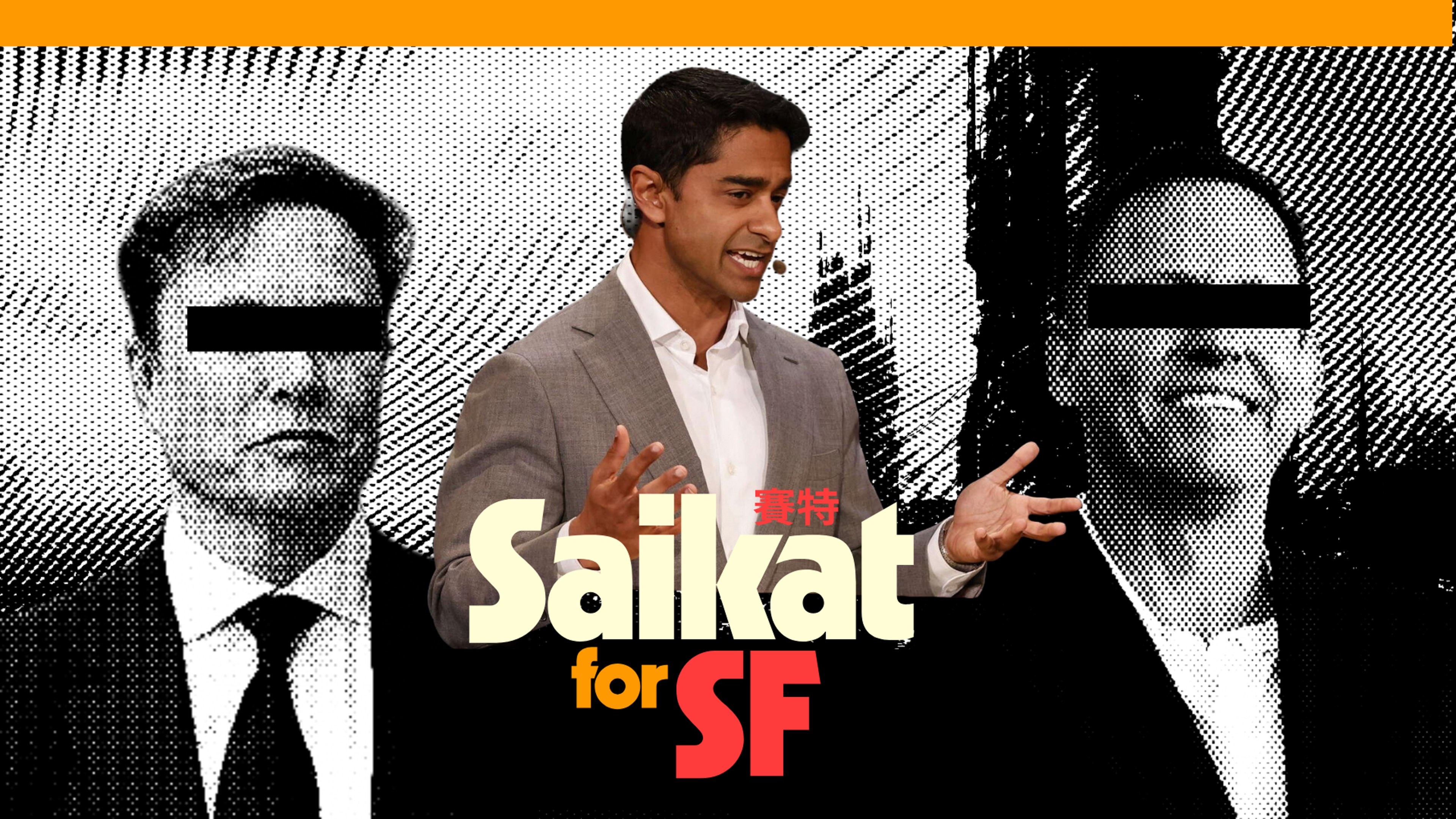
Congressional candidate Saikat Chakrabarti between billionaires Elon Musk and Peter Thiel. Credit: P. K. Gandakin
In the 1930s, as the Great Depression tightened its grip, John Maynard Keynes allowed himself a rare speculative indulgence. "Economic Possibilities for Our Grandchildren" imagined the world in 2030. By then, he proposed, the problem of scarcity would be largely solved. Productivity gains would outpace material need. Humanity would work fifteen-hour weeks and confront, for the first time, not the struggle for subsistence but the question of how to live. The love of money, he predicted, would come to be seen as "a somewhat disgusting morbidity." The economic problem would give way to the moral one.
We stand now at roughly the point Keynes imagined. The productivity gains he anticipated have largely materialized. The problem of scarcity, in a technical sense, has been solved. And yet we do not live in the world he described. The fruits of technological progress have been captured, concentrated, and enclosed. The question of how to live has been answered for us—by markets, by algorithms, by the oligarchs who own them.
The internet was supposed to democratize information; it produced surveillance capitalism. Social media was supposed to connect people; it fragmented public discourse into warring tribes. Artificial intelligence was supposed to augment human capacity; it threatens to replace our livelihoods. The temptation is to conclude that the liberatory potential of technology was always illusory—that tech could serve no purpose but to deepen oligarchic control.
But this rationalizes the given outcome as the only possible one. The same technological developments that intensified the oligarchization of society also produced a current of democratic possibility that has never been fully extinguished–only marginalized. The seeds of a different technological future were always there, and they still persist.
Two figures, drawn from the same ecosystem, embody these two vectors. In the early 2010s, Saikat Chakrabarti was an early engineer at Stripe, the payments startup that would make him wealthy. There, Peter Thiel was an early investor. They met once, when Chakrabarti gave a presentation at the company. Thiel's contribution was a lecture on how diversity is a source of weakness in a startup. Chakrabarti, whose father had migrated to America from India, received it with the disdain it deserved.
The two men were products of America's prosperous tech industry. Both amassed fortunes from it. But they occupied different positions within it—Thiel the investor, Chakrabarti the engineer—and they drew opposite conclusions. Where Thiel saw his wealth as proof of his genius, Chakrabarti saw an absurdity: "I worked hard and I'm proud of some of the work I did, but I didn't work harder than a teacher or a nurse or a sanitation worker. It's completely crazy that I worked hard for two years and now, if I wanted to, I could never work another day in my life. Other people who are working hard every day will never be able to afford a home."
Chakrabarti did not simply draw a different conclusion and leave it there. He would set out to build political infrastructure for the left. After having served as a staffer for Bernie Sanders’s 2016 campaign, Chakrabarti co-founded Justice Democrats and Brand New Congress, organizations that would recruit and field hundreds of progressive candidates. He managed Alexandria Ocasio-Cortez's insurgent 2018 campaign, drafted the original Green New Deal resolution, and organized a sit-in in Nancy Pelosi's office. After leaving AOC's staff, he moved to the think tank New Consensus to continue developing the economic framework that had animated the Green New Deal from the start.
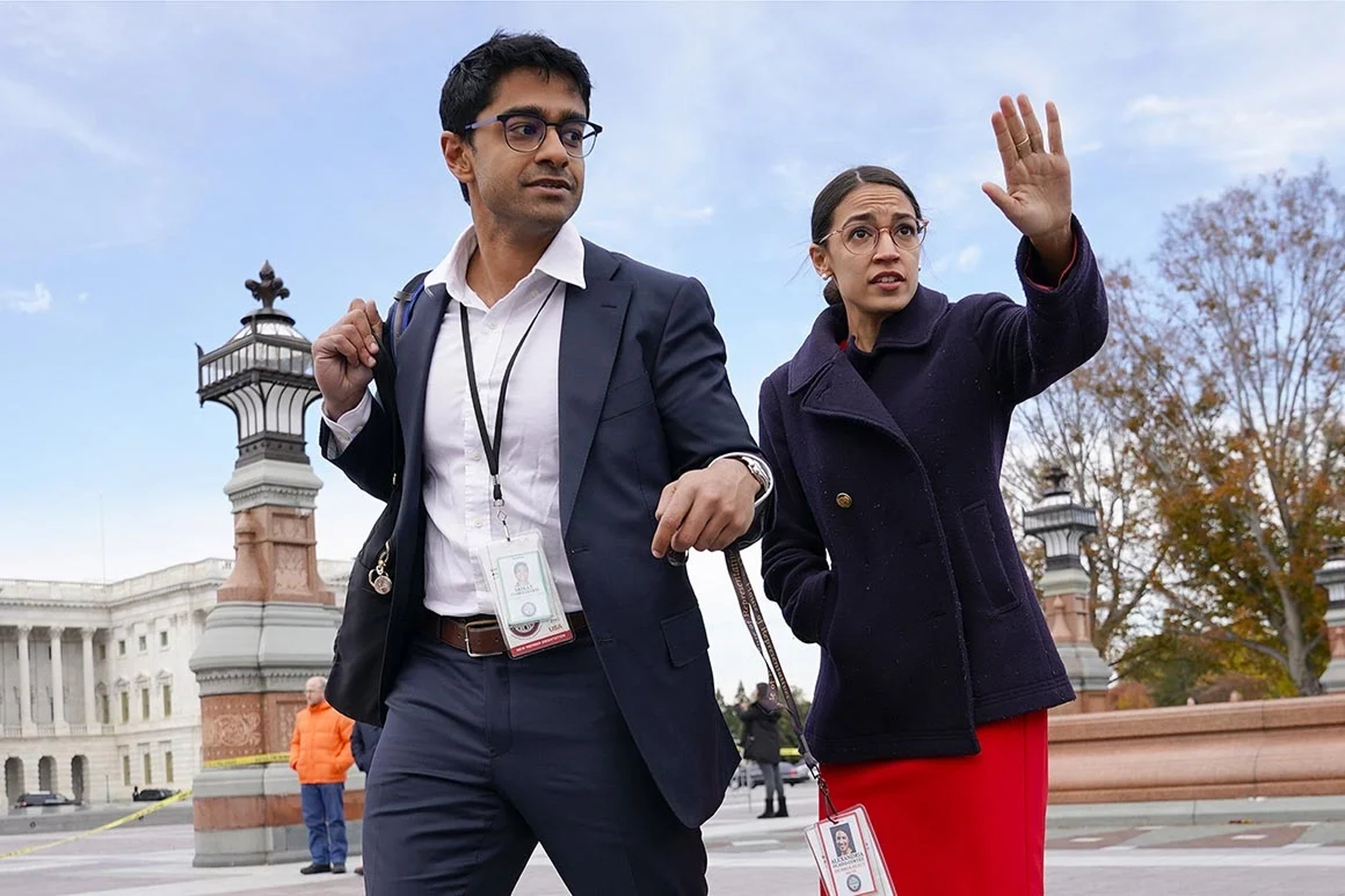
Saikat Chakrabarti with AOC.
Chakrabarti is now running for Congress in San Francisco. He hopes to capture Nancy Pelosi’s seat, and is running against both Pelosi's chosen successor Connie Chan and State Senator Scott Wiener. His platform sounds like nothing else in American electoral politics. His "Mission for America" white paper calls for "total economic mobilization" through a revived Reconstruction Finance Corporation—a "moonshot-style partnership between the federal government, military, RFC, and U.S. aerospace industry." Artificial intelligence, in his vision, would be deployed not for private extraction but for public planning.
This is a vision that maps, whether he uses the word or not, onto a socialist politics of democratic planning. And it represents something the left rarely sees: a political candidate formed by the same forces that produced Elon Musk and Peter Thiel, running to prove that the liberatory potential of the American technology sector was never extinguished–it just required a political movement to claim it.
But what kind of politics can fulfill this function? The answer lies in the question of political logic: how a movement organizes itself, how it relates to the existing party structure, and what it is willing to confront. As I have argued previously, the left winning elections inside the Democratic Party has exposed a new divide between two different political logics: survival-oriented politics and hegemonic politics. I write:
Survival-oriented politics and hegemonic politics operate on entirely different logics. Survival politics minimizes exposure, avoids unnecessary confrontation, and preserves options. Hegemonic politics requires precisely the opposite—the willingness to rupture, forcing confrontations that clarify the frontier and mobilize constituencies around it.
Chakrabarti's time in AOC's office is a case study in this distinction. He entered her staff after managing her insurgent 2018 campaign, bringing with him the same confrontational instincts that had helped unseat Joe Crowley. What he found inside the institution upon winning was a different kind of politics. I write:
[AOC] is not the bold, unabashed left-populist the moment demands. Her instincts run toward self-preservation and earnest triangulation, shaped by a decade of operating as one of the few openly socialist voices in a hostile institutional environment, perpetually caught between the gravitational pull of the party's center-right and the expectations of a left base that looks to her as its most prominent national representative. This can be understood not just as a personal failing, but also as a structural trap–but it is a trap whose consequences are real, and the left is right to feel frustrated by them.
Whether the divergence between AOC and Chakrabarti was personal or political is not something an outsider can adjudicate. What is clear, however, is that it represented two different strategic responses to the same structural trap. AOC stayed and navigated it as skillfully as anyone could. Chakrabarti left and eventually concluded it could not be navigated at all. "I tried the pushing strategy," he told The Intercept. "It's not going to work. We have to replace them." His willingness to call conservative Democrats the "New Southern Democrats," to treat the party's internal divisions as a political conflict rather than a family disagreement, had made his position in AOC's office untenable. But what was a liability inside the institution is now the premise of his campaign. He is running for Congress on the conviction that what is needed is a relentless expansion of conflict in the Democratic Party.
But the logic of rupture is only as meaningful as the project it serves. Conflict in the Democratic Party is not an end in itself, but a strategy to bring about a new governing paradigm. The left-populist insurgency has successfully rebuilt a language of class conflict—"the people versus the oligarchy"—but conflict on what basis? Demands made on the state—Medicare for All, student debt cancellation, higher taxes on the rich—can be absorbed, co-opted, or defanged by a party leadership that concedes the language while blocking the substance. To be a real alternative to the Democratic establishment, to draw the kind of distinction that can form a new party in content if not yet in form, the left needs more than a list of demands. It needs a rival governing vision.
Chakrabarti's "Mission for America" offers one. It is the most detailed articulation yet from an American congressional candidate of what I have called producer populism: a state that builds and invests, rather than merely subsidizing or redistributing the proceeds of a financialized economy. The Reconstruction Finance Corporation (RFC) is a well-chosen historical reference. Under Franklin Roosevelt, it became the largest investor in the American economy, channeling public capital into infrastructure, industry, and wartime production. A revived RFC would be a public investment authority capable of directing credit toward democratically determined priorities—not nudging markets with subsidies, but shaping them. This is the logic of public banking, and it points toward something more ambitious still: state-owned enterprises that build and operate directly, rather than paying private firms to do so. A state-owned energy company to deploy renewables. A state-owned construction company to tackle the housing shortage and build high-speed rail. State-owned enterprises are institutional forms that already exist in much of the world–including in China, where state-led investment has made the country the global leader in electric vehicles, solar panels, and high-speed rail.
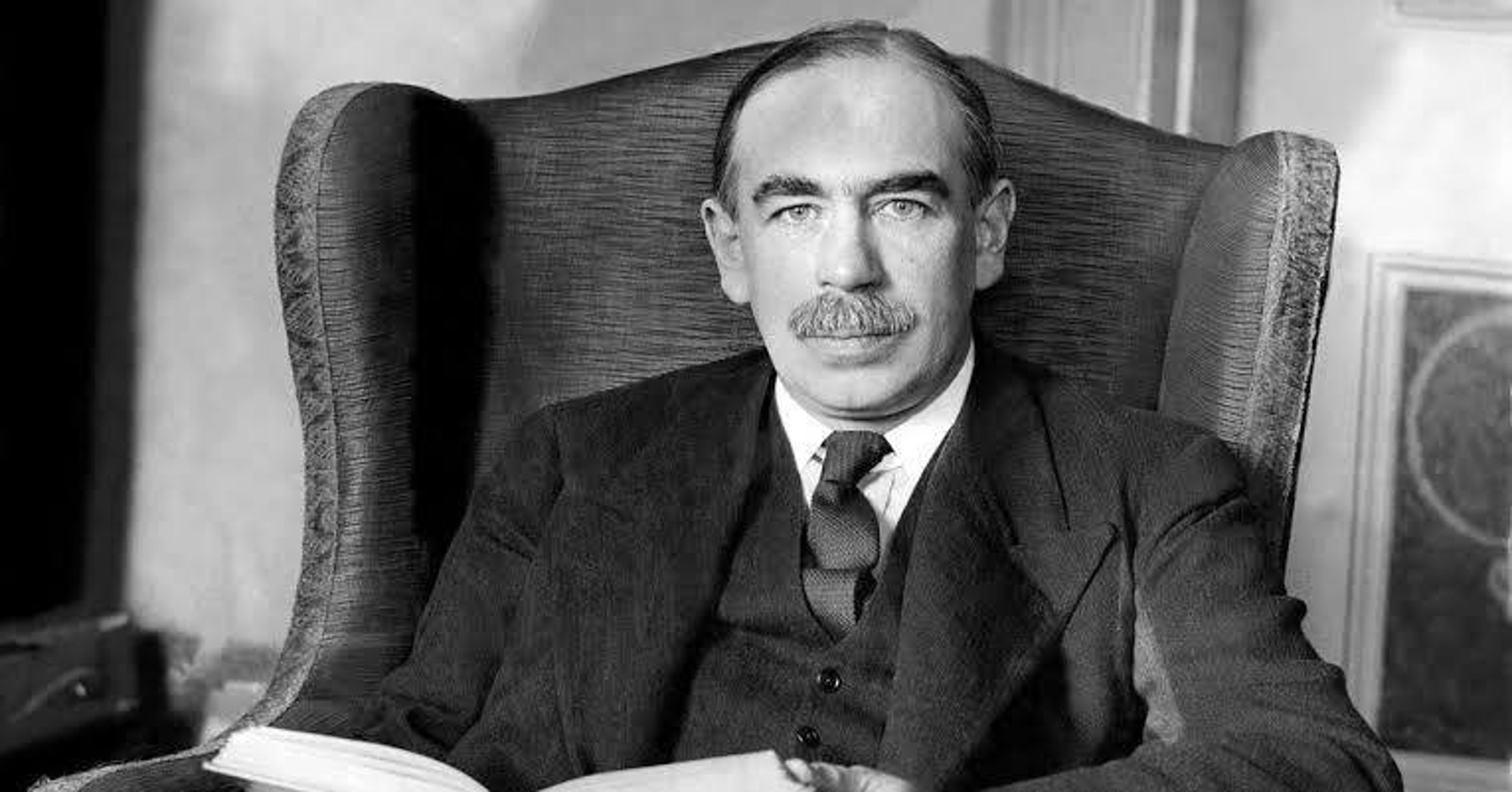
John Maynard Keynes, English economist (1883-1946)
What distinguishes this vision from the Democratic establishment's approach is not merely its scale but its logic. Notice how the financialized, managerial logic of the Democratic Party took the ambitions that the Green New Deal had placed on the table—a call for total mobilization, drafted initially by AOC and Chakrabarti—filtered them through Build Back Better, and then gutted what remained into the Inflation Reduction Act. The Green New Deal envisioned a state that would direct investment. AOC managed to get pieces of it into BBB: a Civilian Climate Corps, public housing retrofits, high-speed rail. But the framework that emerged was already a compromise, and the IRA stripped it further. What survived was a sprawling array of tax credits and subsidies that pays private capital to maybe build. A company can collect clean energy credits while continuing to funnel its profits into stock buybacks. Nothing in the IRA's architecture disincentivizes the financialization that diverts capital from production to extraction. Chakrabarti's "Mission for America" returns to the original ambition of the Green New Deal.
We can extend this logic beyond energy and transportation. The signature demands of left populism, such as Medicare for All and tuition free college, are typically framed as redistributive: the state should guarantee access to services by paying for them. But this framing shares a hidden assumption with the liberalism it critiques: that money is what makes things happen. Spend enough on healthcare and healthcare appears. Appropriate enough for housing and homes get built. It is the worldview of a financialized age, where the act of allocating funds is mistaken for the act of producing goods. Keynes, in a different register, grasped the reality: "anything we can actually do we can afford." The constraint is not the budget. It is the capacity to organize the labor, materials, and institutions that turn public investment into public goods.
Medicare for All cannot just be a funding mechanism; the government acting as the insurer for our bloated, expensive private healthcare system. It requires building the infrastructure for a decommodified health system: training the workforce, expanding public hospitals, establishing the supply chains for generic drugs. Free public college requires investing in the institutions themselves—the faculty, the facilities, the research capacity—not just covering tuition. The point is not to throw money at existing systems and hope they improve. It is to build the systems that can deliver what the demands promise.
Whether he wins or not, what is noteworthy about Chakrabarti is that someone shaped by many of the same forces that shaped Musk and Thiel drew the opposite conclusion from that experience and built a political project around it. Where they saw technology as a means of private control, he saw a case for public investment. Where they sought to escape or capture the state, he set out to reimagine what it could do for the people. His platform—public banks, state-owned enterprises, AI-driven planning—is the most detailed attempt yet by an American candidate to turn the tools of the digital age toward democratic ends. And his strategic conviction, that the Democratic Party leadership cannot be pushed but must be replaced, is the logical endpoint of a decade spent learning what the left-populist insurgency is up against.
Keynes imagined 2030 and got it wrong. But his method—the refusal to accept that the present exhausts the possible—remains the only way to get it right.
Saikat Chakrabarti is asking whether anyone else still believes that.