
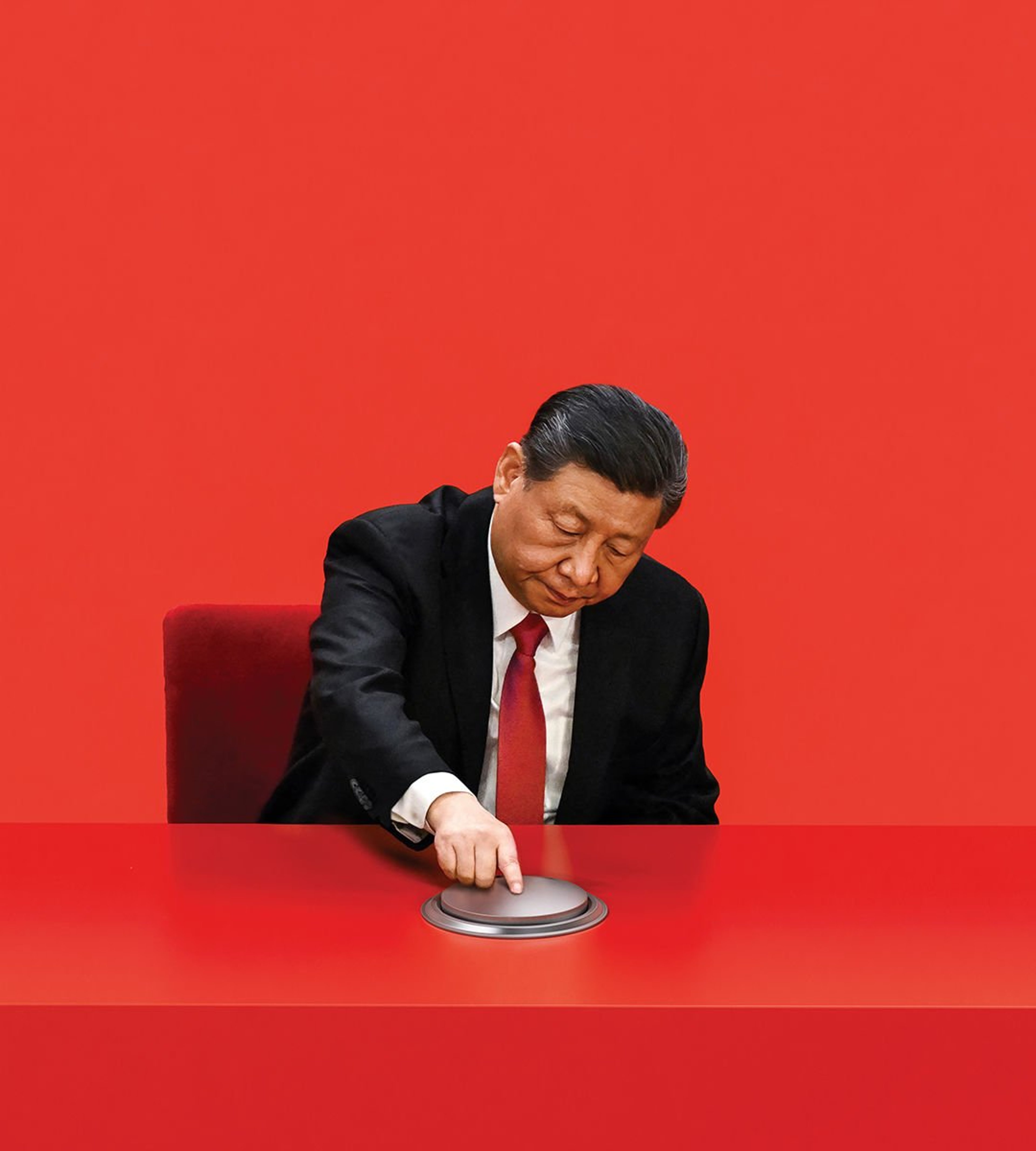
illustration: justin metz/getty images
In Adam Smith in Beijing, Giovanni Arrighi offers a novel reinterpretation of every libertarian’s favorite book, The Wealth of Nations. Rather than a blueprint for laissez faire, Arrighi argues that Smith’s vision of the invisible hand is one of a dynamic, non-capitalist market society built on small-scale proprietors and competitive exchange. Smith distrusted the “mean rapacity” of merchants and manufacturers, foreseeing how their power could distort markets toward monopolistic exploitation. Arrighi uses this reading of Smith to interpret China’s rise, suggesting its development might be the realization of Smith’s market-based—but not capitalist—path to national wealth. We can build on that insight to develop a broader theory: the transition from capitalism to socialism is initially characterized by a shift from markets that serve profit accumulation to markets that serve strategic development.
To do this, we should shift from Smith’s classical economic theory into the static, idealized world of neoclassical theory of Leon Walras. Anyone who has taken an introductory economics course (micro or macro) is familiar with the model of perfect competition, which forms the basis of mainstream economics. Its assumptions include a multitude of buyers and sellers, perfect information, homogenous products, free entry and exit, and price-taking participants. Within this frictionless universe, the price mechanism performs a miraculous, triple function: it steers production (supply), clears the market (demand), and measures exchange value at the equilibrium point. This equilibrium is presented as optimal, maximizing social welfare and fully utilizing productive resources. It serves as the powerful normative benchmark of economics and a vision of how a decentralized system could, in theory, achieve harmony for all.
That the actual historical trajectory of capitalism does not live up to this model is now obvious. In an era of big tech conglomerates and global monopolies, it’s all too clear that the internal logic of capital accumulation—the relentless drive for profit, growth, and market security—does not preserve perfect competition but systematically undermines it. As Joan Robinson argued in The Economics of Imperfect Competition, perfect competition is not the general rule but a “special case” versus the typical case of imperfect, monopolistic competition. As Karl Marx anticipated, even in the era of “free competition”, the logical conclusion of private accumulation is the concentration and centralization of capital. Therefore, in a system shaped by firms with market power, the price signal ceases to function as a tool for market clearing. Instead, it becomes a lever for protecting and boosting profit margins. Faced with slumping demand, monopolistic firms will choose to reduce output and leave capacity idle rather than cut prices and erode their surplus, meaning that the price mechanism no longer functions as a means of optimal welfare.
This insight was developed into a robust macroeconomic theory of stagnation by the Neo-Marxian economists Michał Kalecki and Josef Steindl. Kalecki, independently of and arguably anticipating John Maynard Keynes’s theory of effective demand, rooted the problem of inadequate aggregate demand not merely in underconsumption, but in under-investment. He argued that the price system’s core function in a mature capitalist economy was not the textbook goal of equating supply and demand, but of determining the distribution of profits among firms. Through their manipulation of prices—their “degree of monopoly”—large corporations secure a disproportionate share of the total surplus. Josef Steindl, building on Kalecki, extended the analysis in Maturity and Stagnation in American Capitalism. In analyzing the Great Depression, Steindl demonstrated that rising monopoly power leads firms to maintain high margins by restricting output, which creates systematic excess capacity. This idle capacity, in turn, deters new investment, creating a self-reinforcing feedback loop of insufficient demand relative to existing productive capacity.
Later, in their seminal work Monopoly Capital, Paul Baran and Paul Sweezy synthesized this into the theory of monopoly capitalism: the system tends to generate a rising economic surplus but lacks sufficient outlets in productive investment or capitalist consumption to absorb it. This imperative to absorb surplus, they argued, expresses itself in historically specific ways: the hypertrophy of the military-industrial complex, the vast expansion of marketing and advertising (the "sales effort"), and, albeit only mentioned briefly, the growing role of the financial sector.
Consequently, modern capitalism reveals itself as a fundamentally demand-constrained system, plagued by unemployment and idle capacity. As economist Prabhat Patnaik argues, this failing is intrinsic; the system cannot self-correct to achieve the full employment posited by its own idealized models. Patnaik contrasts this with the historical experience of planned socialist economies. Societies like the USSR faced the opposite problem: they were supply-constrained systems, rather than demand-constrained. Their central challenge was not finding markets for output, but mobilizing sufficient labor, raw materials, and capital to meet ambitious production targets and produce sufficient consumer goods for the people. Full employment was a priority, often leading to labor shortages. Shortages, rationing, and queues were signs of an economy pushing against its capacity limits. The systemic imperative was to expand productive forces, rather than to manage deficient demand.
The dialectic between the demand constraints of capitalism and the supply constraints of socialism is key to understanding the transition between capitalism and socialism in the People’s Republic of China. Indeed, China’s pre-reform planned economy was a classic resource-constrained system, and the post-reform introduction of market mechanisms was, in large part, a strategy to overcome these very constraints—to enhance the production of consumer and industrial goods. Yet, critically, the state retained a socialist commitment to full employment and high capacity utilization, employing market competition as a tool for development rather than an end in itself. Through deploying the “visible hand” of the state for public investment (facilitated by state ownership of credit and banking) and anti-monopoly regulation, China’s economy has fostered structural conditions that mirror the textbook model of “perfect competition”—the special case Robinson identified. It exhibits high supplier density, intense price competition, and sustained high capacity utilization. In effect, it achieves the neoclassical ideal of competitive markets and full employment. Yet this does not stem from laissez-faire, but from socialist planning that strategically prioritizes production and employment over profits.
This paradox is, in fact, logical. In his book Modern Political Economics, economist and former Greek finance minister Yanis Varoufakis observes, “Modern mainstream economics posits an almost socialist society as the foundation on which it erects its theories of contemporary capitalism.” The idealized assumptions—small price-takers, full employment, perfect information—resemble a planned, coordinated economy more than a free market capitalist one. It is no coincidence that a pillar of general equilibrium theory like Kenneth Arrow advocated socialist policies. China’s socialist-market system inadvertently operationalizes the idealized assumptions of neoclassical textbooks.
This theoretical possibility that socialism could rationally outperform capitalism on capitalism’s own terms was most famously formalized by Kalecki’s colleague Oskar Lange in the 1930s. In his model of “market socialism,” a central planning board could simulate a competitive market by using trial and error with shadow prices, instructing state firm managers to follow the neoclassical rules (set price equal to marginal cost, minimize costs). Lange argued this system could achieve a Pareto-optimal equilibrium faster and with less waste than actual capitalism, which was plagued by monopolies, externalities, and cyclical crises. While a theoretical construct, the “Lange Model” was a strong rebuke to critics of socialism, successfully making the theoretical case that the neoclassical ideal logically demanded public, not private, ownership of the means of production to function properly. Lange’s model remained a thought experiment, a pure theory of socialist equilibrium. The historical task of the transition from capitalism to socialism, and the role of markets in socialism, could not manifest from Lange’s thought experiment, but in the tumultuous historical trajectory of China’s socialist modernization.
This reframes the discussion around China’s current economic policies. Measures like consumer vouchers or strategic industrial subsidies are not merely Keynesian demand management, as understood in a stagnating capitalist context. Their function within China’s synthesis is to maintain circulatory flow and clear inventory for a vast network of firms, preventing deflationary spirals and safeguarding employment, without sacrificing the commitment to high productive capacity. The long-term goal is not simply to boost consumption, but to sustain the momentum of production and socialist modernization.
This market economy must not be understood as a static equilibrium or a finished model. Its socialist character derives less from a snapshot of its current property relations—which remain mixed and contradictory—and more from the directional purpose of the state-market dynamic and the reinforcing mechanisms that sustain it. The objective is not profit optimization for a capitalist class, but the continuous mobilization and expansion of society's productive forces to achieve strategic development and full employment. This is where control of key levers becomes the practical engine of the transition.
The state's command over the financial system—through state-owned banks and credit guidance—is a fundamental mechanism. Unlike in a capitalist system where credit flows to develop monopolies, in China credit is strategically deployed to maintain the high supplier density that defines its competitive landscape. It funds new entrants, fosters industrial clusters, and supports small and medium sized enterprises, consciously counteracting the capitalist tendency toward concentration and stagnation. A prime example is China’s electric vehicle (EV) sector. Strategic state credit, along with subsidies and infrastructure investment, helped incubate over a hundred EV manufacturers, fostering brutal price competition and rapid technological iteration. Similarly, flexible, experimental property rights (e.g., various forms of mixed ownership, strategic state holdings) allow the state to structure markets. China’s state-directed market economy can incubate competition in key sectors, use state-owned champions to set benchmarks, and prevent private monopolies from consolidating and switching the system's logic from supply expansion to rent extraction.
Therefore, China’s core contradictions are distinct from that of the advanced capitalist economies of the west. Contrary to analyses that diagnose a classic capitalist crisis of “overcapacity” born of deficient demand, China’s challenge is one of managing the market-driven compression of profit margins—a result of its state-facilitated cultivation of intense competition—within a framework committed to full employment and continuous capacity expansion. The problem is maintaining firm viability in a hyper-competitive, high-utilization system, not resuscitating effective demand in a monopolistic, underutilized one.
The socialist market economy is therefore not quite Lange’s blueprint, but what might be understood as socialism in media res. The process involves the deliberate subsumption of market mechanisms, repurposing them from engines of private accumulation into instruments for broad-based developmental mobilization. The resulting tensions—between fierce competition and social stability, between dynamic growth and the continued exploitation of wage labor—are not signs of the collapse of socialism, but are in fact the substantive content of the transition, generating the crises and imperatives that force the continual reinvention of institutions in an endless negotiation between the market’s logic and the strategic purpose imposed upon it.
Within this movement, the phase initiated by reforms is defined by a concrete, immediate goal: to learn from the successful development of production of the west, but without the stagnation and systemic waste characteristic of capitalism. Its expression, therefore, is not a rejection of markets, but their radical, purposeful redirection to mobilize productive forces and smash resource constraints—a tactical subordination of market logic to a larger developmental imperative. This phase, like all phases in media res, is defined not by a final design, but by the immediate problems it must solve.
Geese is only possible through the time, labor, and personal funds put into this project by our volunteer members. Help support our writing and organizing efforts by donating to us on Patreon.