
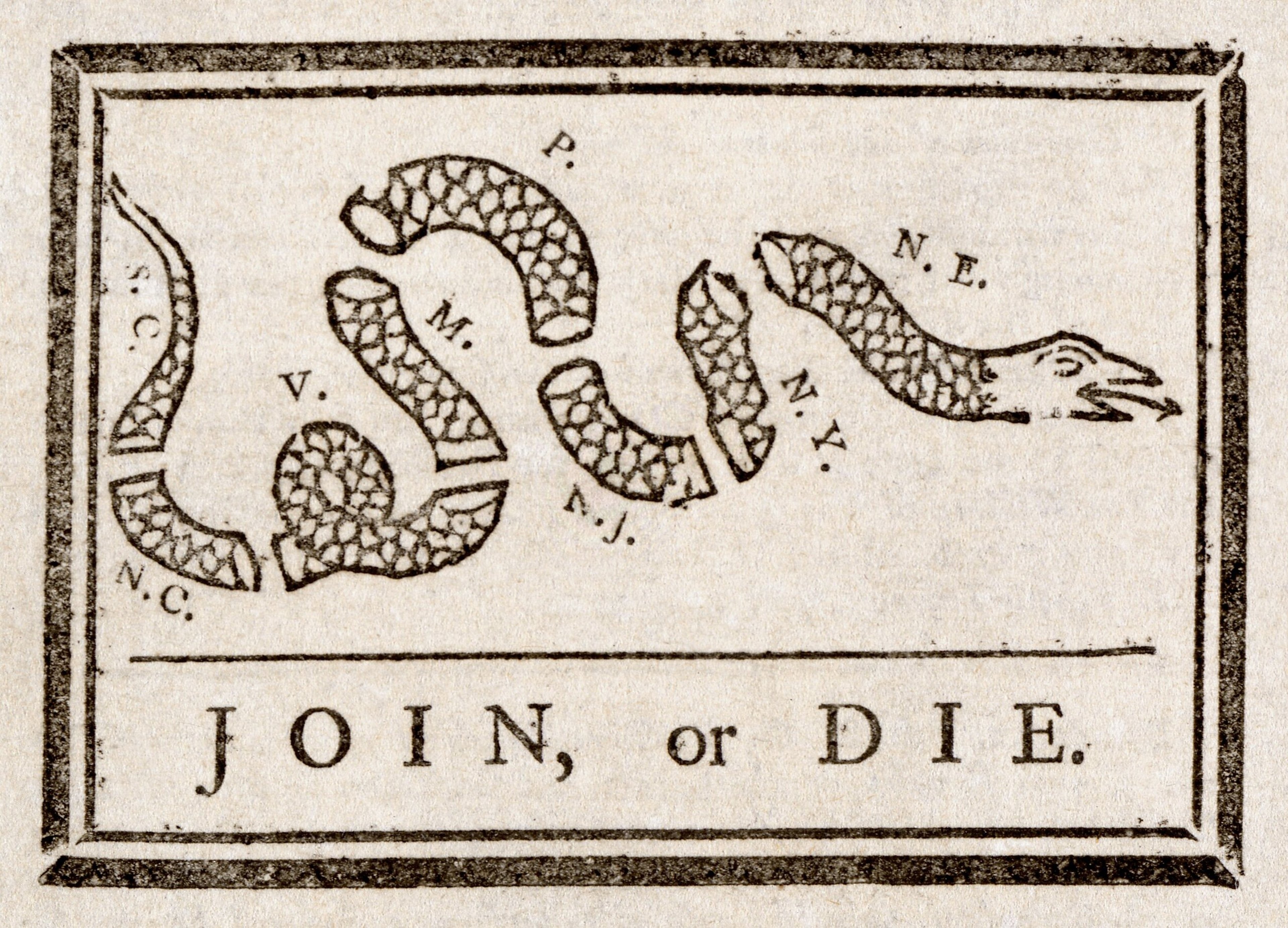
“Join or Die”, a 1754 political cartoon by Benjamin Franklin
If things keep going as they are, the Trump administration is going to kill us all. Not all at once, not in one bright flash. It’ll be a death that comes in clumps, one city at a time. One protestor at a time, one worker at a time, one immigrant at a time. At least until they’ve killed enough people to find their footing.
Make no mistake, though, the regime is coming for you. When they find you, and they will eventually, they’ll offer you a binary choice: total submission or summary execution. Join or die.
The Civil War in Minnesota: A History
The siege of Minneapolis has gone on for more than a month now. Trump and his goons love to give their crimes against humanity names that leap straight from the stage selection menu of Call of Duty Ghosts. Operation Metro Surge is no different, simply the latest manifestation of the ethnic cleansing the Trump administration is currently carrying out. Their chosen target is the fulcrum point of recent American uprising: Minneapolis, Minnesota.
The contemporary geopolitical and social landscape of Minneapolis is not a product of spontaneous combustion but the result of a decade-long accumulation of class antagonisms, state-sanctioned executions, and the repetitive cycle of unorganized proletarian uprising met by bourgeois betrayal. Since 2015, the Twin Cities have functioned as a primary site of experimentation for both the American state’s repressive apparatus and the working class’s capacity for autonomous resistance. To understand the current state of siege under Operation Metro Surge one must trace the lineage of violence from the 2015 killing of Jamar Clark through the 2020 rebellion and into the current fascist consolidation.
The period between 2015 and 2017 served as a foundational era for the current period of, albeit still radically undeveloped, revolutionary consciousness. During these three years, three distinct killings by the Minneapolis Police Department (MPD) revealed the fractures within the city’s social fabric and highlighted the differing interests of the various class actors involved. These events: the killings of Jamar Clark, Philando Castile, and Justine Damond, represent a clear progression of both state violence and attempts by the unorganized proletariat to exert street power.
On November 15, 2015, the killing of 24-year-old Jamar Clark by officers Dustin Schwarze and Mark Ringgenberg initiated a new chapter of militancy in North Minneapolis. Clark was shot in the head during a 61-second encounter outside a party on Plymouth Avenue North. Witnesses immediately claimed that Clark was handcuffed and non-resistant when he was shot, a claim that struck at the core of the state's legitimacy.
The response was an unprecedented 18-day occupation of the Fourth Precinct police station. This occupation was a spontaneous expression of proletarian rage, where the unorganized youth of North Minneapolis, largely Black and marginalized, seized the space in front of the precinct to demand the release of video evidence and the prosecution of the officers.
The class dynamics during the Fourth Precinct occupation were stark. While the unorganized proletariat—composed largely of local youth and radical community members—maintained the barricades through sub-freezing temperatures, the progressive bourgeoisie and its political representatives began a process of containment. Mayor Betsy Hodges and Representative Keith Ellison offered condolences while simultaneously signaling that the occupation had "outlived its usefulness" and needed to "evolve" into safer, less disruptive forms of advocacy. The betrayal was crystallized when the city leadership, after weeks of performative dialogue, ordered a pre-dawn raid by police in riot gear to clear the encampment, prioritizing "public safety" and the return of police operations over the demands of the occupied community.
On July 6, 2016, the killing of Philando Castile in the suburb of Falcon Heights further radicalized the region. Castile, a 32-year-old school employee and member of the proletariat, was widely beloved by his coworkers and students at J.J. Hill Montessori Magnet School. His death was an instructive moment for the masses: despite being a "law-abiding" citizen who followed all police directives and legally declared his permitted firearm, he was executed in front of his girlfriend and her young daughter.
The subsequent acquittal of Officer Jeronimo Yanez in 2017 provides irrefutable proof that the legal system of the bourgeoisie offers no protection, even with high-definition video evidence. The liberal leadership’s response was one of "disappointment" and calls for further training and piecemeal reforms, such as the implementation of body cameras, which had not yet been fully deployed by the MPD. This period demonstrated the "over-policed and under-protected" status of the disproportionately black and immigrant working class, where the state’s presence is synonymous with harassment rather than safety.
The killing of Justine Damond on July 15, 2017, added a final, complicating layer to this period. Damond, a white Australian-American woman who lived in the affluent Fulton neighborhood, was shot by Officer Mohamed Noor, a Somali-American, after she called 911 to report a possible assault. The speed with which Chief Janeé Harteau was forced to resign and the subsequent murder conviction of Noor stood in jarring contrast to the lack of charges in the Clark and Castile cases.
For some in the Somali community and other immigrant and black fractions of the proletariat, the conviction of Noor was seen as a selective application of justice, where the state moved with alacrity only when the victim belonged to the white bourgeoisie. This highlighted the precarious position of immigrant workers who, despite serving as functionaries of the state in some capacities, remained expendable in the face of bourgeois outrage. Despite this, the Damond case strengthened the "progressive" coalition overall, as it became clear that the violence of the police apparatus was not exclusively reserved for working people of color.
The historical trajectory from 2015 to 2020 shows a clear progression from spontaneous, localized resistance to a broader, nearly revolutionary uprising. However, this progression was consistently sabotaged by liberal leadership who utilized their positions to funnel proletarian energy into legislative efforts of “reasonable” institutional reform under the guise of aesthetic radicalism.
The outrage at the murder of George Floyd in 2020 led to a significant step forward towards revolutionary consciousness. Much of the population had been trapped indoors for months as part of COVID prevention lockdowns. Several killings of young black Americans had been filmed and disseminated across the internet in the preceding months. The recorded slaughter of George Floyd served as indisputable proof that violence against black people, against poor people, against workers, was simply the cost of doing business in American society. The proletariat and the progressive segments of the bourgeoisie took to the streets of the Twin Cities, like millions more were doing all over the nation.
The leadership of local liberal protest organizations attempted to discipline the protestors into peaceful civil disobedience. They would follow city officials’ orders, and they would respect private property. The police responded with fear and violence. In Minneapolis, like all over the country, police demonstrated their instant and unshakeable loyalty to the maintenance of good order and private property. The most reactionary and violent among them were eager to let loose with near-maximal anti-riot measures, but the sheer number of the protesters and the overwhelming public support for their cause made such a position difficult to immediately adopt.
On the ground, things turned within a single day when some in the crowd turned to vandalism and private property damage. The moment people began to strike out at private property, Police Chief Arradondo of the MPD ordered forces to respond. Police recklessly fired tear gas into the crowds. They shot rubber bullets at the demonstrators, even those who stubbornly clung to non-violence.
For two nights, the city churned with chaos. The proletariat occupied the streets as if possessed by the spirit of 1792, the spirit of 1917. On May 28th, the protestors took the fight to the oppressors, and they seized control of the third precinct police station. The police station was set ablaze, and the video of its burning spread like wildfire.
In a poll released several days later, Monmouth found that 54 percent of Americans felt the destruction of the police station was justified.
This moment represented the peak of proletarian independence. The police were forced into a humiliating retreat, and for a few days, the people of Minneapolis held the power to determine the city's future.
The job was never fully completed, however. The proletariat, for all their efforts in Minneapolis and throughout the country and the world, was once again betrayed by their supposed allies in the progressive sections of the owning class. The small business owners who feared their shops would be damaged by the actions of protestors, the moneyed men and women who were horrified by the chants, “Abolish the Police,” the politicians who simply couldn’t imagine a world better than the one they got to manage. These counter-revolutionary forces, along with the “democratic release valve” of the upcoming 2020 Presidential election, served to smother the heroic bravery of the Minneapolis proletariat.
By May 30th, Governor Tim Walz had called in the National Guard with the aid and support of the first Trump administration, and the proletariat was cowed into submission by force. The presence of thousands of federal and state troops was a welcome sight to the local petite bourgeoisie, and it proved too intimidating a force for the almost-revolutionary proletariat of Minneapolis and the remnants of their progressive bourgeois supporters to take on in a direct assault. They were simply too unorganized and under-armed. They were deficient in both their theoretical understanding of their revolutionary role in history and the tools necessary to fulfill it.
Another significant betrayal of the 2020 uprising occurred on June 7, when nine members of the Minneapolis City Council stood on a stage at Powderhorn Park and promised to "dismantle" the MPD. This act was a masterclass in bourgeois recuperation. By adopting the radical slogan of "Abolish the Police," the liberal council members successfully convinced the unorganized proletariat to stop the rioting and wait for the legislative process.
The council used the "Defund" and "Abolish" frames to gain credibility with the Minneapolis proletariat. Their promise was immediately delayed by the unelected Charter Commission and legal maneuvers by Mayor Jacob Frey. While promising defunding, the city council eventually diverted only a nominal $8 million from the police budget while later adding $7 million for new officer hires. Protesters were told by Democrats that the 2020 election of Joe Biden would address their concerns, further demobilizing the street movement in favor of the ballot box. The petite bourgeoisie, fearing for their property values and small businesses, joined the state in calling for "order," while the liberal politicians they supported ensured that "order" meant a return to the status quo with mostly aesthetic changes and piecemeal institutional reforms.
It was this smoldering heap of ashes that the Department of Homeland Security decided to thrash with its poker. They descended upon the city with thousands of thugs from ICE and Border Patrol. They’ve decided, away from the dissenting eyes of the public, that they are no longer required to respect the rights guaranteed by citizenship against warrantless search and seizure. They’ve torn the immigrant communities of the Twin Cities, especially the Somali community, apart with a nonstop barrage of racial profiling, abuse, detainment, and deportation. They have declared openly their intent to discriminate based on accent, skin color, and style of dress. They have, out of maliciousness and stupidity, detained many American citizens who fail to appear white or rich enough for them. They drag old men and children out of their houses in chains and parade them before their reactionary hogs for followers in a spectacle of prideful, demonic, pitilessness. And, most of all, they’ve murdered people. They murdered Reneé Good and now they’ve murdered Alex Pretti.
It will never be enough for them. That should be clear to everyone by now, most of all to the people of Minneapolis. The entirety of the population has surely, or will surely soon, must surely soon, understand that they are under siege by hostile force. They intend to disregard your laws, disregard your local officials, and disregard your local police department.
Notably, ICE and federal officials have refused to cooperate with local police and government out of retaliation for local Democratic officials’ previous refusal to sufficiently submit to the needs of their raids. The very same police officers who are the product of the department that sparked the last Minneapolis uprising by their violence are now subject to racial profiling and state violence themselves.
Let me spell out what is happening here: ICE and border patrol are illegally occupying a major American city. They are besieging the Minneapolis proletariat, attempting to eviscerate its immigrant fraction. This effort is alienating the regime from the entirety of the population.
The killings of Renee Good on January 7, 2026, and Alex Pretti on January 24, 2026, were not accidents but the logical outcome of a "hunting" policy designed to terrorize the population. Good was shot while sitting in her vehicle, and Pretti was executed while pinned to the ground by multiple agents after trying to protect a woman from harassment.
The proletariat, of course, is the main source of resistance against their own destruction, despite their lack of pre-existing organization. But the progressive petite bourgeoisie have also been roused to action. They have also been subjected to racialized state violence. And this time., unlike the proletarian uprising surrounding George Floyd, disruption to commerce is originating from Homeland Security’s efforts rather than popular action. The workers these business owners rely on are too scared to come in, for fear of deportation. Masked murderers break down the doors to their shops and kidnap their customers and employees. It’s the Feds bringing disorder and bloodshed to their front step. This last murder took place right on a commercial roadway. One of the most horrific angles of the execution is captured from inside a donut shop. Is the owner of that shop more or less likely to support the protests after a man was killed in full view of his front window, and teargas was let loose on his corpse?
In short, the actions of the Trump administration has reconstituted and reinvigorated the George Floyd class coalition by aligning the interests of the local Minneapolis working and owning class. A day long consumer and labor strike took place just prior to the killing of Alexi Pretti with the support of Minnesota labor organizations and local progressive small businesses. It is likely and essential that such actions pick up steam from here.
The Popular Resistance in Context
Self-described “Left Communists” would likely scoff at my logic. Is the lesson of the uprisings of 2015-2020 not that reformist popular fronts have served as the primary bulwark against proletarian consciousness and revolution? Was it not the Democratic President Barack Obama that deported three million immigrants over the course of his Presidency? How could I argue for yet another popular front after the fruits of decades of class collaboration in pursuit of Democratic party reformism has born a impotent and moribund workers’ movement?
This is the position taken by the International Communist Party in their analysis of the struggle in Minnesota entitled: Minneapolis! For a Real General Strike! Our ICP comrades sternly remind us that the one-day boycott was just that, and not an actual labor strike:
As for the unions which endorsed the protest, Teamsters Local 638’s official statement tepidly reminded workers that striking would be illegal. IATSE Local 13 told workers that they have the right to choose, but to make sure the bosses know in advance. SEIU Healthcare MN issued a stern warning that participation in strike action could lead to job termination. The president of CWA Local 7250 stated, ‘We have not voted on a strike, but our union is calling on people to support this call.’ The MNA told their workers that they hold an essential caregiving role as a moral appeal in order for them to follow the no-strike clause, as well as a quite honest assessment of what the endorsement is by stating that the ‘MNA is joining a broad and growing coalition of labor organizations, faith leaders, business owners, and community members across Minnesota.’ According to the New York Times, the president of the MNA went so far as to discourage members from missing work alongside other labor leaders.
Here, the ICP is highlighting that the traditional workers organizations, the labor unions, have been so thoroughly tamed by decades of submission to Democratic Party power that they are actively opposing the proletariat taking up a leadership role in the current crisis.
The function of the business union leadership seen here is to suppress militancy wherever it organically erupts. By telling workers to not take action and not even bother voting on taking more serious militant action, this layer serves to neuter struggle and keep it legal in order to preserve their labor aristocratic privilege of a salary far beyond what the average worker makes. They fear breaking labor law because it puts their job in jeopardy and salary on the line. Ultimately, the result of this is a drive to find power from other classes, which pushes these unions into engaging in united fronts that keep the status quo.
They go on to further question the proletariat character of the resistance movement:
Let us look more deeply at where the working class was in this action. Spontaneous organization among the proletariat in the form of workplace committees or strike councils did not occur in any significant sense (or perhaps at all), and so the workers who chose not to go to work typically did so on an individual, legal basis. This, of course, is a very weak tactic and one that diminishes the importance of workers acting as one and drawing strength from numbers and common action. The leadership of the regime unions fall squarely in line with the rest of the mush of this activist united front. Unions en masse endorsed the action, but unanimously rejected any strike language, consistently citing contractual legal obligations to the no-strike clause. The function of this endorsement is then to send the workers to the protests, to not strike (they are granting individuals the glorious freedom to choose!), and to rope them into bourgeois politics and tactics that are connected to the growing anti-fascist popular front led by the Democrats.
Here, it might be noted that this is only true in the strictest sense. Spontaneously organized, fully revolutionary councils of proletarian self-defense have not yet sprung up on every corner of Minneapolis. A muscular and organic Communist party has assuredly not yet seized the political initiative. But the people of Minneapolis are organizing. The character of this organization assuredly includes, and is likely led by, progressive sections of the bourgeoisie. However, neighborhood signal chats, observer groups, and armed patrols, all aimed at opposing the federal government, are qualitatively present where once they were not. The majority, if not the leadership, of people participating in organized resistance, as well as the communities targeted by state repression, are proletarian. This is a noteworthy step forward.
They go on to advocate:
“Workers need to recognize the mirage for what it is, abandon the false oasis, and resume the path of class struggle and building the class union. To seriously achieve a general strike, it will take a great deal of effort and coordination that has to contend with enemies on all sides that seek to misdirect the struggle, as well as an objective worsening of the conditions of the class. Practically, workers must agitate within their unions for class unionist principles such as removing the no-strike clause, radical economic demands, aligning contracts to expire on May 1st, 2028, and be willing to struggle against business union leadership that would rather compromise. The NLRB straightjacket can, must, and will be broken so as to unleash workers from their slumber and truly fight back. Unorganized and organized workers alike must come together and unite to strike from below, utilizing what they can in existing unions and forming new organs of struggle to put forth their own class demands. It is only by fighting for the class union and ultimately for communist revolution that ICE will be dismantled and for there to be an end to the bourgeois reign of terror.
For united trade union front from below and a real general strike!
Against the coming popular front!
Against united fronts from above!
For independence from bourgeois parties and activist coalitions!”
To say nothing of the practicability of waiting for the, “objective worsening of the conditions of the class,” the ICP is here failing to see the immediate reality on the ground. I would agree, whole-heartedly, that the reformist popular front has likely been the most successfully method for defusing proletariat militancy in the past several years. Liberal and progressive activist organizations have sworn, again and again, that reform within the current paradigm is not only possible but also the only goal worth mobilizing for. Yet, this strategy has demonstrably born a federal government possessed by the spirit of 1861, of White Nationalism, ruin, and war.
To crudely oversimplify, a "Popular Front" and a "United Front" are defined as follows. A popular front is a cross-class alliance that includes not only workers' organizations but also "progressive" or "anti-fascist" sections of the bourgeoisie. In the 1930s, this was the strategy favored by the Comintern to combat fascism, but it historically led to the suppression of working-class militancy to avoid "alienating" liberal allies, as seen in the Spanish Civil War and France. A united front, by contrast, is an alliance of working-class organizations (revolutionary and reformist) against a common threat, while maintaining the political independence of each group. This is the path the ICP calls for the workers to walk down.
But how? The workers movement in the 1930s, as explained by the ICP by use of example of the Minnesota Labor strike of 1934, was mighty, well organized, and militant. They were able to sway millions of proletarians to initiate labor actions that could cripple industries. There was a strong, if minority, Communist and Anarchist tendency that advocated for increasingly radical action. None of the above exists today. The traditional industrial proletariat has been decreasing for decades. Their unions are indeed controlled by labor aristocrats devoted to the maintenance of the status quo. The service proletariat remains deeply unorganized and atomized. Communism remains pitifully marginal.
There exists, right at this very moment, an organic popular front in Minneapolis devoted to fighting against the federal government. Unlike when the reformists in the trade unions called for submission to FDR’s new deal, or when the petite bourgeois elements of the BLM protests called for an end to the chaos, the orientation of this resistance movement is, and must continue to be, fundamentally, devoted to the removal of the current regime. This must not be a reformist popular front, calling for changes within the current political and social order, but a revolutionary popular front, calling for a radical overthrowing of the current political and constitutional order.
This brings me to the rub: there is an old distinction between the concept of the “Political question” and the “Social question.” What is happening now is emphatically not a social crisis in which the workers of Minneapolis have awakened to their exploitation and are attempting social revolution to overturn the capitalist mode of production. It is, however, a deep political crisis within the bourgeois order.
Unfettered immigration was a product of liberal, democratic bourgeois governance. Corporations wanted cheap labor and supposed liberal commitments to “human rights” and “political equality” provided rhetorical cover to loosen the violent enforcement of the state border. This mass immigration was undertaken without significant reform to ensure many of these new immigrants would achieve citizenship, and so many immigrants found their legal protections sparse to non-existent. Although this benefited the capital that exploited this cheapened labor pool, it caused social friction as well. Segments of capital that feared competition from these immigrants, as well as from broader competition from foreign markets represented by liberal trade deals, mobilized a great deal of the proletariat around the pillars of white nationalism and fealty to Donald Trump. He is thus a nationalist product of bourgeois democratic governance, committed to securing the homeland by and for white American capital alone.
It is this nationalist movement that will come for us all, and the longer we wait the more entrenched our new Gestapo becomes. The actions of ICE are the sole and direct responsibility of Donald Trump, his apparatchiks, and his supporters. These are men and women of blood, and by spilling the blood of their own people they have forfeited their claim to popular sovereignty. For a start, the regime must be opposed with the force of a revolutionary popular front until they have been driven from Minneapolis. A section of the bourgeoisie remains committed to democratic liberalism. They remain committed to a multi-racial society, even if they want that society to be a capitalist one. The progressive petite bourgeoisie are threatened by oligarchic, nationalist, dictatorship. They want to influence their local government, to choose their own leaders, to buy and sell within a marketplace that operates on at least an appearance of “fair principles” and not blatant graft and corruption. They want government by meritocracy, so their educated children might continue to maintain their own class position. They still want liberal democracy and freedom, and Trump and the nationalists want to take it from them.
Indeed, the federal occupation of Minneapolis is not merely about immigration; it is a tool of political extortion. This was made explicit by Attorney General Pam Bondi’s letter to Governor Tim Walz on January 24, 2026. In the letter, sent just hours after the killing of Alex Pretti, Bondi offered to "restore the rule of law" if the state met a list of demands, most notably providing the DOJ with Minnesota’s unredacted voter rolls, including Social Security numbers and party affiliations.
Even if Greg Bovino has been demoted, the regime must not find time to peacefully rest and regroup. Even if their current “operation” ends in humiliating retreat and failure, we must not give up the fight. This regime and President must be removed from office now, as soon as they can be made to. Getting ICE out of Minneapolis is not enough. Abolishing ICE is not enough. Impeaching Kristi Noem or imprisoning any specific official or officer is not enough. The rot goes all the way through. This must be a fight that builds and builds and builds until the whole nation has reclaimed their right to democracy by casting out the tyrant. They must be made to remember that the true and ultimate power always lies with them, and they must take this power and wield it without compunction or scruple.
More than anything, the time-limited strategy advocated above lives in the shadow of Trump’s succession plans. If Trump decides he wishes to remain and further deforms the mangled remnants of the constitutional legal order to do so, the ultimate opportunity will arise for a revolutionary popular front. Instead of the unorganized proletariat being sublimated into the activist organizations of the liberal bourgeoisie to enact legislative reforms, the entire nation will be called to develop radical mechanisms of self-defense and revolutionary organization to overthrow the mad king. Here, the ICP is correct in advocating for a convergence of union contract negotiations for 2028.
Should such an effort succeed, several factors will shift to allow for a more favorable atmosphere for class war. First, this general atmosphere of illegality, or quasi-legality will open up ideological space for radical change. Second, the power of mass action demonstratively displacing the regime, and the propaganda that goes along with this displacement, will have a massive positive effect of proletarian morale and self-confidence. Third, the proletarian organizations actually carrying out this kind of proposed mass action will likely develop in strength over the course of such an effort, and will remain intact following its conclusion, filled with revolutionary vigor and deeply in touch with the masses. Finally, such a national, democratic, revolution would likely demand a sweeping away of the legal and institutional debris that currently limit the development of the workers’ movement (like the straitjacket of the NLRB).
Finally, it must be noted that Alex Pretti was armed when he was killed. The administration, in their usual flurry of lies, has denounced Pretti as an attempted domestic terrorist and cop-killer. It is clear to me that had his firearm been larger, had it been a rifle, and had Pretti been surrounded by fellow armed comrades, that the situation may not have ended as it did. There must be an attitude of rational and organized self-defense amongst the protestors. They will beat you, spit on you, kill you. They have to know that we will defend ourselves with all the means at our disposal. These are scared boys playing with guns. They’ve never had to worry about someone shooting back to save their own lives.
But collective action of the Proletariat, even of the most stiff-spined kind, can only withstand the sheer strength of the American state apparatus for so long. It is most essential that as much state power is utilized in this effort of revolutionary self-defense as possible. The city and state governments of Minneapolis and Minnesota respectively are uniquely positioned to serve as a bulwark of resistance and a flag around which to organize. They have national guardsmen, state troopers, and local police under their command. These forces must be used to protect the citizens they supposedly exist to serve. If the weak-willed losers and bourgeois sellouts like Jacob Frey and Tim Walz refuse to take up this mantle then they too must become a target to be pushed out. They, like all officials around the country, must understand that they will either join in this act of national, democratic, revolution or they will be relegated to functionaries and collaborators of Stephen Miller’s new fascism. The same holds true for the Democratic senators debating shutting down the government. They must be offered the same choice the administration offers: join or die.
The horrors of this past week will only escalate as time goes on. They will grow more emboldened, more confident, more violent, more omnipresent. They will come to kill us. We must remember that we can fight back. In living memory this nation has been wracked by the greatest year of revolutionary protest and consciousness since 1968. This unique political crisis provides a great political opportunity, should the proletariat care to seize it. They are coming for us. Keep the fires burning.
Geese is only possible through the seismic time, labor, and personal funds put into this project by our volunteer members. Help support our writing and organizing efforts by donating to us on Patreon.