
Jan 27
The Concept of Class in Politics
Marx’s Critique of Hegel’s Philosophy of Right
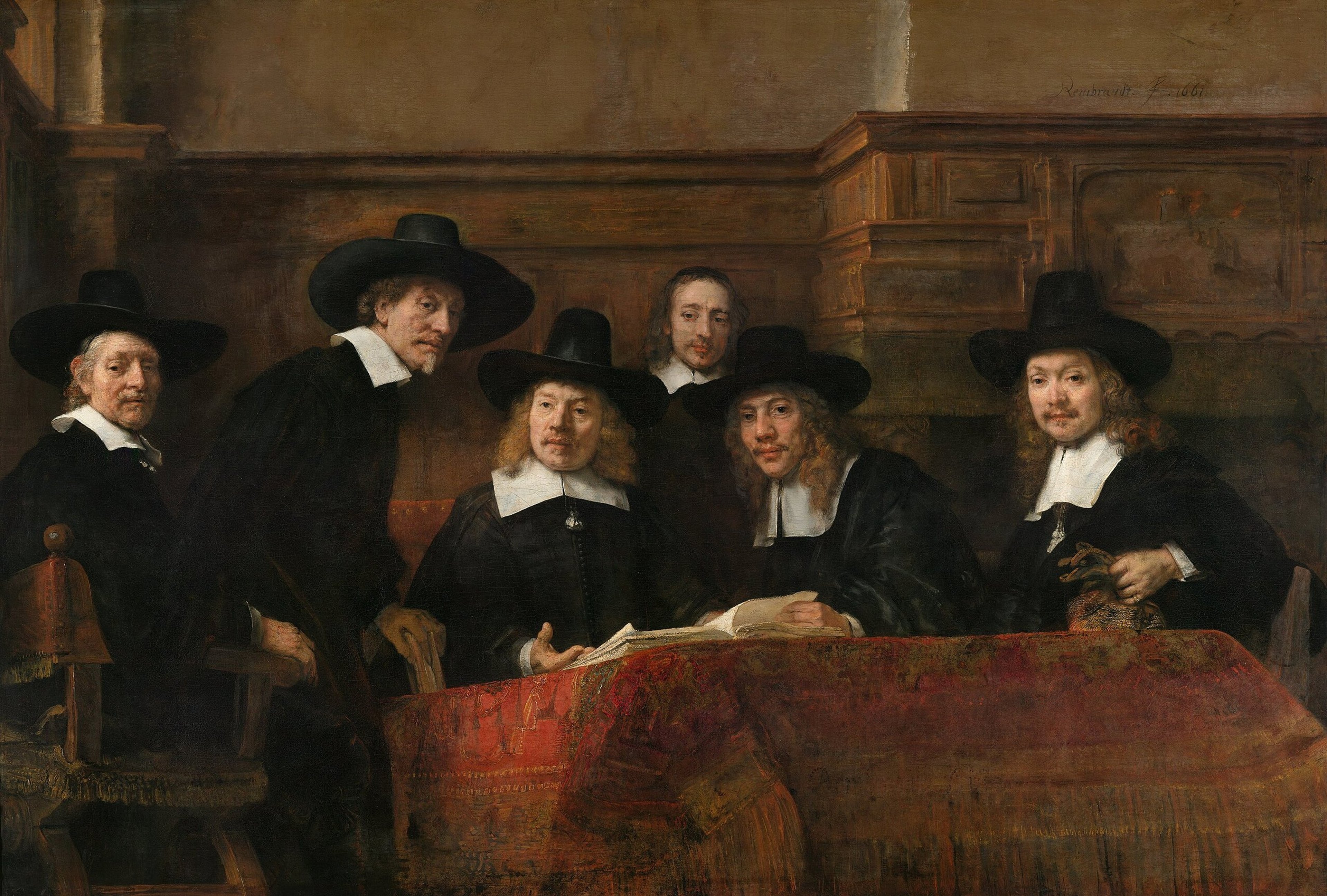
Rembrandt, Syndics of the Draper's’ Guild (1662)
It is obvious that personality and subjectivity, being only predicates of the person and the subject, exist only as person and subject; and indeed that the person is one.
Karl Marx, Critique of Hegel’s Philosophy of Right, p. 27
Economism, as a popular political term, is not formally used in Marxist discourse until after Marx's death, and the entering of the ‘second phase’ of Marxism after 1900. After this point, with Lenin, it became a definite object of critique which retains the attention of communist theory throughout the 20th century.
What, then, is economism? Here we will endeavor to provide only the barest and hence most abstract of definitions. The core of economism, as we understand it, is the theoretical model that understands actions and actors as guided by rational incentive/utilitarian calculus: X person holds a belief, and Y person engages in b action, because a is conducive to the interests of X and b to those of Y. What links this with Lenin’s more narrow, political definition of economism is that this forms the basis for the belief that the rationale appropriate to the proletariat as an economic class—a class that is sheerly defined by its economic function and position—determines its existence as a political class. I.e., the proletariat is an economic class that also exists politically according to its definition as an economic class: the ‘workers’ party’ is the party of economic workers, working-class policy is policy that increases the economic wealth or goods of those categorized as working class, etc. Inversely, and more importantly, this also means that policy as conforming to the rational interest of a class, such as increased wages or access to things like healthcare, is taken to be the determining factor in explaining the political behavior of that class, too.
In Lenin’s critique, this error figures as the rejection of political or ideological struggle in favor of purely Menshevik economic struggle and focus on ‘organizing workers’. Lenin argues that the economist view only understands workers in their economic struggle, not as political subjects concerned with the whole sum of ideology, culture, and politics.
The Critique of Economism
Both the abstract and political sorts of economic determinism are almost completely identified with Marx’s own method in this day and age. But there is nothing further from it, and Marx himself, in his Critique of Hegel’s Philosophy of Right (Crit. of Right), rejects this position and argues that it is an example of poor reasoning and general idealism. The identification of the economic and political concepts of class—of the proletarian as a revolutionary actor, and the worker as a wage-laborer—is, instead, surprisingly attributed by Marx to Hegel’s idealism. Marx writes:
What Hegel wants to establish is that the classes of civil society are political classes; and in order to prove this he asserts that the classes of civil society are the particularity of the political state, that is to say, that civil society is political society.
In other words, Marx accuses Hegel of taking the classes as they exist in their non-governmental, non-political function (for us, therefore, the economic or social) as equivalent to their identity in the political sphere. The wage-laborer in the workplace is (for Hegel) the same as the worker in parliament–he acts according to the same incentives and the same narrow viewpoint—and the wage-laborer is a mere wage-laborer, totally beholden to the instincts of that species, wherever he goes. Inversely, this means that the “classes of civil society are the particularity of the political state”: politics, and the specificity of politics, are reduced instead to the activity of purely economic classes which are said to comprise its real content.
In contrast to this viewpoint, Marx insists on the absolute separation of the classes in civil society and the political classes: the former, the proletarian qua wage-laborer, does not help us understand, and is not identifiable, with the proletarian qua political actor. Rather, each ‘class’—the one present in the economy or civil society, and the other present in the state or politics—can only be analyzed in its specificity, apart from its opposite designations.
Why? For Marx, this is because capitalism itself is differentiated from previous modes of production by its sundering of the civil and political spheres from one another. Under prior modes of production, such as that predominant in medieval Europe, this was not the case, and the class in its economic/civil position was cleanly identifiable with its political status. Marx writes:
The whole existence of the medieval classes was political; their existence was the existence of the state. Their legislative activity, their grant of taxes for the realm was merely a particular issue of their universal political significance and efficacy. Their class was their state.
Under feudalism, there was no difference between the economic class and the political class: the lord was not only the exploiter of serfs and the collector of rents, but he was, also, the real political power and exercised legal authority as the exploiter of serfs and collector of rents. As an economic exploiting class, the lords are no different from themselves as a political ruling/administrative class. Or, rather, the point is that the political category of the ‘lords’ are equivalent to the ‘lords’ as an economic category. To be a member of a ‘class’ under medieval society not only described and defined your economic status, but also your rights and duties (or lack thereof). A simple intuitive example of the traditional interpenetration of the civil/social and the political is the difference between the common function of last names in traditional feudal society as quasi-identifiers of occupations or status (“Smith”, “Roy”, etc.) versus the modern day where names are delinked from function: a ‘Smith’ is no longer a smith wherever he goes.
Capitalism, on the other hand, ends this identification and separates these two spheres and their objects. Marx writes:
The identity of the civil and political classes in the Middle Ages was the expression of the identity of civil and political society. This identity has disappeared […] The identity of the civil and political classes, if it expressed the truth, could be now only an expression of the separation of civil and political society! Or rather, only the separation of the civil and political classes expresses the true relationship of modern civil and political society.
Consequently, unlike with feudalism, Marx does not believe that we can understand a political class within capitalism by reference to its economic position, or vice versa. Although Marx frequently makes reference to the inevitable result of revolution, it should be noted that when examining specific political scenarios Marx sticks closely to specific political demands: this proletariat in this period demands a shorter workday, that proletariat understands the need for democracy, etc. Even if Marx grounds these struggles in the narrative of the ultimate upending of capital, for each particular case he provides particular reasons and causes that cannot be reduced to extrapolation from the concept of the economic proletariat (and we might posit this, for example, by pointing to the current lack of demand for a shorter workday and reminding the reader that a variable within the development of capitalism cannot be explained by the constant of capitalism).
The result is that the proletarian in the factory is not the same proletarian in the political world, where he is not merely ‘reflected’, or ‘determined,’ but, according to Marx, completely “transubstantiated.” It is not a matter of influence, effect, or form versus content—but, again, ‘transubstantiation.’ What Marx is likely alluding to by the use of ‘transubstantiation’ is the Catholic doctrine of the Eucharist, wherein the flesh and blood of Christ are held to be literally transformed into a new ‘substance,’ bread and wine, and then consumed. What is key is that the doctrine understands by this that the appearance of the bread and wine (its taste, texture, etc.) remains the same, while its substance—its essence—is altered to be Christ’s flesh and blood. In the same way, the proletariat as a political class is apparently the same: it is superficially the ‘working-man’s politics,’ and directly representative of the interests of the working class. But in reality, this appearance belies a change in substance; the essence of the proletariat as a political entity is fundamentally different from its essence in the economic sphere. No matter what they should do, we invariably find that the working class peeks its head out of all sorts of bizarre and incompatible political and ideological windows throughout history, and what is claimed to be the determined and necessary class politics often finds itself to actually be an almost never-occurring exception.
Marx establishes this through some rather clever dialectical maneuvers. He points out that if it were not the case that economic and political class were fundamentally different, like under feudalism, the economic and political functions of a class would be directly identified. Marx writes:
The unofficial class [i.e., the class in civil society in its economic function, or the economic concept of the proletariat—P.K.G.], civil society, cannot appear here as what it already is. For what is it already? Unofficial class, i.e., opposition to and separation from the state. In order to achieve political significance and efficacy it must rather renounce itself as what it already is, as unofficial class.
For an economic class to be a political class, therefore, it must cease to carry itself as an economic class in the streets of the political world. This is actually rather evident, insofar as in modern liberal society we understand rights and duties as attaching not to individuals according to their economic function—a ‘worker’ does not have a right to vote due to his place in the production process—but as attaching to individuals in the form of abstract citizens of the state, partisans, etc. This could be called the juridical basis for the separation of civil and political society under capitalism. And it might be noted here that Marx isn’t calling for the proletariat at this point to enter politics, which requires a specific analysis of their lack of existence in a given political formation, but establishing that the proletariat as already in politics—just not under the garb we are used to seeing them don, not immediately as the economic proletariat.
Where, then, does this leave the economic concept of the proletariat? Marx writes:
The sole characteristic thing is that the lack of property, and the class in need of immediate labor, of concrete labor, forms less a class of civil society than the basis upon which the spheres of civil society rest and move. (81)
To understand the capitalist mode of production in its political actuality as containing an immediately identifiable ‘proletariat’ and a contrasting, antagonistic ‘bourgeoisie’ is to fail to understand the structure of capitalist society itself. Marx’s famous statement that all hitherto history is the history of class struggle is not a statement that class struggle is the law to which every particular event must subordinate itself to or the model to which all individuals can be pinned, but, rather, that the class struggle is the foundation for all political activity in general. But this additionally means that it is mere foundation: politics is always a particular politics, a specific history, a given culture, a particular fight between sides, and a recurrently novel result.
The takeaway for our analysis is the understanding that “class difference […] acquires in the political sphere a significance different than in the civil sphere” (83). It is not the same proletariat in both cases, and in the task of identifying the economic and political class with the singular, general category of class “as the essential subject of both predicates, or in order to prove the identity of the two predicates, both are mystified and developed in an illusory and vague dimorphism” (83). What this leads us to do is reject the idea that any real understanding of communist politics or the proletariat as a particular, living class in a particular, living society can be achieved by understanding the proletariat in its abstract economic function. Even more importantly, it means that the discourse of politics—even when it takes the form of discourse about wages, inflation, or other nominally economic phenomena—must be understood on its own terms, without recourse to economic explanation. The content, for example, of the popular criticism of ‘Bidenflation’ is obfuscated if read as a general and direct frustration with economic decline rather than as an ideological position and a political weapon.
Ultimately, then, the reproach for economism is the same reproach Marx delivers to Hegel. He writes:
The sole interest here is that of recovering the Idea simply, the logical Idea in each element, be it that of the state or of nature; and the real subjects, as in this case the political constitution, become their mere names. Consequently, there is only the appearance of a real understanding, while in fact these determinate things are and remain uncomprehended because they are not understood in their specific essence. [my emphasis]. (57)
What is the ‘Idea’ of economism? We could say that it is the abstracted model from Marx’s works and modern reputation: the pure history of class struggle, the ascension of one class, and the subordination of the other. For Hegel and the Marxist objectivists, real history is nothing more than the continuous realization of this ‘Idea’: nothing unique happens, as everything has already been telegraphed by the ‘Idea.’ Each strike, political conflict, or surprise is merely one expression of the Idea–of the ‘truth’ that underlies it.
To say this is completely wrong is not to reject Marx’s model. Marx, in his concrete political analysis, never discusses ‘the proletariat’: it is always this proletariat; he discusses the German proletariat’s unfortunate reluctance towards democracy, the French proletariat’s unique history of ideological critique, the English proletariat’s position in the center of the most advanced 19th-century capitalist country, and so on. And each is granted its own special qualities–love for democracy, hard-headedness, even stupidity–that clearly cannot be attached to the economic concept of the proletariat itself.
Marx’s theory of dialectical and historical materialism is a break with previous theories, not yet another theory claiming to describe. It is a notion of practice–a practical notion. There is no way to move from Capital to American politics. There is no way to move from the extraction of surplus-value to the revolutionary party of the working-class. The only way to understand politics is by understanding politics. And this closed circle of focus—which emphasizes the particular and the empirical—is precisely what differentiates Marx’s materialist method from the pretense of insight characteristic of idealism and, also, the useless abstractions proffered as self-evident truths by vulgar materialism.
What is to be Done?
Capital remained incomplete—and Marx was extremely reluctant to publish even the first volume. It is not a Bible, it is a tool and a weapon. The objects of politics are not determined by the real happenings of the economy, or any other ‘base’-like structure posited as conceptual law expressing itself through real men, but, instead, by the transformation of that economic real into salient political objects through a particular intellectual mode of production: political practice. Their genetic origin may be in economic class, but their real existence is in the unity of society, where each field—politics, economics, etc.—is an individual mode of practice that cannot be cleanly collapsed into one another.
In our situation, the upshot is that an American communism cannot rely on the traditional categories of Marxism or on the economic analysis of Capital (or any other work by Marx or a disciple) to form the basis for an effective politics. What is to be done with class, then? The task is to take Marx’s work as a starting point and, in a particular national situation, articulate a living analysis of class, where it is always specific and politically mobilized. Briefly, let us wager that every communist revolutionary begins with this particular and political analysis. Is this found in the historical record? Invariably, yes.
Mao’s Analysis of Classes in China (1929) is a great case study. Slyly referencing Lenin, Mao begins by establishing the pressing need for a class analysis to ask: “Who are our enemies? Who are our friends?” Immediately, we see the entry of the subjective and the political as the starting-point for materialist analysis: Mao is not asking, abstractly, what the classes in China are, but identifying them from the specific position of a communist politician.
This subjective position is contained in the political definition of the classes, which are built based on the specific Chinese political situation: we are given, first, the “comprador bourgeoisie,” the section economically dependent on foreign imperialism and irreconcilably oppositional to the popular alliance represented by the CCP’s alliance of New Democracy (proletariat, peasants, and progressive bourgeoisie). Along with more traditional categories, like the petit-bourgeoisie, we are also given the class of “those whose standard of living is falling”, loosely identified with the “left-wing of the petty bourgeoisie”—but conceptually distinct and not defined by any property relation and instead by their position of continued immiseration under the dominant economic paradigm.
These classes are further supplemented by Mao’s totally unique category of the “semi-proletariat,” which, despite being distinct from both “those whose standard of living is falling” and the petit-bourgeoisie, contains “semi-owner peasants,” “small handicraftsmen,” and “pedlars” (‘peddlers’, small salesmen: think street stalls). Within the “semi-proletariat,” we receive further classification into upper, middle, and lower (which was also the effective means of class differentiation and hence the salient class categories during the 1920s and 1930s Soviet collectivization debate). What both the Chinese and Soviet examples show is that the definition of a class cannot be purely from the perspective of a neutral observer uncovering truths about a society, but that of a partisan and militant who is actively attempting to classify an otherwise ambiguous social mass for the purposes of mobilizing or engaging with them (or to identify them as historical actors). This classification is not given, but the product of labor—it involves a specific act of production, the expenditure of human labor-power (Mao’s, here), and objects upon which the labor is performed (the political practice, study, and analysis of Mao and the larger contemporary Chinese intelligentsia). There is no Marxist basis for differentiating a “pedlar” from a petit-bourgeoisie unless the former can be engaged with or acts in a way different from the latter from the perspective of the communist political party. Further, we should understand concepts such as ‘protracted peoples’ war’ as growing out of the analysis of these specific political classes—as being concretizations of Marxism rather than ‘applications.’
Working backwards: the same procedure marks the opening of Russian communism and the true birth of Lenin qua Lenin the Communist politician. He establishes this move in two texts: What the “Friends of the People” Are and How They Fight the Social-Democrats (1894) and The Development of Capitalism in Russia (1899). Both are directed against the contemporary and dominant belief in Russia that, while Marxism may be an adequate theory for Western capitalism, it was not vital in semi-feudal, historically unique Russia. What is remarkable about Lenin is the way in which he refutes this claim: Lenin does not point to the proletariat, or to the inevitable economic destiny of Russia, but redefines Russian society along the lines of a communist politics. In doing so, he is quite ingenious and subverts the concepts of Marxism. To this day, communists read the Russian Revolution as a question of the relation between the traditional peasantry and the modern proletariat (so much so that Gramsci even boldly describes the Russian Revolution as a “Revolution Against Capital”!), while Lenin can only be described as deftly reorganizing class relations in Russia along his own lines.
While the rest of the nation saw the peasantry as merely peasantry, Lenin connects their debt-relation to capital and their integration into the larger Russian market-economy to the substantive content of the proletariat as the abstract subordinate class. This is offered as the basis for redefinition. Leaving aside the specific content of his investigation, we can briefly quote his conclusion:
The system of social-economic relations existing among the peasantry (agricultural and village-community) shows us the presence of all those contradictions which are inherent in every commodity economy and every order of capitalism: competition, the struggle for economic independence, the grabbing of land (purchasable and rentable), the concentration of production in the hands of a minority, the forcing of the majority into the ranks of the proletariat, their exploitation by a minority through the medium of merchant’s capital and the hiring of farm labourers. There is not a single economic phenomenon among the peasantry that does not bear this contradictory form, one specifically peculiar to the capitalist system, i.e., that does not express a struggle and antagonism of interests, that does not imply advantage for some and disadvantage for others. It is the case with the renting of land, the purchase of land, and with “industries” in their diametrically opposite types; it is also the case with the technical progress of farming.
This was deeply controversial: basically every other intelligentsia in Russia, both left and right, limited the extension of the concept of the proletariat exclusively to the urban industrial worker population. But where others merely identified a peasantry, Lenin was able to ‘see’ a revolutionary proletariat. It exists in its relation to other classes, also identified by Lenin, each of which is also determined as salient political actors. A ‘strict’ Marxist class analysis is simple: there are two classes, occasionally a third in semi-feudal countries. A genuine communist class analysis takes this as the starting point, but strives to integrate apparently neutral and ‘objective’ knowledge about a given society into the larger totality of class relations, struggles, and concerns.
The question of whether the Russian peasantry, before or outside of Lenin’s analysis, is actually ‘rural proletarian’ rather than ‘peasant’ or even part of Mao’s ‘semi-proletariat”' is moot. There is no single, objective answer: arguments can be made and evidence adduced in any direction. Many communists today are still wont to describe the Russian peasant of the 1900s as essentially serf-like in its class character, out of a mistaken notion that the class can be observed and categorized based on its qualities rather than its relations. What we will posit is this: Lenin did not only identify a capitalist dynamic in the Russian peasantry, but the product of his intellectual production was the identification of that class as such. Granting that Lenin is only one moment in this historical event—the creation of the revolutionary proletariat in Russia—it is clear that his work makes the political class objective, rather than merely finding it. The economic qualities of a social mass are dormant and open to interpretation, but its political content as a class is a distinct and open terrain of struggle.
The task, consequently, is not merely to understand or identify the classes of American society. It is, and only can be, their transubstantiation into politics—a class analysis of American society is not just a tool or useful description, but a political act unto itself. And the key to this task is that it is written from the active perspective of the (incipient) communist party.