
Nov 13, 2026
RAD-PACT is a Capitalist Policy Failure. Socialists have to Salvage It.
The public housing complex is falling apart. But conversion is not a fair option, either. What should socialists do?
by Rohan L
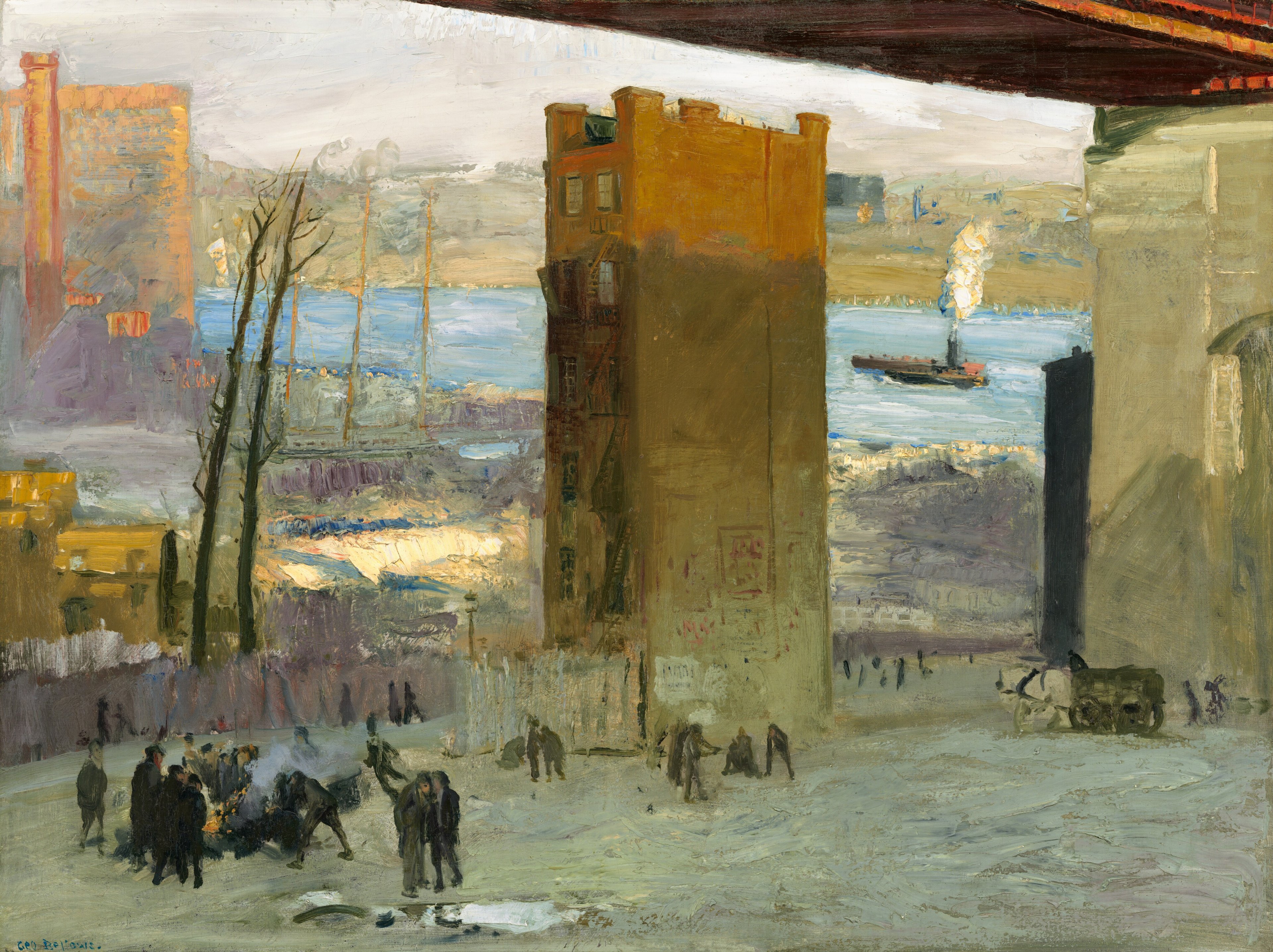
The Lone Tenement by George Bellows (1909)
On the west side of Manhattan, a battle is brewing over the future of four public housing developments. A plan supported by Mayor Zohran Mamdani would see the crumbling brick towers of Fulton & Elliott-Chelsea houses–home to more than 2,000 apartments and 4,500 residents–demolished and rebuilt, along with 1,000 new affordable units and 2,000 market rate ones. While the city’s housing authority will continue to own the land and buildings, they will be privately managed and maintained, a deal which reeks of a concession to privatization to some on the left.
Under a policy known as RAD-PACT, similar efforts have been underway across the country since 2016, transforming at least 32,000 homes across 119 developments in New York City–and generating all forms of local anger and support in the process. What makes the Fulton & Elliott-Chelsea case unique and assume so much symbolic power in the eyes of New York’s left is the place it takes shape in. Chelsea is one of the wealthiest neighborhoods in America, where starchitect-designed condo buildings soar above the High Line and Saudi princes launder their images and petrodollars through austere art galleries. Fulton & Elliott-Chelsea houses is an island in the sea of New York City’s working class disintegration.
The contours of the debate around Fulton & Elliott-Chelsea are broadly as follows: supporters point to the one-to-one reconstruction and anti-displacement guarantees to argue that, for the small price of a few months of construction-related dislocation, the reconstruction will be an unambiguous boon. Critics, arguing against this, say there was no democratically deliberated consensus built around the project, fret over permanent destruction and the possibility that tenant rights will be abrogated post facto, and cite more ideological concerns of NYCHA sliding further into the filth of neoliberal urbanism. Faced with this contradiction, socialists have found themselves unable to articulate a clear position or path forward on the housing question.
The RAD-PACT conversion, from an administrative standpoint, is diving toward disaster. At the same time, there is little idea of what an alternative to RAD-PACT would look like given the current economic situation. While the conversion's critics do hit at many salient points, the struggle represents a historic conjuncture wherein the state’s role in affordable housing can be enlarged. The left must emerge from this contradiction with an alternative vision for NYCHA as an empowered public developer: one that keeps the administrative work PACT hands to private contractors within accountable public institutions, uses its bond financing capacity to fund repairs, and builds and restores housing it owns permanently. If the critics are to win and kill the conversions, already happening all over the city, without winning additional demands we will return to a decrepit status quo without having improved the economic conditions of the working class in this city.
It is worthwhile to consider the historical and political-economic context RAD-PACT operates within. Under the postwar compact of urban renewal and state-managed urban welfare provision, Fulton & Elliott-Chelsea was one of the first examples of the “tower in the park” urbanism that came to define New York City’s mid-century Robert Moses era of monumental thinking. But the prospects of the project were questionable from the start. For one, it depended on tenant rental income rather than mandatory state budget outlays to fund maintenance. This, along with the subsidization of suburbanization which eviscerated the urban tax base, lead scholars like historian Destin Jenkins to conclude that these buildings were built to fail.
These were just the beginning of the project’s struggles to sustain itself. In 1973, then-President Nixon announced a moratorium on Section 9 spending, the federal subsidy for public housing, and invented the voucher-based Section 8 program to replace it. After him, Ronald Reagan took a sledge hammer to HUD’s budget and dramatically expanded the role of private capital in affordable housing development through the Low Income Housing Tax Credit. 40 years later, no acting government has found a way to either adapt the private market mechanism to the adequate provision of affordable housing, or meaningfully bring the state back in. Housing costs have ballooned and displacement abounds.
Concisely, RAD-PACT is the result of historical processes, neoliberalization and the imposition of the “consumer choice” model of welfare provision, that the left instinctively finds revolting. However, if one analyzes the (very physical) material conditions that substantiate NYCHA’s $80 billion capital needs gap—the holes in the walls that leak asbestos into apartments occupied by the elderly and disabled, the lack of heat, the trash, the lead paint, the mold—alongside the reactionary forces which have obliterated the state’s capacity to build and to rehabilitate, RAD-PACT emerges as an embattled, but necessary intervention.
The critics of these projects, well-armed with language around the dangers of displacement, tenant democracy, and “the right to remain,” nevertheless lack an actionable alternative to the urgent need of rehabilitating building conditions which can be a matter of life and death for NYCHA populations. We are told to “listen to residents,” when many residents have repeatedly insisted that they are on board with necessary renovations that, for the residents themselves, are free-of-cost.
What is lost in the unqualified defense of the FEC reconstruction, however, is the necessary critique of the bureaucracy and administrative bloat that have plagued PACT developments in a manner consistent across market-friendly, means-tested welfare policies. This bureaucracy and the way that private ownership utilizes it portends to nullify residents’ “right to remain,” a fundamental bulwark of permanently affordable housing, and undermines the argument that there is no risk for tenants involved. In fact, the dangers of conversion are significant.
To illustrate what I mean, consider two rent balance sheets: one is for a resident in Section 9 public housing (the current status of the complex), and another in a PACT development with a project-based Section 8 voucher (the new legal status the conversion would place Fulton & Elliott-Chelsea under). In the former, rent is frozen at 30% of their income. That number stays constant every month, and is periodically updated through income verifications. The Section 8 system is subject to the same 30% rule but, due to the market orientation of the voucher system, is reverse-engineered rather than directly derived from income. On the balance sheet, you see the monthly rent for the apartment’s “market rate value” (usually $3,000+), which is subtracted by the project-based voucher (the subsidy the tenant is receiving), and finally, the monthly rent, which should be 30% of the tenant’s household income. The system has proven to be arduous and subject to the whims of eviction-quick private property managers operating under a profit motive that, by design, NYCHA eschews.
A recent investigation conducted by The City Reporter demonstrates how this plays out. A paperwork breakdown inside NYCHA snowballed into an eviction crisis at PACT developments, after the authority failed to process annual income recertifications and mistakenly terminated Section 8 subsidies. The lost subsidies created hundreds of eviction proceedings as unpaid balances mounted–through no fault of tenants. This is a logical outcome of the reverse-engineered rent balance sheet: when the subsidy line fails, the “market rate value” of $3,000+ lands on the tenant as a bill, and the 30% guarantee exists only on paper. It is a feature of the bloated structure, in which a public authority administers the voucher, a private firm manages the building, and the tenant is left to prove their own compliance across both. Researchers have found that many of the management companies winning PACT contracts carry checkered histories of violations from before PACT began, including aggressive and illegal eviction practices and failure to conduct root-cause repairs within expected timeframes.
A more muscular state program would take on this administrative burden directly, and there exist clear models for this. The Public Housing Preservation Trust, created by the state in 2022 as a result of pressure on Governor Kathy Hochul from NYCHA residents and advocates, is a public agency that partners with NYCHA to fund repairs while rents stay at 30% of income and resident rights continue unchanged. Programmatically, the Trust model facilitates the same Section 9 to Section 8 conversion as RAD-PACT, but keeps this conversion contained within a public agency that rehabilitates and manages the buildings. It treats public housing as what it is: a public trust, financed and held by the state rather than handed to whichever operator wins the contract. The outcomes for tenants under a public property management system can be expected to be meaningfully and materially improved as public property managers lack a financial incentive to evict.
The Trust model is not perfect, is thus far untested, and still relies on an administration system that has proven to be too complex for NYCHA to manage. However, as a result of collective action led principally by public housing tenants, the Trust demonstrates how RAD-PACT has opened a window into a more streamlined, egalitarian, and socialized system for housing production and rehabilitation. Socialists should not treat RAD-PACT as a fixed system. It is a malleable procedure that can be iteratively transformed through public deliberation and organized mass action.
By consigning the working class to deplorable conditions unfit for the wealthiest city in the world, the Fulton & Elliott-Chelsea project critics seek to absolve themselves entirely from an exigent social drama—that of winning a functioning social housing development program. They, too, will abandon the tens of thousands of families outside of FEC that have already undergone or will undergo PACT conversions to malignant corporate actors. Mayor Zohran Mamdani’s housing plan puts $5.6 billion toward NYCHA, just under half flowing toward PACT and the Trust. Socialists should demand that city and state dollars flow toward the public option first, and that private partners be the exception that has to justify itself.
What does this mean for the tenants of FEC? They are, alongside more than 30,000 other NYCHA households, the inheritors of an imperfect transformation that was not of their design. They will be subject to years of disruption to their everyday routines and, once they are able to move back into their homes, will spar against large corporations with little oversight to preserve their rights. They will, also, live in a brand new, mixed-income building with updated communal and individual amenities and new possibilities for collective action on the horizon.
Existing PACT tenants cannot be written off as casualties of neoliberal development; residents need the oversight their developers and property managers are legally bound to follow but, under NYCHA’s current regime, rarely do. As report after report has found that evictions in PACT properties are higher than in traditional NYCHA developments, the Mayor has been repeatedly pressed on the issue and, just last month, convened an accountability assembly gathering more than 2,000 residents and community leaders. Socialists must be in that room, pushing for audits, enforceable standards, and a standing public role in any conversion, while also agitating toward a better model.
RAD-PACT will continue to shape the lives of the over 500,000 public housing tenants in New York City. The choice is whether or not socialists will see to its evolution, and demonstrate our capacity to run public housing. FEC critics would rather hold on to a withering Section 9 program while, outside of Chelsea, in Brownsville, the South Bronx, and Central Harlem, tenants in PACT properties languish under a corporatized system. In this alternative, we accept the state’s retreat to private operators, self-satisfied for holding to our principles.