
Apr 17, 2026
Communism is Already Here. We Just Have to Take It.
The failure of 20th-century socialism was not ideological, but technical—and that limitation has now been overcome. The material conditions for communism already exist.
by T. E. Moon
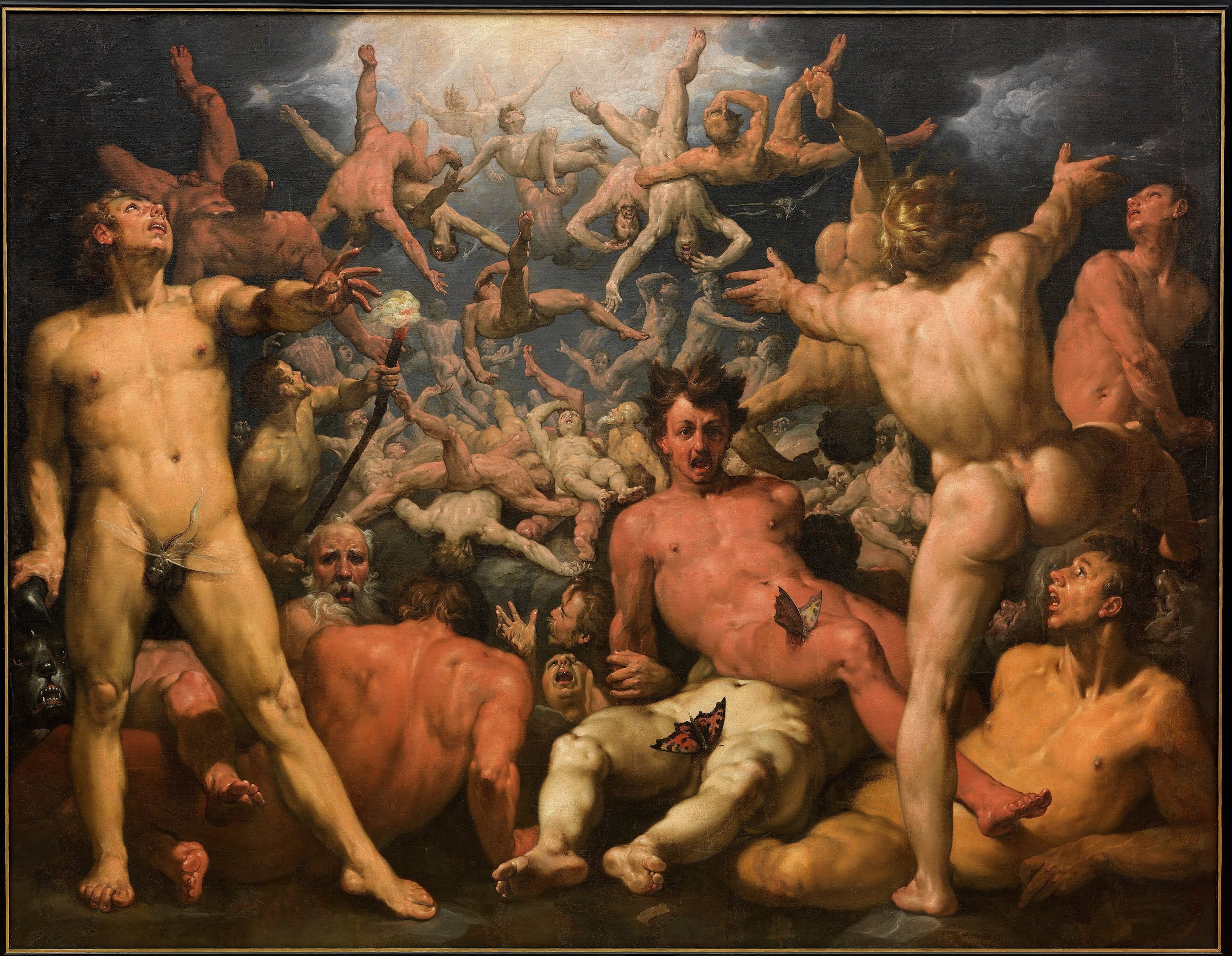
Cornelis van Haarlem, The Fall of the Titans, 1588-1560
Birthing Pains
New, higher relations of production never appear before the material conditions of their existence have matured in the womb of the old society itself. Therefore mankind always sets itself only such tasks as it can solve; since, looking at the matter more closely, it will always be found that the task itself arises only when the material conditions for its solution already exist or are at least in the process of formation.
— Karl Marx, Preface to A Contribution to the Critique of Political Economy (1859)
Our present era did not arrive with the calm chime of a clock; it began with a hemoclysm. Between 1914 and 1945, the planet devolved into a period of global war that claimed upwards of 100 million lives. This was the terminal spiral of a world long since wasting away under its own internal contradictions.
To understand the origins of this violence, we must understand the historical tension between the Economic Base (the raw material forces of production) and the Political Superstructure (the laws, states, and ideologies that justify them). The dying thrashes of the Long 19th Century were the material consequences of a dynamic, explosive base—Capitalism—that had become too powerful for a superstructure designed for eternal stasis.
To grasp the magnitude of this rupture, we must look at the stasis of the world that was being destroyed: Agricultural Feudalism. For most of human history following the Neolithic Revolution, society was defined by a specific, rigid material reality. It was a world of direct, localized production where 90% of the population lived and died within five miles of their birth, yoked to the soil.
This was not an "economy" as we understand it, but a system of extra-economic coercion. The Lord did not use "incentives"; he used the sword, the tithe, and the corvée. Value was not calculated by price; it was decreed by tradition and enforced by the gallows. While particular cultural formations varied globally, they all structurally resembled this picture.
As all upstanding Marxists recognize, the state is but the material expression of the class hierarchies that make up any particular society. In the case of this broad understanding of agricultural feudalism, the state was an expression of the society of the slaveowner, the landlord, and the feudal despot. Recognizing the threat of allowing material change to this closed loop, these gentlemen assumed the societal role of what the Nazi political theorist Carl Schmitt would call the Katechon: the “restrainer,” a concept he appropriated from St. Paul’s Second Epistle to the Thessalonians. These lords and slavers acted as a reactionary force, utilizing the violence of absolute monarchy to freeze political history, stifle the rising bourgeois class, and hold back the end of their world to preserve their dying divine right.
The embryo of that new capitalist world had existed long before the world possessed the infrastructure to support it. Centuries before the choking smog of Manchester factories, the material prophecy of this new world was visible in the Venetian Arsenale, a state-owned industrial complex employing thousands of workers that used standardized parts and moving assembly lines to build a warship in a single day.
The Arsenale broke entirely from the logic of the feudal manor; it treated its assets like a capital-expanding firm rather than a king's hoard. It functioned as a concentrated physical proof of the coming era long before the world was ready. Its workers were not serfs bound to the soil but mobile, individual subjects who traded specialized time for a money-wage. It replaced the artisanal decree of the master craftsman with the systemic efficiency of technical coordination based on market prices for parts, proving that social knowledge could create wealth that no Lord could ever match through land-rents alone. It was, effectively, capitalism before capitalism.
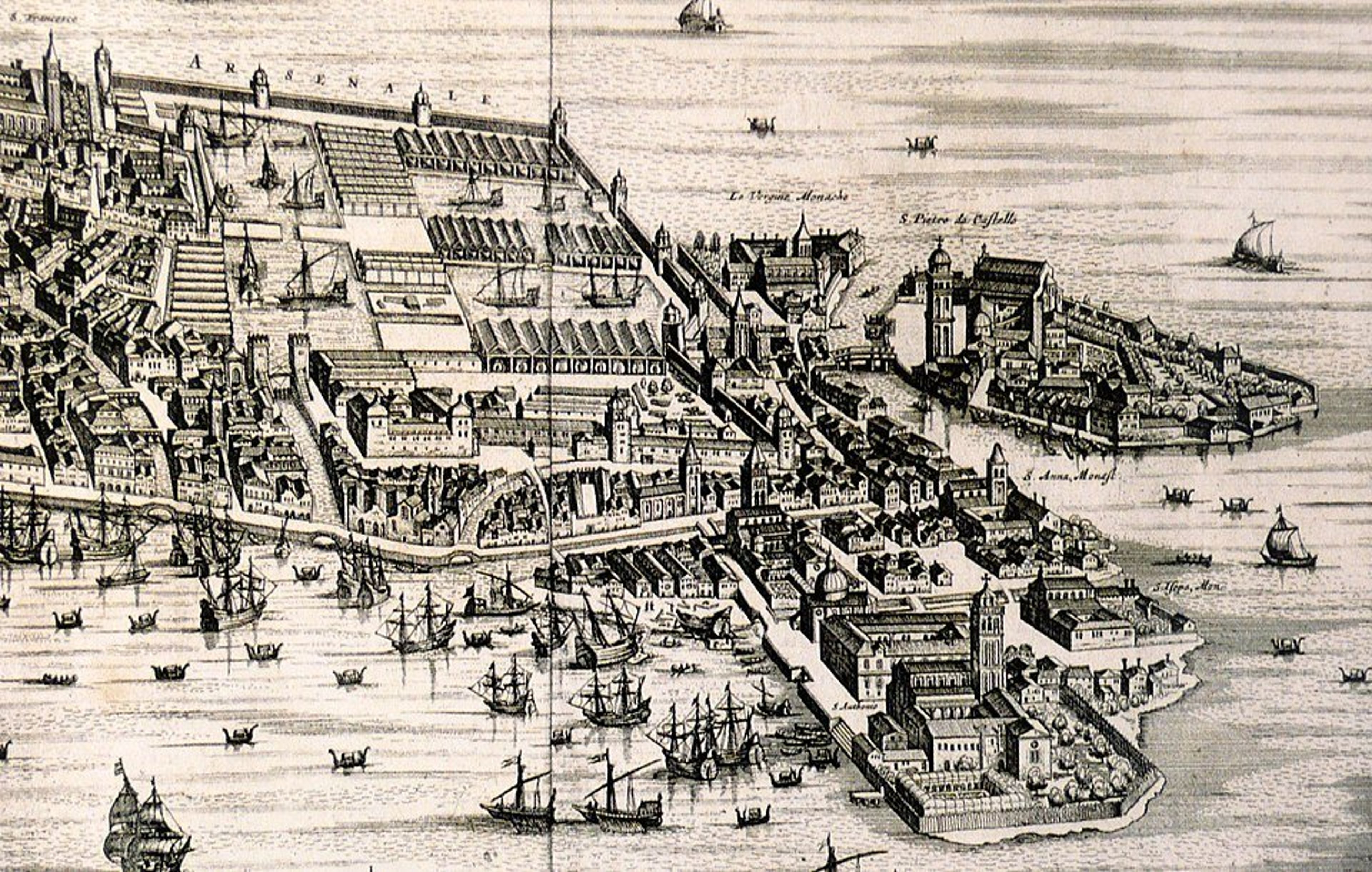
Venetian Arsenal, 1724 engraving by Joan Blaeu
Why, then, did the Venetian prototype not immediately conquer the globe? Because it suffered from a hardware failure. The broader material base lacked the logistical nervous system, the global supply chains, and the protective shell of the nation state required to scale such production. The Arsenale was a glimpse of the future trapped in a world that moved at the speed of the horse and the paper ledger. It took centuries of primitive accumulation, the enclosure of the commons, and the horrors of global colonialism to build the material hardware that Capital required to finally break the monarchical Katechon. And more than that, it was the crowned heads of Europe who chose to construct these very structures to help their kingdoms survive the dog-eat-dog world of early modern geopolitics. They raised their armies and navies on loans from financial capital, rationalized property law and standardized weights and measures, and invested heavily in constructing a stable state apparatus conducive to the practice of commerce. Each monarch and their ministers dutifully built a world perfect for capital to stay one step ahead of their competitors, foolishly believing that they could forever ignore the shifting political economy under their feet. And so the bourgeois revolutions finally swept the globe, serving splendidly as the executioners of the old world. The unleashed forces of industry shattered the feudal shell.
Today, in 2026, the wheel has turned. We face the exact same structural friction, but the dialectic has progressed. A new material base: a planetary logistical network capable of post-scarcity calculation, a highly accurate real-time tally of human wants and needs, a global collective intelligence, has begun to mature in the womb of the old society. The embryo of a new mode of production, a latent, uncoordinated communism, already exists, built into the supply chains and algorithms of the platform monopolies. It is communism before communism.
Yet, the capitalists are no longer revolutionaries. Having conquered the globe, they are now terrified of the abundance they have created. They use the violent shell of the modern nation state to enforce artificial scarcity, deliberately crippling our technological capacity to protect their profit margins. The capitalist class has become the exact thing they once destroyed: a new Katechon. They are desperately trying to freeze time, holding humanity hostage in a decaying world. The only task remaining is for the universal proletariat to recognize this reality, shatter the modern shell, and turn the wheel yet another rotation.
100 Years Too Early
If there existed the universal mind that projected itself into the fancy of Laplace; a mind that would register simultaneously all the processes of nature and of society, that could measure the dynamics of their motion, that could forecast the results of their inter-reactions; such a mind could, of course, draw up a priori a faultless and exhaustive economic plan... But the ruble is the only objective measure of the productivity of labor.
— Leon Trotsky, The Soviet Economy in Danger (1932)
20th-century Communism was not a failure of will, but a failure of hardware. The revolutionary experiments that defined the era were attempted on a material base that simply lacked the nervous system to support them.
To move beyond the price signal, society requires a coordination mechanism of equal or greater effectiveness than the price signal. In 1917, that mechanism was the paper ledger, the telegram, and the human committee. These tools were too slow, too prone to noise, and too easily corrupted to map the chaotic movements of a global industrial society. This was Hayek’s calculation problem in its rawest form. Without the real-time signal of the ruble, the system defaulted to the only other tool available for large-scale coordination: the bureaucratic decree.
What resulted was a tragic paradox. A movement theoretically dedicated to the abolition of the state was forced to construct a state more massive, more inflexible, and more intrusive than any that had preceded it. The bureaucracy was not simply an ideological choice or a necessity of the civil war; it was a crude, manual workaround for a lack of processing power. Because the state could not calculate need in real-time, it was forced into the surveillance of its subjects. Often presented as a political problem, Soviet surveillance was in many ways primarily an economic one.
The secret police were the human sensors of a low-tech system, tasked with verifying preferences because the technical infrastructure to do so transparently did not exist. The infamous black markets of the period were a symptom of this lack of social knowledge. These were a function of the price signal asserting itself through the gaps in an inefficient plan. When the central command is too slow to respond to the reality on the ground, the shadow price becomes the only objective measure of need.
By 2026, the technical excuses for the State and the Capitalist have been objectively dissolved. Technology does not create the revolution, but it removes the technical justification for the current ruling order. The revolution remains an act of will, organization, and timing—but it is now an act of clearing away wreckage rather than building from scratch. We are not describing a new system, but a seizing of a system already in existence at this very moment, a system that must be reconstructed and redirected post-seizure to meet the needs of the masses rather than built from the ground up.
As a provisional answer to this problem of planning in 20th-century socialist states, there is a specific mechanism to replace the price signal: the utility tally or social vote. While a market price is a low-resolution, compressed signal that only reacts after a resource has already become scarce, the utility tally functions as a high-fidelity, multi-dimensional map of social and material reality that is proactive rather than reactive. Instead of waiting for the market to signal a shortage through a price hike, the network monitors the flow of every physical asset at the moment of consumption. The utility tally does not view society as a series of financial transactions, but as a live ledger of human need, ecological limits, and logistical capacity.
So how are these tallies actually counted and verified? Here, we can look to Marx’s 1875 Critique of the Gotha Programme. Marx’s vision for the lower phase of communal society had a major logistical flaw that current technology finally resolves: the problem of the labor voucher. He proposed that the worker receive a certificate from society proving they have furnished a specific amount of labor, granting them access to the social stock of means of consumption. He explicitly stated that this certificate is not money and does not circulate. However, in 1875, there was no way to stop a piece of paper from being traded.
Today, the solution is found in zero-knowledge proofs, edge computing, and non-transferable digital, biometric identities. We now possess the cryptographic mechanism to ensure that the labor certificate, the unit of the utility tally, is truly non-circulatable. These vouchers cannot be traded, circulated, or invested, nor can they accrue interest, and so they cannot become money. They are access keys to social abundance, not currency for a market. The currency flaw of the 20th century is resolved when the unit of account is soulbound to the individual, and extinguished upon being redeemed for goods and services.
This cryptographic truth also exorcises the bureaucratic ghost. In the Gotha vision, society must make deductions for schools, health, and the expansion of production before the voucher is issued. Today, the utility tally could handle these deductions automatically, with ultimate authority remaining under democratic control. The network manages the administration of things transparently, ensuring that social funds are allocated where they are needed, while the utility of individual goods and services is instantly demonstrated and incorporated into calculation through their consumption or usage. Thus, the old capitalist saying about “voting with your dollar” is made manifest through labor vouchers. A market without capital.
“This is Utopianism!” will surely be the cry of any good Marxist reading this. But it is not so. The technology and mechanism are already in existence at this very moment. Authors like Leigh Phillips and Michal Rozworskihave demonstrated that the calculation problem itself has been chipped away by the internal mechanics of entities like Amazon and Walmart. These logistical singularities are the digital fulfillment of the utility tally, maintaining a real-time map of need that coordinates the vassalized muscle of automated tractors and warehouses without requiring an internal market price for coordination. Decentralized verification allows for truth without revelation: we can prove a task was completed or a need exists without a central auditor ever knowing who the individual is. The bureaucrat is replaced by the proof.
The Austrian economists and defenders of the old calculus will inevitably raise their oldest ghost: the calculation problem of subjective value and opportunity cost. They will argue that an automated logistical network, no matter how vast, cannot measure the intensity of human desire, allocate heavy machinery between competing industries, or fund an invention that does not yet exist. A perfectly mapped utility tally, they claim, is still just a reactive quota system.
But this assumes the network operates as a rigid, monolithic rationing board. It does not. The fatal flaw of 20th-century planning was attempting to centralize the entirety of human existence. The 21st-century solution requires a deliberate bifurcation of the material base: a guaranteed, unconditional "social floor" of survival (housing, nutrition, healthcare, and transit) provided free at the point of use, paired with a dynamic, decentralized sphere of discretionary production managed by democratic worker associations.
It is within this discretionary sphere that the utility tally annihilates the calculation problem, not by recreating the market, but by rendering it mathematically obsolete. Drawing on the cybernetic blueprints pioneered by Paul Cockshott and Allin Cottrell in Towards a New Socialism, we must recognize the capitalist price signal for exactly what it is: a low-resolution, compressed metric designed to violently ration goods by pricing out the working class. The logistical singularity, conversely, is anchored to the unyielding physical reality of labor-time. One hour of socially necessary labor time equals exactly one non-transferable labor voucher. The cost never floats. The commodity is never fetishized into a speculative asset.
The intensity of subjective human desire is measured entirely through the velocity of consumption. The singularity functions as a high-fidelity cybernetic feedback loop, reading the physical depletion rate of goods as a direct social vote. When consumption outpaces production, the product simply goes out of stock. To the capitalist, an empty shelf is a missed opportunity for extortion; to the utility tally, it is an automated trigger.
This dynamic inventory resolves the opportunity cost of capital goods. "Dead labor", the physical machinery, server space, and raw materials, is not allocated by the decree of a central committee, nor is it leased to competing firms. It is automatically, with democratic human overrides, redirected by the network to the decentralized production nodes experiencing the highest velocity of consumption. The network reads the shortage, instantly authorizes a surge of dead labor to the demanded node, and scales up production until supply meets the social need. The workers do not operate a business desperate for revenue; they operate a node of the general intellect, credited directly by the network for their surrendered time.
Yet a strict labor-time accounting inevitably collides with the physical reality of undesirable labor. Without the coercive threat of starvation, society must still coordinate the maintenance of sewers and the extraction of raw materials. The solution lies in adjusting the metabolic weight of the time surrendered rather than inflating the cost of the end product. This can be achieved through a system of labor voucher multipliers. If society requires sanitation workers and a deficit of volunteers arises, the democratic planners apply a multiplier to that specific node. One physical hour in the sewers may generate three hours of voucher credit. The individual is heavily rewarded in discretionary consumption for taking on a heavy social burden, yet the objective cost of the utility they provide remains statically anchored to its actual time. This balances human reluctance with a democratically audited incentive structure, entirely bypassing both the authoritarian gun and the capitalist whip.
It should be noted that the boundary of “socially-necessary” labor time, whether workers at any one co-op or another are recognized as providing a good or service worthy of being paid in vouchers, can be subject to democratic decision-making, as well as the objective measure of the social vote. In this way, both petty fraud and economic sclerosis are avoided to the best of human investigative abilities while crucial healthcare, childcare, eldercare, and other previously uncompensated laborers may be equally rewarded for their obvious and essential functions. This is also why the planned economy is only possible under communism, which can properly calculate the value of people’s labor without being forced to structure that valuation on the basis of regressive social relations.
Furthermore, we must answer the final critique of the Austrian school: the paradox of innovation. A utility tally maps the present, but how does it fund the future? To ensure the system does not stagnate by merely optimizing the status quo, the network must structurally quarantine a massive material reserve specifically for research, development, and the incubation of experimental production nodes.
If a free association of labor conceptualizes a radical new technology, they do not need to convince a solitary, risk-averse central planner. They may petition any level of the public. A greenlight from any single jurisdiction constitutes a binding resource order, compelling the network to release the necessary dead labor to fund the prototype. A federalist communism that Elinor Ostrom could love. Here, a planning bureau functions merely to mediate disputes and determine tie-breakers based on resource scarcity or ecological safety. This polycentric architecture replicates the decentralized risk-taking claimed by capitalist venture equity, but completely strips it of the profit motive. It allows local producers to take material risks on the unproven, ensuring that the general intellect can aggressively fund its own future without ever begging permission from a central bureaucrat or a billionaire.
As with the price signal and wage-labor, our society must outgrow the nation state cage. The Soviet Union was forced to adopt the nation state form to defend itself, which turned the revolution into a fortress shell and eventually a poisonous Empire. They were always subject to encirclement, as they occupied a specific geography that could be sanctioned, blockaded, or invaded. They were a local anomaly in a global system, forced to prioritize military survival over social liberation. But the social relations of production are now fully international. The internet and global logistics have already outgrown the nation state. The cloud, the fiber-optic veins, and the automated hubs are not tied to a single flag: they are a distributed mesh, albeit concentrated in the West, that the current elite uses to extract value.
However, we must look directly at the barrel of the gun. The old world does not simply disappear; it retreats behind the shield of the state. While the network is planetary, the men who claim to own it still command the physical violence of the state. The capitalist superstructure, the courts, the police, and the standing armies, exists specifically to protect the right of the oligarch to gatekeep the abundance we have already produced. This is the final fortress of the old world: the use of state violence to enforce a scarcity that no longer exists in the material base.
The encirclement today is not geographic, but legal and kinetic. The ruling class will attempt to use the nation state as a defensive bulwark, utilizing the law to criminalize the redirection of the network and using the police to physically guard the automated hubs. They will attempt to keep the social knowledge of production as a private secret. Gnosis meant exclusively for extraction.
This creates a terminal friction. The more the state uses violence to protect a dead price mechanism, the more it reveals itself as a parasitic shell. The logistical network already tracks the needs of the masses through the primitive tally, and the state’s attempt to enforce oligarchic control should be seen as nothing less than a declaration of open war against the very survival of society.
It must further be noted that the material base has shifted from the 19th and 20th-century phase of industrialization. The Soviets were forced into brutal industrialization because they were fighting physical scarcity from a peasant baseline. They had to build the factories, the power plants, and the tractors through a process of primitive accumulation that mirrored the violence of early capitalism. In 2026, the industrial work is effectively done. We produce enough food for ten billion people and have the technical ability to coordinate shelter for all. The machines exist; the warehouses are full; the fields are already yielding. We are no longer in the era of building the base, but of removing the price-parasite from the logistical host.
Under the current system, capitalism has become an obstacle to its own productivity. It must create artificial scarcity to maintain the price signal, destroying food while people starve and leaving homes empty while people sleep on the streets. Shortage is necessary for the price mechanism to function. In a situation of abundance, the price drops to zero, and the capitalist loses their reason for being. This is the structural reason for the state's current descent into authoritarianism: it must use the gun to enforce a zero that the network is screaming is actually infinity. We are not just installing a digital nervous system; we are performing an amputation of the violent superstructure that is currently strangling the communal body to protect a bank account.
In this way, Communism exists in embryonic form, built brick by brick by the high capitalists out of fear of being outcompeted, yearning to be seized and unleashed by the international proletariat. They are in the same bind as the old Lords.
What is the Proletariat?
The development of fixed capital indicates to what degree general social knowledge has become a direct force of production, and to what degree, hence, the conditions of the process of social life itself have come under the control of the general intellect...
— Karl Marx, Grundrisse (The Fragment on Machines)
The most common refrain from the orthodox wing of the left is that the working class is shrinking. To the Orthodox Marxist, the proletariat is strictly defined by the point of physical production: the man sweating on the assembly line, hammering the commodity into shape. Within this nostalgic framework, a user scrolling on a smartphone or prompting an algorithm is merely engaged in consumption. They are not producing ‘tangible’ value: therefore, they are not workers, and the fundamental dynamic of capitalism remains unchanged.
This view is a fatal misreading of modern capital. It fails to recognize the architectural shift of the 21st century: the traditional industrial capitalist has been demoted. Theorists like Yanis Varoufakis have rushed to call this Techno-Feudalism, but this gives Capital too much credit by treating it as a new epoch. We are not in a new mode of production: we are in the terminal, rent-seeking mutation of monopoly capitalism.
Capitalism has fully concluded its destined revolution from a historically progressive force to a reactionary one. Just as the Concert of Europe violently restrained the inevitable death of absolute monarchy, today's platform monopolies act as a violent fetter on the abundance of modern technology. The structural reality is clear: the entity that owns the physical factory no longer masters the economy. In fact, thinkers like Nick Srnicek would say the producers of physical commodities have been cannibalized and subordinated into a vassal.
Consider a firm like General Motors. In the 1950s, GM was at the cutting edge of accumulation. They extracted surplus value directly from the worker in the factory line to sell a physical commodity. Today, GM still makes cars, they still extract surplus value—but their path to profit has been violently hijacked by the platform monopolies.
To manufacture and sell a vehicle in 2026, a company like GM must pay a series of inescapable tolls. They pay Cloud Rent to Amazon to manage their global supply chains. They pay Attention Rent to Google and Meta to reach their own customers. They pay Software Rent to Apple for the operating systems embedded in their dashboards. The physical commodity is rapidly becoming a secondary shell. The true locus of power and accumulation has shifted from the extraction of surplus value on the factory floor to the extraction of monopoly rent via digital enclosures.
But where do these Cloud Lords derive the power to hold industrial capitalism hostage? To answer this, we must look past orthodox readings of Capital and into Marx’s Grundrisse. In the Fragment on Machines, Marx predicted that wealth would eventually no longer be generated primarily by direct, physical human labor, but by the accumulated technological and social knowledge of the species: what he called the general intellect.
The Cloud Lords, as McKenzie Wark calls them, did not create the general intellect: they merely enclosed it. And, to maintain this enclosure, they rely on a massively expanded, unacknowledged workforce: the users. A Large Language Model or a social media algorithmic feed is the literal, material manifestation of Marx’s prophecy. It is not just the product of software engineers: it is the harvested, aggregated social knowledge of billions of people. Every sentence typed, every image uploaded, every micro-decision made online is literally extracted as the raw material to build the algorithmic engine. To apply the logic of Autonomist Marxism to the 21st century: the engineers simply built the bucket; we are the rain.
The digital platform is a ghost town. It possesses servers and code, but it has zero actual value until the human subject enters it. This entrance is not a leisure activity: it is the modern equivalent of clocking in. Within the digital sphere of this terminal stage of capital, the money wage has been replaced by the attention wage. The Techno Lord does not pay you in currency to keep you biologically alive: they pay you in Access.
Access to your social network, your professional identity, and the tools of your labor. Access to entertainment and the general intellect itself. Access to the means of production of a social life.
But this Access is more than a wage: it is a tether. It is the psychological fetter that prevents the Collective Subject from striking, for to lose Access is to be erased from the general intellect itself. Building on what Dallas Smythe diagnosed as the audience commodity, every second of Engagement is a Unit of Labor Time. The algorithm functions here as the invisible foreman, optimizing the Time Spent metric to ensure the maximum extraction of your attention and data.
This is the Great Inversion of consumption. Every micro decision: every purchase, every scroll, every trend followed: is not a private act of choice, but a social signal extracted to calibrate the planetary machine. The Cloud Lord uses microtargeting to maintain the illusion of the Individual, but the underlying reality is the total socialization of data. We are no longer consumers in a market: we are nodes in a real-time logistical census. When you follow a trend or click a targeted ad, you are performing the unpaid surplus labor of refining Cloud Capital, providing the living labor that brings to life the great, global ghost town.
Ultimately, this collective labor acts as the literal fuel for the machinery of capital. The proletariat has not shrunk; it has universalized into a Collective Subject forged in the cloud and the mine. Yet, this planetary circuit is powered by a brutal Differential Rent. The Cloud Lord extracts raw surplus from the Global South miner’s backbreaking poverty to subsidize the Attention Wage of the Western user. The nation state is the filter that enforces this. The border ensures that the utility tally is not a global record of human need, but a proprietary asset of a specific national oligarchy, maintaining differentiating tiers of survival.
Nationalism in 2026 is the grand diversion of the international working class. It is a massive class collaborationist project designed to convince the worker that they share a destiny with their local capitalist simply because they share a passport. The nation invites segments of the proletariat to band together with small and large business owners on the basis of race, religion, language, or citizenship. They are offered money, belonging, and security in exchange for their participation in the exclusion of the vassalized muscle, the miners and field hands who exist outside the border. These national identities are the fossilized remains of past material struggles, utilized today as a populist mechanism to keep billions from developing a global class consciousness. Whether a democrat or despot, the goal is the same: to stop the collective subject from realizing they already run the planetary machine.
Just as the English Lords enclosed the commons to create the wage laborer, the modern state uses the border and intellectual property to enclose global social knowledge. The nation state is the only entity with the visible fist of police and military capable of enforcing the capitalist’s paywalls and intellectual property. Without the state’s enforcement of national copyright and trade laws, the price of digital abundance would collapse into the floor of the general intellect. The state exists to ensure that, when the international proletariat works, the value of that work is captured by a national firm. The border isn’t simply walls, detention camps, and masked enforcement officers: the fence wraps around the collective mind of the species.
The nation state has become the modern Concert of Europe: a reactionary force attempting to freeze history to prevent the administration of things from replacing the government of persons. This creates a terminal paradox. The capitalists are global: they drift across borders with their Capital and few have loyalty to the people who share their nationality. Yet, they rely on the national sentiment of the masses to provide the military, police, and paramilitary force necessary to protect their property rights. We cannot capture the nation state for the people, because the nation state is the very tool that sections the people off from their own global co-production. The lower phase of communism requires recognizing the nation state as the ultimate administrative structural failure: a 19th-century cage holding back a 21st-century species.
This is where I answer the critic who asks how the scroller and the miner can be the same class when one gets to scroll a smartphone and the other is forced into brutish conditions in mines and factories. The nation state is the mechanism that manufactures this difference. It is not a natural byproduct of geography, but a logistical partition. The capitalist needs the physically exhausting labor of those in the Global South to be dirt cheap to maintain the attention wage for the scroller in the North.
If the utility tally were allowed to go global, the material divergence would vanish. The general intellect, guided by rational, democratic planning, would equalize the standard of living. The state uses nationalism to convince the scroller that the miner is an outsider rather than a co-producer. It turns the scroller into a managerial vassal who unconsciously polices the miner through their consumption. Inequality is not just policy, but a capitalist necessity, and an inevitable outgrowth of our current collection of “independent” states.
A Moribund Metabolism
Even an entire society, a nation, or all simultaneously existing societies taken together, are not the owners of the globe. They are only its possessors, its usufructuaries, and, like good heads of the household, they must hand it down to succeeding generations in an improved condition.
—Karl Marx, Capital, Volume III
The previous section established the modern nation state as the primary reactionary filter of our age, but Capital’s role in the 21st century has mutated into something far more lethal. It has become an executioner, and not just of inbred monarchs or striking workers. We are currently attempting to manage a planetary crisis with administrative tools forged in the 19th century. The result is not merely a political failure, but a moribund metabolism.
To be clear, the planet itself does not possess a moribund metabolism. The Earth is vastly indifferent to our economic systems and, to quote George Carlin, will ultimately just shake us off like a bad case of fleas. The moribund metabolism belongs entirely to us. It is our species-wide, social inability to process resources, protect ourselves, and adapt to the climate catastrophe that the capitalists have unleashed. We are trapped in a system that is aggressively siphoning the very energy required for our own survival, turning our productive mechanisms into a grim death-march towards collective extinction.
The fundamental logic of capital, infinite growth reliant upon a finite base, is no longer just a theoretical contradiction. In 2026, it is a physical rupture. Because the nationalist filter prevents any rational, global distribution of resources, humanity is forced into a redundant and competitive waste of energy. Every competing nation must secure its own energy vent just as every AI firm must secure its own collection of data centers. This is a social metabolism that is fundamentally self-cannibalizing. The price mechanism we rely on is structurally incapable of valuing the future. It treats the finite resources of the Earth as mere inputs that do not register until they are permanently exhausted.
Indeed, the collective mind and labors of our species are ravenous consumers of energy. To keep the attention wage flowing and the digital platform monopolies afloat, the oligarchs and their national shells are doubling down on a strategy of extractive desperation. They are entirely willing to sap the original sources of wealth, the soil and the worker, to maintain their digital hallucination. This is a dead end. It is impossible to run a post-scarcity digital brain on a scarcity-era energy metabolism. The reactionary fetter of our time is the stubborn refusal to transition to a rational, logistical management of global energy and production, simply because such a move would require the total abolition of the capitalist class and their profit margins.
The metabolic rift does not respect borders, but the immediate impacts of its rupture are brutally partitioned by them. Expanding on John Bellamy Foster’s diagnosis of the metabolic rift, we see that the nation state functions as a massive, violent shock absorber for the capitalist core, ensuring the periphery drowns or starves first. But no fortress is immune to a collapsing biosphere. When the external shock absorbers fail and global supply chains decimate, the violence of the state will inevitably turn inward.
This is where the illusion of the cross-class national alliance will brutally shatter. When the grocery store shelves remain empty and the power grid begins to fail, the capitalist class will not share their bunkers or their privatized water supplies with the technicians and the well-paid users who previously defended them. The state will deploy the same militarized police forces that patrol the border to protect the dwindling property of the owners from their own starving citizens. We will see the visible fist of state violence deployed not just against the Global South, but against the domestic working class, stripping away the thin veneer of liberal democracy to reveal the autocratic core of capital preservation. The reactionary descent into fascism is not a deviation from capitalism; it is its final, desperate reflex to protect the profit margin when the natural world can no longer subsidize it, a democratized suicide pact with their loyalists struck through stoking mass fear of collapsing imperial stability and the loss of demographic majority in the face of war and displacement.
The transition to the lower phase of communal society is therefore no longer just a political project; it is a biological imperative for the entire species. Only global, transparent planning that objectively accounts for every joule of energy and every gram of carbon, can heal this rift. The nation state cannot accomplish this because its very existence is predicated on the competitive exploitation of the natural environment and the hoarding of temporary security.
Just as the Concert of Europe desperately tried to freeze history to save the absolute monarchy, modern green capitalism is a reactionary project designed to freeze the metabolic crisis to save the capitalist. They offer illusions like carbon credits and market-based solutions, absurdly attempting to use the price mechanism to solve a catastrophic failure caused entirely by the price mechanism itself.
The brutal truth is that there is no market solution to a metabolic rift. You cannot negotiate with the laws of thermodynamics or ecology. The reactionary fetters of capital and the nation state must be broken, or the prevailing economic order will simply facilitate our demise while the Earth moves on without us.