
For A Left Populism Reading Group Handouts and Analysis
The following short, one-page handouts were distributed at the beginning of class sessions for a reading group discussing Chantal Mouffe’s “For a Left Populism.” In these handouts, the authors attempt to concretize Marxism’s class analysis and Mouffe’s contributions for our current period.
By P. K. Gandakin and Nik M.
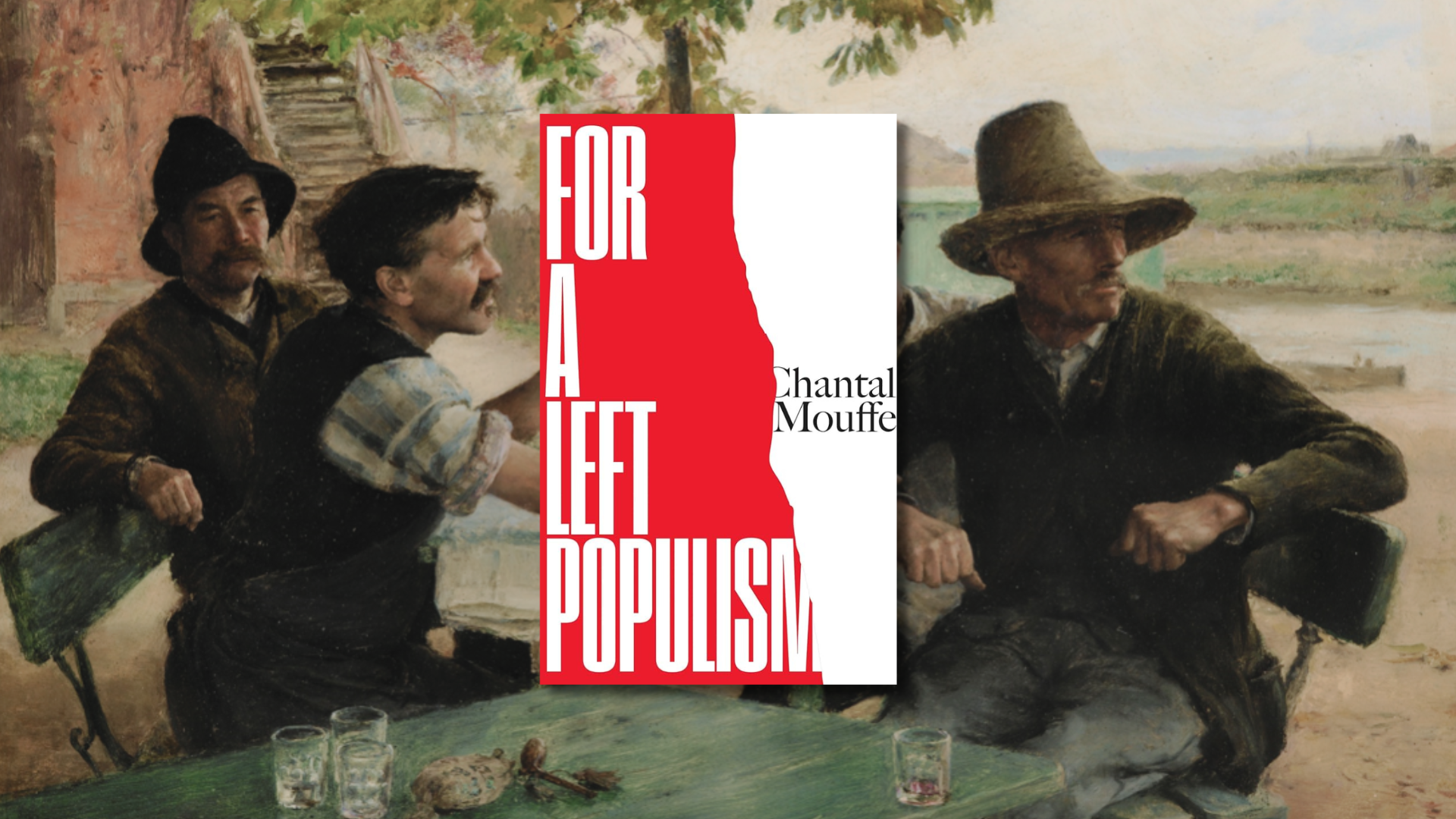
0. Information about the Reading Group
Marx’s Political Theory of Class & Socialist Strategy began on July 17, 2025 and was based in NYC.
Week 1: Welcome, Marx’s Concepts as Tools
Reading #1: Ollman, With words that appear like bats (excerpt from Alienation)
Reading #2: Melenchon, Now, the People! (Introduction)
Week 2: Populist Moment
Reading #1: Mouffe, For A Left Populism (Introduction , 1. Populist Moment) pg. 9-18
Reading #2: Lenin, Letters on Tactics + On Guerilla Warfare: Section I
Reading #3: (Optional) Nik M, Zohran and the Interregnum
Week 3: Class as Ideology
Reading #1: Mouffe, For A Left Populism (2. Thatcherism, 3. Radicalizing Democracy) pg. 19-32
Reading #2: Hall, Gramsci and Us
Week 4: The People
Reading #1: Mouffe, For A Left Populism (4. Constructing a People, Conclusion) pg. 33-46
Reading #2: Melenchon, Now, the People! (Ch. 9. The People)
Week 5: The Political Party
Reading #1: Melenchon, Now, the People! (Ch. 10, Grain of Sand)
Reading #2: Gramsci, Prison Notebooks (The Political Party)
Week 6: Modern Prince
Reading #1: Melenchon, Now, the People! (Ch. 11, The Revolution’s New Clothes)
Reading #2: Gramsci, Prison Notebooks (Spontaneity And Conscious Leadership)
I. “Marx’s Concepts as Tools”: Session 1 Guide
“It seems that Marx’s terminology, besides being new and unusual, is also inconsistent, the same word meaning different things at different times. Rather than seeing this as a fault, Engels proclaims it a virtue, and says this was necessary to express Marx’s understanding of the society he describes. Engels argues that we should not expect to find fixed, cut-to-measure, once and for all applicable definitions in Marx’s works. It is self-evident that where things and their interrelations are conceived, not as fixed, but as changing, their mental images, the ideas, are likewise subject to change and transformation, and they are not encapsulated in rigid definitions, but are developed in their historical or logical process of formulation.” (pg. 4)
In this section, Bertell Ollman argues that Marx’s ambiguous terminology is not accidental, but a necessary part of his dialectical worldview. This stands in stark contrast to the popular idea of Marx and Marxist theory as being comprised of a strict ‘science’ with clearly delineated ‘laws.’ Instead, we get the impression that Marxism is a ‘tool’ that is adapted to the situation rather than applied as systematized method. This raises interesting questions about the meaning of the proletariat, the bourgeoisie, and socialism itself. These debates can take a variety of forms.
Today, technology and the service sector play significantly larger roles in the process of capitalist production than they did in Marx’s time. While Marx saw capitalism as increasing the proportion of machine to man in production, he did not live to see those consequences play out to the degree they have today: a highly specialized division of labor on an international scale, a large portion of workers who do not seem to ‘produce’ a physical commodity but rather a service, and even fresher questions such as about the role of technology such as generative AI in emulating and in some cases even supplanting human labor. Trying to reduce these developments to the minimal terms of Marx’s categories can be useful, but treats Marx’s categories as “cut and dry”. To fully appreciate Marx’s method, it is valuable to understand the ‘contradictions’ within our concepts: the way they fit neatly into the categories we place them in, and the ways in which they don’t.
In other words, Marx's terms are indeterminate and must be understood as tools rather than truths. He posits that a given ideology or social class should be understood in an existential sense, i.e., a class is defined not only by what it is but what it does, what it believes, and what it thinks.
For instance, W. E. B. Du Bois, through "wages of whiteness," shows how class-identities are actually formed and divided within concrete historical formations. For Du Bois, what it meant to be a white worker was intrinsically linked to that worker’s social relationship to American white supremacy, thereby closing the gap between class conceived purely at the economic level and class as a social process. This exemplifies how ‘Class’ is an abstract category which, in every actual manifestation, is necessarily constructed socially and historically, and must be investigated concretely.
In your groups, let’s try to apply Marx’s materialist analysis of ideologies to contemporary ideology. What are the major ideological trends in society, and what attitudes or classes do they represent?
In the same way that white supremacy in the United States forms a stratum within the proletariat called the ‘white proletariat’ defined by its social superiority to Black labor, how do current popular beliefs, morals, and ideologies indicate ways to ‘class’ify American society?
II. “The Populist Moment”: Session 2 Guide
In the Introduction of For a Left Populism, Chantal Mouffe conceptualizes our current era marked by the crisis of the post-Reagan neoliberal consensus as “the populist moment.” The book starts with a brief recap of Mouffe’s earlier critique of social democratic and Marxist politics, pointing out that in the latter half of the 20th century, their “class essentialist” perspective was inadequate to grasp the emergence of “the multiplicity of struggles [including feminism, the gay movement, the anti-racist struggles and issues around the environment] against different forms of domination.”
Where Mouffe finds Marxism inadequate for grasping these different forms of struggle, Lenin asserts that this grasping of different forms of struggle is in fact what makes Marxism unique. He writes in On Guerrilla Warfare, “Marxism differs from all primitive forms of socialism by not binding the movement to any one particular form of struggle. […] Under no circumstances does Marxism confine itself to the forms of struggle possible and in existence at the given moment only, recognizing as it does that new forms of struggle, unknown to the participants of the given period, inevitably arise as the given social situation changes. In this respect Marxism learns, if we may so express it, from mass practice, and makes no claim what ever to teach the masses forms of struggle invented by “systematizers” in the seclusion of their studies.”
As the social situation changes, so do the “forms of struggle.” A particular social situation, broken down, is the particularities of culture, race, ideology, etc. A class that is constructed within a particular social situation necessarily expresses itself in a form that reflects that construction. A “concrete analysis of concrete conditions” informs the orientation of a political party towards a given political conjuncture. Class-identity is not strictly identical with abstract economic concepts but articulated within a full cultural and political context.
It is within this understanding of dynamically changing social situations and the constructed nature of political identities that Mouffe turns to populism as a key strategy. As she explains, drawing on Laclau’s definition: “In his book On Populist Reason, Laclau defines populism as a discursive strategy of constructing a political frontier dividing society into two camps and calling for the mobilization of the ‘underdog’ against ‘those in power.’ It is not an ideology and cannot be attributed a specific programmatic content. Nor is it a political regime. It is a way of doing politics that can take various ideological forms according to both time and place, and is compatible with a variety of institutional frameworks.”
The neoliberal hegemonic consensus, now under crisis, can be characterized by the “oligarchization” of Western societies due to the financialization of capitalism ushered in during the Reagan era. She describes this as the triumph of economic liberalism over democracy, where the market's logic increasingly dictates societal organization. This shift, which led to an “exponential increase in inequalities,” is evident in the outsized control of money in politics and elections, making it clear how power has become concentrated. This explains why left populist movements have articulated their primary political frontier as between ‘the people’ and ‘the oligarchy.’
For Mouffe, “A left populist strategy aims at federating the democratic demands into a collective will to construct a ‘we’, a ‘people’ confronting a common adversary: the oligarchy. This requires the establishment of a chain of equivalence among the demands of the workers, the immigrants and the precarious middle class, as well as other democratic demands, such as those of the LGBT community.” This strategic formation of a unified 'people' out of diverse struggles stands as a central challenge for contemporary socialist politics.
Considering Mouffe's concept of building a 'people' through a 'chain of equivalence,' and Lenin's insight that new forms of struggle inevitably arise, what contemporary movements or struggles (e.g., racial justice, LGBT rights, housing justice, etc) do you observe today, and how might these embody novel expressions of class conflict in our current moment?
III. “Class as Ideology”: Session 3 Guide
In Chapter 2 of For a Left Populism, Mouffe takes the case study of Margaret Thatcher in the UK for how populism as a strategy was effective at disarticulating key aspects of the post-WW2 welfare state consensus and replacing it with a new one. In the 1970s, the post-WW2 social-democratic consensus faced a "legitimation crisis." This was due to both economic slowdown (e.g., 1973 oil crisis, declining profits, fiscal crisis leading to Labour disciplining workers) and the rise of new social movements (feminist, LGBTQ+, anti-racist, environmental, etc.). These diverse struggles, which couldn't be easily framed in traditional class terms, contributed to political polarization and a conservative backlash against the "egalitarian precipice."
Thatcher's objective as Prime Minister in 1979 was to "break the postwar consensus." Recognizing politics as a hegemonic struggle for common sense, she deployed a populist strategy: identifying the “them” as "oppressive state bureaucrats," "trade unions," and those benefiting from "state handouts,” and the “us” as the industrious people who were considered victims of the bureaucracy, even if many of them benefitted from its welfare provisioning. Thatcher was able to acquire popular consent for the neoliberal project by championing individual freedom over state power, tapping into resentment against state bureaucrats, and dividing working people by pitting them against feminists and immigrants (i.e., accusing them of stealing jobs, etc). Influenced by Friedrich Hayek, Thatcherism sought to subordinate democracy to “freedom” with economic liberty and private property posited as the new primary social values.
Thatcher's neoliberal revolution successfully ingrained its vision into "common sense." This was so effective that even when Labour returned to power in 1997 under Tony Blair, they "did not even try to challenge the neoliberal hegemony." As Stuart Hall observed, New Labour's discourse continued to use Thatcherite "discursive figures" like the "taxpayer" (hard-working, over-taxed) and the "customer" (free to choose in the marketplace). These terms emphasized individual economic roles, overshadowing the collective identity of a "citizen who needs or relies on public services," demonstrating how deeply neoliberal common sense reshaped societal perceptions—and how class is deeply tied to subjective ideology rather than a pre-existing empirical category.
In Gramsci and Us, Stuart Hall, drawing on Antonio Gramsci, emphasizes that Thatcherism's success wasn't just about economic policy, but about its ability to reconstruct "common sense" and articulate a new political project. Hall argues that political identities and interests are not fixed or "given" by class position, but are actively constructed through ideology and contestation across many social sites. Thatcherism, in its 'regressive modernisation,' effectively unified diverse aspirations into a contradictory but powerful 'historical bloc,' while the traditional Left struggled to adapt to this expanded field of politics and the proliferation of new antagonisms beyond narrow economic terms, demonstrating that power operates on multiple fronts.
In Chapter 3, Mouffe argues that the goal for a left political project is not to abandon liberal democracy altogether but to "radicalize democracy" with a hegemonic shift that reasserts democratic values over economic liberalism. She observes that many contemporary protests, like the "movement of the squares" (e.g., Indignados in Spain: "We have a vote but we do not have a voice") articulate their grievances through the "language of democracy," rather than explicitly calling for "socialism."
This indicates the "crucial role played by the signifier ‘democracy’ in the political imaginary." Mouffe contends that despite its abuse, "democracy" retains its "radical potential" when used critically, emphasizing its egalitarian dimension. With this approach she recalls Gramsci's notion that political change was “not a question of introducing from scratch a scientific form of thought into everyone’s individual life, but of renovating and making ‘critical’ an already existing activity” or in other words, build on people's existing understandings and experiences to bring about political alignment. For Mouffe, a progressive populist strategy should learn from Thatcher's success by "intervening on a multiplicity of fronts to build a new hegemony aiming at recovering and deepening democracy."
Did you canvass for Zohran or know anyone who did? Thinking about those door-knocking conversations, how did successful efforts to build support connect with what people already cared about (their daily lives, concerns, frustrations)? How did those interactions build on existing feelings to create new political ideas or support for a new direction, rather than simply trying to "teach" people about a new ideology?
How does the current Trump administration, especially through initiatives like DOGE, represent a continuation of the hegemonic project of Thatcherism/Reaganism and in what ways does it break with it? What kind of “us vs them” does the MAGA movement articulate? How does MAGA and the movement in opposition to it shape people’s ideas of the world?
How does New Labour (or here the Democratic Party) framing people primarily as "taxpayers" or "customers" (instead of, say, "workers" or "citizens") influence their sense of identity, their political priorities, and their understanding of their place in society? Can you identify other examples in current political discourse where the language used shapes how people perceive their own "class" or group interests? In what ways have figures like Jean Luc Melenchon and Zohran Mamdani encouraged different notions of class identity from New Labour/Democrats? What might “combining various democratic resistances” look like in practice?
IV. “The People”: Session 4 Guide
Imagine you have to guess the political leanings of a random anonymous individual, Allie. You learn the following about her: she is pro-LGBT+, advocates for a higher national minimum wage, and supports Palestine. From this, you could surmise that she probably also supports BlackLivesMatter and universal healthcare. It’s even more reasonable to assume that this individual didn’t vote for Trump, and probably either voted for Kamala or abstained in the recent election.
The next random individual you meet, Bernard, thinks Joe Rogan is the GOAT and claims that trans people in society have “gone too far”. Despite not knowing much else about this individual, you could reasonably guess he’s also critical of things like ‘Critical Race Theory’, is wary of progressivism, and probably voted for Trump in the recent election.
Naturally, in any actual individual case, any given individual could believe anything. But as this exercise hopefully shows, there are still collections of standpoints that appear to unite coherently for us in single identities. Allie appears to us to be a progressive or a liberal, while Bernard is a conservative. Mouffe argues that these collections of otherwise contingent political positions cohering into identities is what political identity is: in other words, Mouffe does not believe that something like universal healthcare or expanded democracy are necessarily progressive or socialist unless they are articulated in a political identity that is progressive. So, she writes:
“This process of articulation is crucial because it is by their inscription in this chain that singular demands acquire their political signification. It is not so much where those demands come from that counts, but how they are articulated with other demands. As the example of right populism testifies, demands for democracy can be articulated in a xenophobic vocabulary and they do not automatically have a progressive character. It is only by entering in equivalence with other democratic demands, like those of the immigrants or the feminists, that they acquire a radical democratic dimension.” (My emphasis)
The glue that holds these disparate issues together (or, in Mouffe’s terms, the basis of the “chain of equivalence”) is the affective dimension of identity: the feeling behind it. For Allie, her chain of equivalences feels like a fight for what is ‘right’, whether that takes the form of narratives for equality, self-actualization, or up-endings of society. For Bernard, the same thing applies in the form of a defense of ‘traditional values’ or the patriotic ‘homeland’ or even an affection for what Bernard might perceive as political ‘common sense.’ From this angle, it becomes clear that the various self-justifications of all political tendencies have the function of providing this affective ‘glue’ rather than being genuinely rational or objective standpoints.
This means that, for Mouffe, the "people" is not an empirical group based on sociological categories but a "discursive political construction." It does not exist before political struggle but is created through a "chain of equivalence” where various democratic demands (ie movements for Black and LGBT liberation) are linked together into a collective will that nevertheless maintains internal differentiation of the multiplicity of heterogeneous demands. This chain is not a simple coalition but a dynamic process that defines both the "people" and its political adversary.
In other words, these identities are formed in political conflict. In tandem with the classic Marxist sense, Mouffe asserts that identity is not who we are, but what we do. Identity is essentially practical. The chain of equivalence means that class identity is the coherent collection of a person’s position in a multiplicity of political struggles. What makes a liberal a liberal is not a belief in liberalism, e.g., but her support and participation for one salient side of a social conflict which she participates in.
Is this a useful historical or practical tool? Turning to Lenin, we find that his analysis of the contemporary Russian proletariat affirms rather than defeats Mouffe’s approach. The Russian proletariat was never the abstract ‘proletariat’ transposed to Russia—it was a historically concrete group of people that had a shared identity and set of struggles. Lenin co-articulated the struggle for higher wages and unions with the struggle for political democracy, an end to World War One, and national independence/self-determination. The Russian communist worker was democratic, anti-war, and for self-determination. He was not just linking these struggles, but saw them as expressions of the same moral and social position/identity, and affirmed that identity.
Mouffe argues that a major flaw of the Left has been its rationalist framework, which fails to grasp the crucial role of affects (emotions and non-conscious feelings) in politics. Drawing on Gramsci, she suggests that a successful strategy must achieve an "organic cohesion in which feeling-passion becomes understanding." By resonating with popular experiences and offering a vision of the future that provides hope, a left movement can mobilize affective energy and foster the collective will needed for a progressive alternative. Mouffe concludes:
“The construction of a ‘people’ apt to build a different hegemony requires cultivating a multiplicity of discursive/affective practices that would erode the common affects that sustain the neoliberal hegemony and create the conditions for a radicalization of democracy. It is essential for a left populist strategy to acknowledge the importance of fostering common affects because, as Spinoza was keen to stress, an affect can only be displaced by an opposed affect, stronger than the one to be repressed.”
In the chapter The People in Now, The People!, Melenchon follows much of the same lines of inquiry as Mouffe in developing his conception of the People. Melenchon argues that "the people," rather than a traditional class category, is a social group defined by its members' dependence on the collective networks of urban life. He sees a new political consciousness emerging as workers and other urban masses share a collective anger over issues like shoddy transport, inadequate housing, and poor public services. This new consciousness extends beyond the physical workplace, as people begin to see themselves as part of a wider social identity and their struggles as a fight for the general social interest. Mélenchon highlights that this is particularly evident in public service protests, where workers often emphasize the social benefit of their demands over their own narrow sectoral interests.
Mouffe’s decomposition of social identities into chains of equivalence allows her to open up the contingency of politics: she demands that we do not expect a ready-made ‘proletariat’ to rise up for socialism, but that we work to actually create one. Do you agree with this idea?
For Mélenchon, a "population" transforms into a political "people" when it mobilizes around shared objectives. Thinking about the Zohran Mamdani campaign in New York City, what were the issues it focused on, and what were the common feelings of frustration or injustice that were shared among voters? Did focusing on these shared frustrations help create a new sense of "the people" and build a collective will that successfully mobilized voters?
V. “The Political Party”: Session 5 Guide
Last week, we discussed the affective and cultural quality of politics. But what does that mean concretely? In Gramsci’s notes from The Modern Prince, it means that we have to understand the concept of the party as broader than the formal American definition of “political party.” A party, for Gramsci, is not just an organization but the “prince” that represents a social group.
This means that, just as every specific historical social group is comprised of a variety of economic and non-economic factors not reducible to strict ‘class’, so, too, is every party defined by the unique makeup of the social group it expresses as that group’s representative.
Gramsci asks us to understand parties not as formal organizations but as historical movements of people, or collective crystallization of social practice. This means that their content can only be truly understood by understanding that mass social practice that is its real heart. A party is not just its leaders, but its membership. And its membership is not a body that stands above history, but is made up and determined by it. Education, media, culture, social conflict, class, etc. all play key roles in determining our identity. In turn, our identity (obviously) plays a key role in how we express ourselves politically. This means that the various factors, institutions, and people that shape our identity are engaging in a type of political practice. By shaping the collective political subject, they shape politics. The party cannot just be Joe Biden, but is also, despite formally being unrelated, MSNBC, Pod Save America, even Sesame Street, etc.
In the chapter "The Grain of Sand," Jean-Luc Mélenchon argues that revolution is back on the world stage, taking a new form that he calls the "citizens' revolution." Drawing on chaos theory, he presents a vision of how these popular uprisings emerge and spread, not from organizing, but from spontaneous and decentralized collective action. Mélenchon begins by chronicling a wave of popular demonstrations and revolutions that have occurred globally since 2010. From the Arab Spring movements to Occupy Wall Street to the Yellow Vests in France, he argues that these seemingly disparate events are all part of a shared struggle against global capitalism's inability to manage a "networked society."
This new form of uprising is, according to Mélenchon, a citizens' revolution. He notes that while the name is different from the "socialist revolution," many of its core tasks are the same: the struggle for equal living conditions, collective ownership of common goods, and democracy in all fields of life. In this sense, the citizens' revolution is about winning the power to organize human society as a community whose members have inalienable equal rights. This power is deposited in the single figure of the citizen, understood in its fullest sense. Citizenship is not a passive status but a function of actively exercising power and making decisions. This revolution, therefore, takes two forms: spontaneous collective action and the organized program of a political party.
To explain how these movements emerge, Mélenchon borrows from physics and chaos theory, specifically the concept of "self-organised criticality." He uses the metaphor of a pile of sand where a single "grain of sand" can trigger a massive avalanche. The avalanche is inevitable, but its timing and scale are unpredictable. He applies this to revolutions, suggesting that a small, chance event can trigger a disproportionately large popular uprising when the system is in a "supercritical state"—that is, when the people are highly interconnected and the conditions for a crisis are ripe, rejecting the notion that revolutions are hatched by a small group of organizers. Instead, he argues, they emerge organically and spontaneously as explosive ruptures from pre-existing conditions.
Social media plays a crucial role in this context by linking the elements of the system together, allowing the "grain of sand" to spread like wildfire.
Discussion:
Gramsci argues that social groups like the proletariat are shaped by cultural forces like education and media. Thinking about today, how do new cultural spaces and platforms like TikTok, YouTube, or meme culture act in shaping the collective identity of a new generation of political actors, and how is it different from the role of traditional media like CNN? What forms should the Party take that aren’t captured by current organizing?
Mélenchon's "citizens' revolution" is born from spontaneous action, and Gramsci argues a party is the "prince" that represents a social group's "collective crystallization of social practice." The DSA is often debated as a "party" in this non-conventional sense. Considering DSA's relationship to movements like labor, Black Lives Matter, and Palestinian Liberation, how has it attempted to act as a "prince" by giving form to or crystallizing the collective practices of these different struggles? What challenges does an organization like the DSA face in being a "prince" to unify disparate people? How can a political organization prepare for and respond to moments of spontaneous action when the system becomes supercritical?
The final session was an open discussion and did not involve a handout.
