
Oct 26, 2026
The Stakes of Nithya Raman and Mass Politics in Los Angeles
DSA’s vote to expel Nithya Raman or punish the LA chapter is an existential threat to the Left of Los Angeles. By analyzing the balance of forces and allegations against Raman, Matthew J. Hunter and P.K. Gandakin argue against this dangerous move to undermine the working class movement in LA. This internal repression must be rejected if we want mass revolutionary politics.
by Matthew J. Hunter and P. K. Gandakin
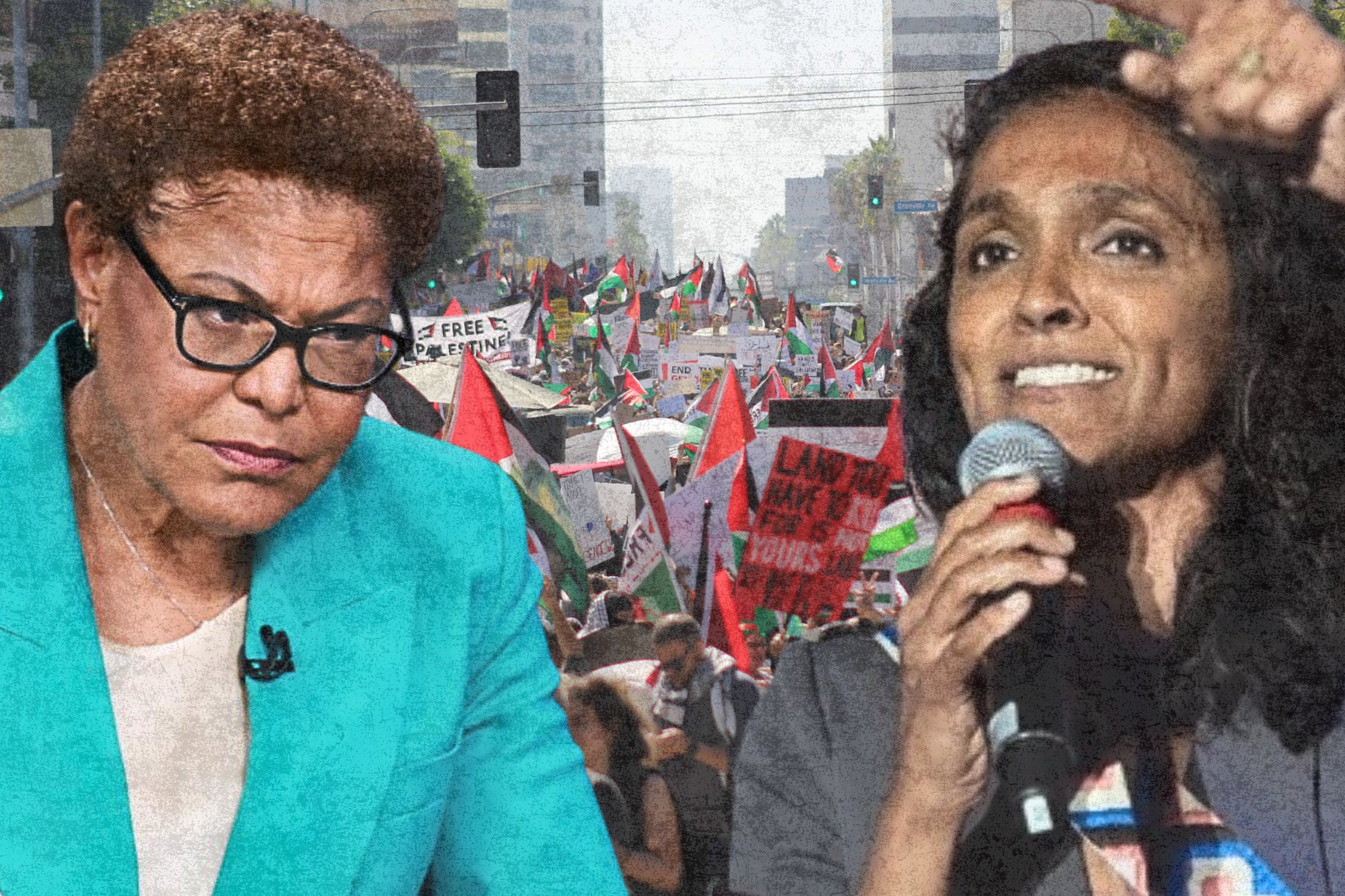
Nithya Raman’s race for the mayor's office in Los Angeles and her subsequent endorsement from DSA LA have led to months of debate, with the culmination being a call from multiple of the organization’s internal organized factions, including Bread and Roses and Springs of Revolution, to expel Raman from DSA or unendorse her weeks before the election. Tempers are flaring on both sides of the discourse, and many see the question of whether to unendorse Raman as a test of the organization’s national leadership, the National Political Committee (NPC), and its relationships with DSA’s local, relatively autonomous and regionally organized chapters.
Raman’s messaging, which includes claims of being “both” a capitalist and a socialist, along with previous acceptance of an endorsement by the Democrats For Israel in 2024, have caused many to push for punitive measures. These flaws do merit criticism, before and after the mayoral election–particularly if Nithya ousts the beleaguered Bass, who is currently trailing the challenger in the polls. Supporters, meanwhile, have pointed to Raman’s continued open identification with both socialism and DSA, along with her significant shift left on Zionism, primarily including commitments made to DSA to stop arms shipments to Israel coming out of LAX and to halt cooperation between the Israeli Defense Force (IDF) and the Los Angeles Police Department. To resolve this debate, it is necessary to take a step back and look at the broader picture of LA. One way or another, the reality is that any attempt to deal with DSA LA’s relationship to Nithya punitively would be short-sighted: it would ignore the material conditions and balance of forces in LA, along with Raman’s own complex role in the struggle in Los Angeles.
As previously reported on both the internal DSA LA debate on the Nithya Raman endorsement and the anti-ICE resistance efforts in the region, the question of whether DSA should endorse Nithya Raman has been primarily litigated in LA through the lens of local conditions and the balance of forces. Participants examined how local formations, including unions like UNITE HERE Local 11, related to Nithya; they also examined what Nithya meant to different communities and social groups in LA. Beyond these questions, however, and outside of the deliberations on tactics between socialists, it is important to look at the bigger picture: we are racing against an existential ecological clock while facing down the most dangerous rise of reactionary politics in nearly a century, and our approach to political challengers should ultimately, from New York and LA to Wisconsin and Florida, emphasize our ability to change the existing political constellation and strengthen the progressive movement as much as possible.
Los Angeles and the greater Southern California area have faced over 650 days of continued fascist violence and intervals of military occupation. At least 15,000 people have been kidnapped, ripped from their lives and families, and deported from the seven counties of Southern California. Thousands are still in concentration camps like Adelanto. Untold tens of thousands have been taken, brutalized, and disappeared. This has been a daily struggle for our humanity.
This is on top of generational reactionary and colonial violence that permeates the region. Los Angeles is the home of white supremacist police gangs–Proud Boys as Sheriffs–let alone a site of historically brutal “triple slavery” of Indigenous, Black, and Chinese people. The same year as the revolutionary Paris Commune, 1871, a racist white settler hate mob murdered 10% of the Chinese population of Los Angeles. Japanese communities on Terminal Island were sent to concentration camps during World War 2; that same island featured as a major site for ICE operations all last year. There were positives, too. This region saw revolutionary armed struggle from the New Communist Movement in the 60s and 70s as part of the anti-Vietnam War and Civil Rights Movements. The Black Panther Party engaged in shootouts with the LAPD, robbed armories, and, along with Chicano revolutionaries, built a web of safe houses and underground organizing to attempt to evade COINTELPRO repression.
California and Los Angeles specifically are a crucial site of contradictions and struggles. Its urban sprawl’s effects on organizing and politics have been excellently detailed in Mike Davis City of Quartz, while the radical militant history analyzed by Gerald Horne’s Armed Struggle is extremely vital for outside organizers and people to accurately get a picture of the Los Angeles we have to struggle within.
Los Angeles, under the zombified neoliberal status quo embodied by Karen Bass, has seen a police force that cooperates with ICE, including sharing data with ICE, and is so vicious that a US district judge has granted journalists a restraining order after LAPD was found to have isolated journalists from public spaces to hit them with rubber bullets and expose them to tear gas.. This is all with the ignored backdrop of constant environmental and community disasters such as the Lineage Fire. The working class of Los Angeles has at least 12% less purchasing power than the rest of the country, has stagnating real wages, and faces a soaring cost of living. Bass’ response to all of this is purely an attempt to put lipstick on a dying pig: selling out LA to corporations and to Trump with no backup plan.
The Democratic Party neoliberal establishment has zero vision for workers and oppressed people in LA. Bass and the rest of them are too busy collecting checks from Chevron, multinational banks, and Airbnb. She and the establishment won’t deal with the suffocating housing crisis or keep fascists from kidnapping us; in fact, Bass and the faction she represents will continue to work with and encourage these finance capitalist oligarchs and fascist paramilitaries. The people of Los Angeles can not continue to maintain this same political paradigm. We have to break out of this cycle of neoliberal austerity and fascist violence.
Raman, as her agenda currently stands, is not the end-all-be-all of socialist candidates. This is no secret. She has voted to increase police funding multiple times, including a bill giving them an extra $300 million on top of their multi-billion-dollar budget. DSA LA publicly censured her for taking an endorsement from a Zionist organization in 2024. Her contentious relationship with the organized left of LA continues to be an obstacle, with many simply not trusting Raman’s commitment to working people in LA.
Raman was the first of DSA LA’s wins on LA City Council in 2020, where they now hold a ⅓ voting bloc. She’s made many mistakes and clearly lacks a radical and revolutionary ideological orientation, and her many faults are well understood by organizers. But the broader Los Angeles community does not find her failure to live up to our expectations to be salient for the immediate decision facing them at the ballot box. On the outside, to the masses, Raman is not Bass, and is known as a socialist because of her connections to DSA and her own statements. Whether we–or even she–likes it or not, she plays the practical role of the left challenger representing socialism against a decadent neoliberal establishment. And that is more than enough for her to act as a destabilizing force against capitalist and neoliberal hegemony, and an intermediate step forward for the left’s political prospects.
To understand this, we must reckon with Nithya’s mixed history, which includes how she has been forced to make many concessions ahead of this campaign to retain the relationship with and support of DSA LA and various other organizations. When seeking endorsement from DSA LA, she was asked by the chapter if she would use her mayorship to “prevent weapons or other tools of war from being shipped ” from Los Angeles to Israel. Raman responded in her questionnaire answers to DSA LA:
Yes, within the authority of the office that I am seeking, I will always uphold the law. I would direct City departments to cooperate fully with investigations, use the City's leverage as landlord over terminal leases and operating agreements to demand compliance, and say so publicly.”
While Nithya has committed to materially fighting LA’s role in the Gaza genocide, Karen Bass has insisted that she continues to “stand unequivocally with Israel.” At a recent controversial forum, she denied the Gaza genocide while Raman took the opposite position, later pointing to consensus by international experts and the recorded targeting of civilian centers, hospitals, and minors by Israel. While her statements have often raised the ire of the left, in the past she has introduced the ceasefire resolution in the LA City Council, and more recently even motioned for investigations into police brutality against Palestinian solidarity protesters at UCLA.
At the same time, Raman’s record on police has been challenged by the slate of her anti-ICE proposals: firing the chief of the LAPD, Jim McDonnell, over his cooperation with ICE, allowing Kenneth Mejia's office to audit the LAPD for sharing data and resources with ICE/DHS, expanding legal aid funds for immigrants and migrants (something Karen Bass has defunded), banning ICE from city property and expanding the sanctuary city ordinance, banning third-party surveillance companies like Flock from sharing data with DHS, prosecuting ICE and federal agents for breaking local laws, and more. She has not reached these positions because she is especially good or especially bad, but because she seeks to represent the growing left-populist wave that has spread across the country this year.
This is why the LAPD’s union has donated nearly $6 million to Karen Bass, despite opposing her in the previous cycle. They have seen that the game has changed. Raman’s proposals are a laundry list of what the progressive masses of LA have been demanding city governments in the county do to protect our communities for years. Local police leadership has to be fired. We should ban them from all city property and resources. And, ultimately, we must aggressively prosecute them. We can’t let fascist violence continue, and, within LA, within this mayoral election, this is what advancing that struggle looks like. The police know Nithya Raman–no matter what her personal characteristics are–is the canary in the coal mine of the revolutionary wave that is slowly going global.
Within DSA, the debate rages over whether Resolution R22: “For a Fighting Anti-Zionist DSA”, passed by DSA’s convention in 2025, applies to Nithya Raman. The thrust of the debate centers around to what degree Nithya Raman’s commitments regarding anti-Zionism are sufficient, and whether or not DSA LA’s failure to extract explicit commitments around the Boycott, Divestment, Sanction (BDS) movement rather than her general commitment to halt arms shipments and cooperation with Israel should invalidate the chapter’s endorsement. As an undercurrent to these discussions, and the real source for a lot of opposition to Raman’s endorsement, is a suspicion that her commitments are inauthentic and only the product of opportunism on her part after DSA LA’s pressure.
But it is difficult, in the context of the demands committed to and DSA LA’s own censure and engagement with Raman, to call her a supporter of Zionism. Would a Zionist push for an arms embargo on Israel? Would a Zionist push for ceasefire resolutions and to punish cops brutalizing students at Palestinian student encampments–before R22 was promulgated and passed? Nithya Raman has routinely said publicly and privately that she supports organizations and people engaging in BDS and is proposing blocking military aid to Israel from the largest container port in the US and one of the most central airports in the world. In what world is pushing for an arms embargo not a material advancement of the policy of BDS?
Raman is not perfect. But neither is she, at this stage, in this question of the mayorship of Los Angeles, a political enemy. The task of the left when engaging with politicians like Raman is to use her challenger status and progressive politics to expand the strength of socialism in general, and to criticize and continue to push her left as much as possible. This is the only way we can continue to fight and strengthen the working class while maintaining a clear and principled politics. We cannot either retreat from challenging the existing political establishment, nor be afraid to use every opportunity to continue pushing left and advancing our own politics.
This much is clear when one examines how the right is reacting to Nithya. Raman’s critics from the broader public and ruling class sing a quite different tune than the critics from within DSA. They don’t say she is a Zionist, and they certainly don’t paint her as a betrayer of socialism. No–the MAGA right screams at Nithya Raman, accusing her of being a “DSA Jihadi” for defending BDS and rightfully calling what Israel is doing to Palestine a “genocide.” Fascists see Raman as an “antizionist radical” while seeing Bass as a fellow Zionist who won’t do anything to impede the United States’ relationship with Israel. LAPD is also making it clear which candidate they believe to be the pro-cop one by donating between $3 million and $6.7 million to Bass’ campaign, along with $4 million from Airbnb–so much for any increase in public housing or rent freezes if Bass wins again.
Then there is, of course, Karen Bass herself. She is being investigated for multiple pay-to-play schemes and alleged fraud, including with Airbnb, as they actively lobby the city to change its rental laws. She is willing to not only politically but literally sell out to capital. Bass represents the quintessential corrupt neoliberal establishment politician. Raman represents something else, something new. This is why progressive Los Angelenos, and why the majority of Los Angelenos, are rallying behind the radical left political candidate for mayor. Her campaign is a historical attack by the working class on the establishment, not produced either by either organized intention or spontaneous mass movement. She is the rearguard of a historical phase. She is not a permanent fixture, but the candidate of this race in this place.
Los Angeles has seen rising class consciousness and struggle for decades, with an acute increase in recent years since the George Floyd Uprising. The Day Without an Immigrant May Day protest of 2006 saw half a million people march in the streets of LA. Labor here has become the vanguard nationally; half of the major strikes of 2023, for example, were in California, centered in Los Angeles. The wave of Palestine solidarity student encampments from UCLA, USC, Long Beach State, and more all saw intense physical struggle against fascist elements. And, as previously mentioned, the anti-ICE struggle has brought thousands of people into community organizing and defense who were never engaged politically before. Nithya Raman is a part of that general rise of our movement, and today is even representative of the tip of the electoral spear. If she is successful, the possibilities for further and more advanced struggle will open up to us.
The reality is our struggle and movement is eclectic and uneven. The people are eclectic. DSA is a reflection of that. To attempt to resolve the contradictions of popular struggle through bureaucratic maneuver, such as overturning the decision of DSA LA through a national committee, would be counterproductive. To do so on the explicit basis of ideological agreement, especially in a case such as Raman where the shoe does not fit, where she has campaigned as an open socialist and made commitments in dialogue with DSA, would be disastrous for the organization's integrity and ability to posit itself as the vanguard of the mass struggle.
As our movement progresses, there will be various manifestations of that advancement. The rise of DSA electeds is one of those manifestations of popular unrest. It is not anything more nor anything less. The people we elect are not the ultimate representatives of socialism; they are representatives of the fact that the working class in the United States is being driven to socialism by the demands of their own daily lives. They are representatives of the fact that this population is expressing its energies in the ways it is most comfortable with as it stumbles forward. We have to work through the contradictions of our movement and how it manifests, and refuse to be cowards and shrink back into irrelevance. The masses demand that we are relevant. They demand we take up the struggle against the status quo and rising fascism. These electoral advancements are happening in conjunction with the rise of militant radicalism. The popular unrest and rage are manifesting in Zohran Mamdani, AOC, and Nithya Raman, just as much as they manifest in our rapid response networks, mutual aid networks, and other more radical actions. We have to understand how these are connected tactics in a grand revolutionary strategy, even if we, as one-sided participants in this network, may value more or less certain or other elements of the mass struggle.
Raman represents and actively is a destabilizing force for neoliberalism and capitalism. Her victory–not by itself, but in concert with the mass struggle, as a moment the mass struggle will overcome and progress beyond—advances our class towards greater levels of capacity, consciousness, and training. We know Raman isn’t the revolution, but her, and more like her in the short-term winning, act as small tears in the capitalist fabric of society. We have to utilize people like Raman, not be terrified of the contradictions that come with becoming an increasingly meaningful and powerful social force that attracts wider and wider swathes of society to our cause, and puts a socialist purview over more and more diverse events.
We have to understand how these elements of our struggle and movement can critically support each other as we grasp in the darkness for the pathway to revolution. None of us have the magic answers for that. But we know that a diversity of tactics, expanding the radical mass base, and building organized coalitions are necessities at this current juncture. Raman will surely disappoint, as all individual people do. But she’s shown an ideological and personal progression, and is a key current manifestation of the people’s rising political consciousness in Los Angeles. We can not reject this moment, or the people will reject us, and rightly so.