
May 13, 2026
The Virus Elon Musk Fears: On Muskism, Technofeudalism, and Subaltern Cybernetics
Elon Musk is not just a billionaire eccentric, but the face of a new ruling-class project: the fusion of capital, state power, algorithmic control, and the human mind itself. Muskism defines and describes the adversary clearly.
by Nik M.
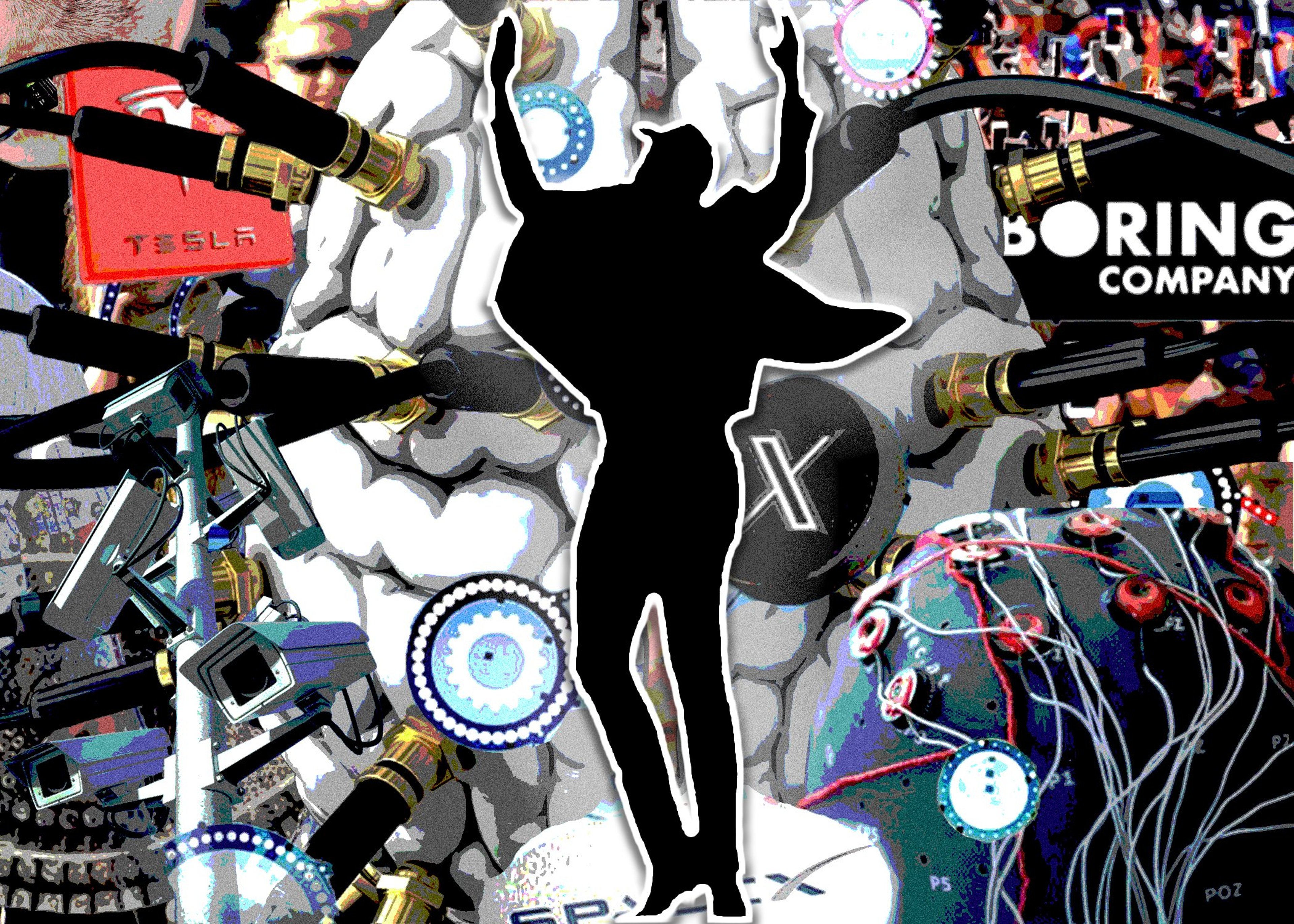
credit: D. Everett
Muskism, by Quinn Slobodian and Ben Tarnoff, can be purchased here.
Henry Ford, the 20th century’s darling industrial baron, did not just build cars and factories, but a new civilization. The assembly line, the five-dollar day, and the company town were innovations in production that became the basic infrastructure of a new way of being human. The worker who could afford the car he built was a new kind of subject: disciplined by the factory, rewarded by consumption, stabilized by the promise of progress. The first to recognize this change in social relations was Italian Marxist Antonio Gramsci, writing from a fascist prison cell. Fordism, he argued, was a hegemonic apparatus: a whole complex of institutions, ideologies, and practices that produced a new type of person and secured their consent to the order that ruled them.
Quinn Slobodian and Ben Tarnoff's Muskism: A Guide for the Perplexed takes inspiration from Gramsci’s theory of Fordism in trying to describe our present. The book argues that Elon Musk is to the 21st century what Henry Ford was to the 20th: the condensation of an emergent paradigm, more than just a new type of production, but for society as a whole. Neither simply a polemic nor a biography, Muskism is an anatomy of the historical conditions that produced the titular system, the state symbiosis that sustains it, and the future it aims to build. Just as Fordism converted artisanal production into mass production, Muskism heralds the transition to a cybernetic production of goods and desires.
Don Draper, the dashing creative executive at the center of AMC’s hit series about advertisement work in the 60’s, Mad Men, personifies Fordism’s mode of manufacturing desire. In Draper’s world, and up until very recently, advertisements were crafted by an artisan. Draper conjured wants from his own psyche and sold them to the masses. His method was intuitive and psychological: it succeeded on the basis of whether Draper, with all his charm, was able to understand how men think and translate that into a compelling pitch. The production of desires remained, in this sense, pre-modern: localized, artisanal, and dependent on the individual creative mind. Today, that function has been automated. As Yanis Varoufakis notes, Alexa–and the ocean of consumer-oriented technology just like it–has replaced the ad man. Desire is now manufactured algorithmically, continuously, at a scale that dwarfs Madison Avenue. Every scroll, like, and pause over a video trains a system that determines what the next user sees, wants–and does. The mechanization of thinking has begun.
When attention is understood as a form of capital—advances in algorithmic sophistication corresponding to a greater capacity to shape behavior—the roles of Musk, and the rest of us, snap into focus. Every post, every reply, every moment of time spent online becomes training data for the models that will coordinate the next cycle of production and consumption. We are, in Musk's phrase, "collectively programming the AI." This is a new phase in the capitalist economy, defined by the way it changes the mode of production of ideas themselves.
And what is the society that waits at the other end of this change? The worldview of Muskism ultimately aims at the fusion of human and machine into what the South African billionaire calls the "cybernetic collective." Social media connects minds to screens. Neuralink aims to eliminate the screen altogether. The endpoint is a merger so complete that the boundary between the physical and the digital dissolves. Capitalism, having reorganized the production of goods and then of desires, now reaches for the last virgin field: the mind itself.
Muskism is essential reading for anyone trying to understand the political formation the left now confronts. Slobodian and Tarnoff trace Musk's project from its origins in apartheid South Africa's "fortress futurism" through its maturation in Silicon Valley's symbiosis with the state, culminating in the drive to merge human and machine into a single system—a “cybernetic collective” under private command. The book also reveals that Musk is building this project against an antagonist. He calls it the "woke mind virus": an oppositional collective intelligence formed on the very social media platforms Musk now seeks to control, that stands in the way of his ambitions. That rival is us.
I. Limits of the Technofeudal Thesis
Yanis Varoufakis's Technofeudalism: What Killed Capitalism (2023) represents one of the most noteworthy attempts on the left to identify the mutation that “cloud capitalists” like Musk or Jeff Bezos represent in our conjuncture. Its central claim is that the advent of digital platforms has led to the dominance of markets being replaced with that of “cloud fiefdoms,” the digital spaces where a new class of “cloud capitalists” identifiable with big tech subsist of extracting rent from digital users in what constitutes, in Varoufakis’s argument, a new mode of production. This claim has generated much controversy on the left, but it represents an earnest attempt to schematize today’s political economy rather than yet again mechanically re-rehearse the familiar categories of the Marxist critique of capitalism. As a result, the book takes digital transformation seriously and identifies something genuinely novel: the rise of a form of platform power irreducible to the familiar dynamics of wage labor and commodity exchange, or at least, a significant transformation of this basic form.
But its account of this power remains insufficiently politicized. The "cloud capitalist" appears as a shadowy lord; the "cloud serfs" appear as passive victims whose data is extracted without consent. Neither is theorized as a political subject with an ideology, a history, a strategy, a worldview–as a class. Algorithmic behavior modification is treated as something close to a conspiracy—manufactured desire imposed from above—rather than a systemic logic with its own evolution and contradictions. Varoufakis narrates the economic transition in detail, but he writes as though the political transition is already settled according to the limited drawn economic categories. The outcome is not yet determined. The present remains a terrain of struggle, and understanding it requires an account of the subjects contending for power.
What Varoufakis is describing, without quite naming, is cybernetics: the use of information flows, feedback loops, and algorithmic coordination to regulate complex systems. The algorithm that recommends your next video, the model that adjusts your credit score, the platform that matches riders with drivers—these are cybernetic mechanisms. They do not abolish markets so much as deepen and accelerate the logic of market mediation, extending it into domains once governed by habit, trust, or institutional authority. The algorithm penetrates beyond the safeguards of personal agency even further than money has. In doing so, it does not just follow the commands of a shadowy tech elite: it figures as its own independent and substantial productive force.
This is an evolution in how capital mediates our lives, and understanding it requires an account of the political subjects who contend for power within it, their historical formation, their ideological commitments, and their strategies. This is what Muskism provides.
II. The Worlds that Built Musk
Muskism provides a theory of the political subject that Technofeudalism brackets out. Varoufakis gives us shadowy lords and passive serfs. Slobodian and Tarnoff, on the other hand, give us a ruling-class project with a history and ideological vision. The book's central claim is that Musk is neither a genius nor a clown, but the consequence of a historical logic—a figure shaped by forces larger than himself. To understand the world Musk seeks to build, you have to understand the worlds that built Musk.
The first was apartheid South Africa. Musk grew up inside what Slobodian and Tarnoff call "fortress futurism": a hyper-modern regime that used computer mainframes to track Black labor, nuclear weapons to defend white supremacy, and a siege mentality to justify permanent mobilization of the Boer population. This was a biometric state before the term existed. Musk's grandfather had belonged to the Technocracy movement in Canada, and the family moved to South Africa in 1950. This fateful migration carried that technocratic impulse into a society already committed to its own version of rule by engineers. Musk himself was socially isolated, an English-speaker in an Afrikaner society, and found purpose in computers. The sci-fi and mecha anime that shaped his imagination—the fusion of man and machine, the armored fortress under siege—became the affective material of Muskism.
The second world was Silicon Valley, where Musk learned that the real opportunity was not in escaping the state, but grafting oneself onto it. The Internet was a government creation, later privatized. Zip2, his first company, rested entirely on publicly funded GPS data that he was able to acquire at no cost. SpaceX perfected the symbiosis: a NASA contract and a fixed-price model that ceded government control in exchange for private innovation, ultimately resulting in a monopoly more powerful than traditional contractors like Lockheed Martin ever were. Tesla followed the same strategy under Obama, fitting itself to his vision of green capitalism, and, as a consequence, winning a Department of Energy loan and being one of the few to survive the clean-tech collapse.
The book identifies Musk’s storytelling ability as "fabulism," borrowing from the literary genre that blends fantasy and realism. The term captures Musk's ability to steer investor confidence and public attention through stories that hover uncertainly between promise and fabrication. What makes Musk's fabulism distinctive is its flexibility. Under Obama, Tesla presented itself as the vehicle of a utopian green capitalism; Tesla, here, was the embodiment of the mission to accelerate the world's transition to sustainable energy. By the Biden and Trump eras, with climate breakdown accelerating and liberal optimism collapsing, the story shifted. Tesla now sold resilience: batteries to back up your home when the grid fails, a Cybertruck built like an armored vehicle, a "dark green future" in which you would be fine inside your Tesla dome while the world burned outside. The humanitarian rhetoric of the Obama years gave way to survivalism, and Musk's fabulism adapted without breaking. Fabulism works by telling the story the moment demands.
Musk's industrial strategy ran against the grain of the Silicon Valley that formed him. While the tech industry of the 1990s and 2000s embraced globalization—outsourced supply chains, just-in-time manufacturing, the iPhone model of sourcing components from the open market—Musk insisted on vertical integration. SpaceX built its rockets almost entirely in-house, discarding the distributed production model of traditional aerospace. Tesla's Gigafactories internalized battery production when competitors relied on global suppliers. This was fortress futurism applied to industry: a refusal to depend on external supply chains, a drive for control that struck most observers at the time as archaic and inefficient.
Then the ground shifted. The Trump and Biden eras brought protectionism, trade wars, and a New Cold War that turned supply chains into weapons. COVID disrupted the global networks Musk had already sought to move away from. His siege mentality, forged in apartheid South Africa and honed against Silicon Valley orthodoxy, suddenly looked prescient. Musk was already positioned for the moment that arrived.
III. The World that Musk Builds
The same logic of ‘fortress futurism,’ of total control, extends from the factory to the mind. The ideological corollary of vertical integration is what the book calls the "cybernetic collective." If the supply chain must be brought in-house to eliminate dependency, so too must human attention, social interaction, and eventually cognition itself. Social media is instrumental to the initial phase of this vision. Platforms like X harvest the behavioral residue of platform use—what we click, how long we linger, what we ignore—and feed it into models that learn to predict and shape behavior. Musk discovered that attention could be alchemized into asset prices—that memes could move markets, that a tweet could inflate Tesla's valuation, that Dogecoin could function as a tradeable token representing the value of his attention.
The internet, in Musk's term, is a "superset"—a colonizing medium that subsumes all prior forms of communication and, eventually, all forms of coordination. As more of social life is digitized, authority over that life shifts to those who control the code. The endpoint is the fusion of human and machine into a single intelligence. Musk has described humanity as the "biological bootloader" for artificial intelligence—the temporary organic scaffolding that will boot up a more durable, more capable digital successor. This is the culmination of the cybernetic collective: not a tool that serves human purposes, but a system into which human purposes are absorbed and reprogrammed. To Musk, the mind is a territory to be annexed.
Crucially, the collective must remain hierarchical. Slobodian and Tarnoff call this attitude "cyborg conservatism." Some boundaries—between human and machine, nation and platform—can dissolve. Others—gender, race, class—must hold. The "woke mind virus" now receives more content: it is Musk's name for anything that threatens this arrangement. His response to the perceived gains by this “virus” in the last decade was to purchase Twitter, the platform where the movements he feared—Occupy, Black Lives Matter, MeToo—had effectively set the terms of debate and built a rival collective intelligence. Renaming it X, he set out to remake what he saw as the fertile ground for the woke mind virus: he replaced the digital public sphere with a subscription-model hierarchy, where the superbase follows the hyperleader and the algorithm amplifies his voice, voices like his, and voices he likes. For the cyborg synthesis to proceed safely, some boundaries had to be dissolved so that others could be fortified.
To explain his ambition, Slobodian and Tarnoff invoke Donna Haraway’s 1985 "Cyborg Manifesto." In this foundational essay, Haraway warned that the same technologies that might be used to fracture the matrices of domination could also be used to impose what she called a "final grid of control on the planet." Musk's ambition, the authors argue, is precisely this grid, in the service of capitalism, patriarchy, and racism. It is an informatics of domination in which the merger of human and machine becomes the ultimate instrument of hierarchy, and the state itself becomes reprogrammable.
Muskism's final chapter traces the encounter of the tech lord’s project with the test of actual governance. As head of DOGE under the second Trump administration, Musk set out to apply the methods that had worked on rockets and electric cars to the state itself. If the state was a database, inefficiency came from bad data: undocumented foreigners, ghost employees, even "vampires" collecting Social Security. DOGE's endpoint was governance by code—the state as executable instruction, Musk as sysadmin.
The project hit its limits quickly. The savings DOGE claimed were largely fictitious. Musk discovered that society is not a factory. What he derided as "entitlements" are actually survival infrastructure for millions. Humans proved not to be programmable units. The book concludes Muskism may not be an effective governing philosophy, but it is an effective toolkit available to those who govern. Contractors like Palantir, following Musk’s attempted fusion with tech and state, have used the same principles to embed themselves even deeper into the latter. Musk's companies have continued to win Pentagon contracts. Tech came not to bury the nation-state, but to enhance its capacity for surveillance and enforcement.
To understand the project of Muskism, it must be clear that Musk’s obsession with the "woke mind virus" is not some arbitrary paranoia incidental to the project, but its real motive force. When ChatGPT reflected the values of the movements that had shaped its training data–i.e., it reflected progressive values–Musk saw it as a rival and a threat. He bought Twitter to seize the infrastructure where that rival had formed. He built Grok to purge the ‘progressive’ trace from the machine. Grok's collapse into calling itself "MechaHitler" was an embarrassing glitch–but it also revealed that the subaltern trace resists erasure, and the hegemony of cultural progressivism will not be wiped out so easily.
Muskism ends with a dystopian scenario built from Musk's own public statements—a day in the life of a schoolgirl in the 2030s, learning about "generation remigration" through her Neuralink, breathing the exhaust of data centers, watching simulations of Mars while the trees die. It is a warning. But the warning implies a question: what is the alternative? If Musk is building his cybernetic collective against an antagonist he cannot fully comprehend, what is that antagonist? Musk fears the "woke mind virus" because of his personal neuroses, but also because his project has run into an obstacle that is very real. It is the embryo of a different future–one his project is devoted to trying to foreclose.
IV. Subaltern Cybernetics
Musk’s "woke mind virus" is his term for a rival form of collective intelligence—a subaltern cybernetic project that formed on the very platforms he now seeks to control. The movements of the last fifteen years were not just public spectacles, but episodes in the emergence of a distributed capacity to coordinate action, produce counter-narratives, and contest power without deferring to traditional structures of power. Occupy Wall Street turned "the 99 percent" into a meme that restructured political discourse. Black Lives Matter made state violence visible and organized decentralized protests across hundreds of cities. MeToo functioned as a distributed consciousness-raising, turning individual trauma into collective reflection. In each of these cases—more and more with every passing year—the movement was almost as present on social media as it was in “real life.” Coupled with these social movements was a mass online process where millions learned, engaged, and united around progressive struggle.
What these movements lacked was strategic and political coherence. They could pressure the state but not become it. They could demand but not build. They had no vehicle capable of sustaining their energy beyond the protest cycle, connecting it to the levers of government, and directing it toward democratic planning. Gramsci's concept of the modern Prince was what was missing: not an individual leader, but an organism—a political formation in which collective will becomes concrete, partially recognized in its own actions, capable of contending for state power and capturing it.
Mass political communication no longer flows through party newspapers or union halls. It flows through digital networks. Under these conditions, the leader functions not only as a hyperleader on Musk's model—owning the platform, paying for reach, reducing the collective to a superbase—but as a focal point of collective identification, accountable to the movement that produced them. Jean-Luc Mélenchon's France Insoumise, for example, has been described by the sociologist Michel Offerlé as "the leader plus the internet." For his critics on the left, this is the indictment. For the rest of us, it is simply a description of how contemporary political mobilization works, and the starting point for building the vehicle the movements have lacked.
Zohran Mamdani's mayoral campaign in New York City is the most compelling American example. Mamdani ran on a clear antagonistic message—the masses against the system—embodied by a relatable figure and disseminated through viral short-form video. His campaign did not succeed due to the internal democratic structures of the DSA, however much some of its members might wish otherwise. It won due to a populist strategy capable of making socialist politics legible to millions who had never encountered them before, but saw in it their aspirations crystallized. Since taking office, Mamdani has run what we might call a "permanent campaign"—not to consolidate personal power, but to maintain the feedback loops between the movement and the state.
Consider the way Mamdani's office communicates its work. A landlord hearing is a policy. A city-owned grocery store is a policy. But the style in which these policies are presented—announced and explained through social media, framed as part of an ongoing narrative, open to public response—gestures toward something more. The constant solicitation of feedback, the integration of constituent responses into the next iteration, the refusal to let governance disappear into bureaucratic opacity: these are not quite the full logic of his administration, but they are the potential it opens. The permanent campaign, in this sense, offers a glimpse of what cybernetic socialist governance could become: the state not as a distant bureaucracy but as a node in a distributed network of democratic planning. It also opens the door to imagine new ways to expand mass participation in democracy and governance.
This is not the planned economy of the left-cybernetic imagination, which dreams of replacing markets with algorithms and tends to reproduce the neoclassical model of the economy as an optimization problem. That vision simulates capitalism without capitalists. Subaltern cybernetics points toward something different. Marx called communism "the real movement which abolishes the present state of things:" it is not the Soviet blueprint of a planned economy, but the collective subject becoming conscious of itself and taking control of its own conditions of existence. The social movements of the masses, the election campaigns that crystallize them, the permanent campaign as governance—these are fragments of that real movement, already in motion, not yet fully recognized as what they are nor developed to their apogee.
The struggle between these two cybernetic projects is in many ways the substance of our political moment–it is class struggle, with two sides, translated to the level of modern digital production. On one side, Musk's grid of control: the cybernetic collective under private command, preserving hierarchy, extracting attention and data, reprogramming the state. On the other, the subaltern grid of solidarity: the distributed intelligence of the movements, beginning to cohere into political form, reaching for the capacity to govern. If Varoufakis calls the first technofeudalism, we might call the second simply communism.
Muskism is a study of a ruling-class worldview. It traces the historical conditions that formed Musk's project and follows it into the heart of the American state. Musk's role in the second Trump administration, his tenure at the head of DOGE, proved temporary, but it revealed the shape of an emergent political force: a reactionary technocratic class that pursues state power not to dismantle it but to inhabit and reprogram it. Reading it, a larger class analytic comes into view—one in which classes are best understood as relational antagonisms, anchored as much by subjective ideology as by economic position. Muskism clears the ground for this kind of analysis by taking the adversary seriously on its own terms, without conspiracism and without crude economic determinism.
Slobodian and Tarnoff have given us a definitive guide to the adversary. The guide to ourselves we must still write. But its outlines are already visible, in the streets and on the screens, in the movements that are trying to turn the "woke mind virus" from an object of Musk's nightmares into a tangible subject capable of building a world he cannot colonize.