
Jul 3, 2026
We Must Fight For a Socialist Project 2029: The Manifesto
The Democratic establishment has shown that it doesn’t represent the American people. What is needed is decisive change through the executive.
by J. Ryder and T. E. Moon
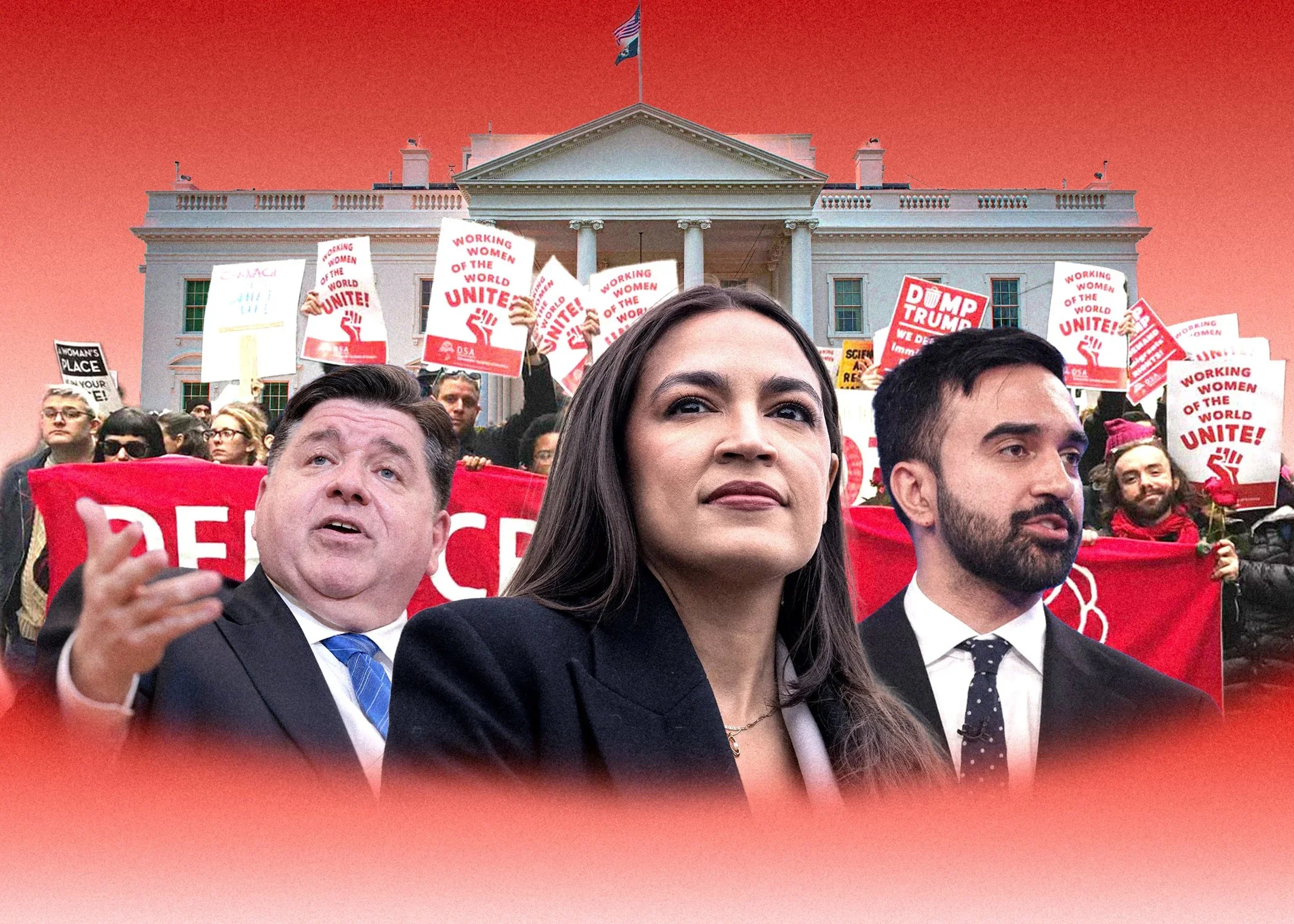
Credit: D Everett
Manifesto
When Illinois Governor J.B. Pritzker recently declared to the New York Times that “there should be a ‘Project 2029’ for Democrats,” he did not do so just to prod his Republican colleagues. Pritzker’s proposition for the Democrats to concoct their own version of the GOP and Heritage Foundation's ‘Project 2025’ inadvertently exposed a contradiction that his party has long deferred: one in which democracy itself is claimed as a guiding tenet, yet a vision for its actualization is only perpetually deferred. It seems that this contradiction has come to a head, as the deferral of a solution of this sort amongst establishment leaders has gone from an abstract problem to a pressing one, especially as the critical 2028 moment looms ever nearer. As June of 2026 has come to a close, reports have begun to trickle in that the Democratic Establishment is meeting Pritzker's call to respond to Trump's detailed fascist war plans and efforts at constructing a rabid nationalist state. Their answer? Some limp new regulations coalesced around what former Joe Biden and Cory Booker advisor, Chad Maisal, is calling a “Project 2029 for America”.
In the face of a fascist onslaught, the Democrats’ solution has only so far mustered up the most meager policy initiatives, such as banning children from social media—it is difficult to find a better way to encapsulate the total failure of Democratic political leadership to provide direction. It is a political formation that is both politically and morally bankrupt.
A true people’s Project 2029 must be decisive. It will take more than repealing MAGA’s executive orders and returning to business-as-usual neoliberalism if we want to extinguish fascism as it exists in the United States today. American politics doesn’t need yet another technocratic fix— we need to bring down the hammer of the popular will. We must create a forwardly socialist alternative to the liberal conception of Project 2029, one that can defeat fascism at the ballot box, contest its hegemony over American political institutions, and restructure our domestic governance structures to be more fundamentally transparent and democratic.
The neoliberal conception of such a project as it is being put forward is no accident. The Democratic Party does not lack credentials or deep pockets, but it does lack the capability to articulate a positive vision of a better future. The very coherence of the party depends on a balancing act of reconciling what are ultimately irreconcilable interests: capital and labor, democracy and empire, welfare and accumulation, the oligarchy and the people—without ever resolving any of them, aiming instead to co-opt and demobilize the progressive energy of its own supporters. These do-nothing Democrats are not leaders who bring the people forward, but rather the representatives of special interests and personal careerism. This establishment has only managed the decline of the current social order while suppressing the vision and energy for a better world among its base. Such a phenomenon has been inspiringly contested, with the momentum behind the ongoing socialist insurgency only growing day by day. The party’s attempt at mediating these irreconcilable antagonisms is becoming an impossible task. It has survived this long, but it has become clear that it cannot and will not in this form for much longer.
A party project that genuinely embodies the spirit and politics of the people who support it would require an entire upending of the Democratic establishment’s political methods. But that the Democratic establishment is so oppositional to even the most minor popular reform means that this insufficiency is an Achilles’ heel we must capitalize on. It is exactly a consolidated, ideological campaign from the left flank in the lead-up to the looming 2028 presidential elections that could bring these contradictions to the fore and fracture the very coalition the current Democratic Party leadership is desperately trying to hold together. It would unleash the energy of the people into an electoral surge against the far-right and for socialism in order to make meaningful and lasting change.
This is why we cannot let the question of a ‘Project 2029’ be monopolized by agents of internal reform and incrementalism, an initiative to return to business-as-usual politics, as the Democratic establishment (in the image of Pritzker or Booker, of all people) would prefer. Such an endeavor, in the hands of these people, would be dead on arrival. There would be no need for the far-right to contest the election and attempt another Jan. 6—the visionless Democratic establishment will hand the election to the far-right on a silver platter, just as it did in 2024. Our Project 2029 is something that must be organized and burst onto the scene, developed with the tasks of the moment and the real needs of the millions in mind. In its content, it means a shift in the very conditions through which the current political system, the constant and draining tug-of-war of the current political duopoly, is reproduced, changing it forever.
This is not the first time something like this has happened in American history. The far-right’s transformation of the GOP in the wake of Obama succinctly represented a similar phenomenon. Trump and the ideological consolidation of the Republican Party were both the result of a sustained internal insurgency, a “tea-partying” of the GOP, that displaced existing leadership, reoriented its priorities, and imposed a new ideological coherence on the party. Figures like Charlie Kirk, Ben Shapiro, and Tucker Carlson, along with their accompanying brain trusts and ideological institutions, concretized what were previously dispersed demands of the Tea Party by consolidating tactical nodes in a broader network that aligned media, youth organizations, donor influence, and electoral strategy toward a common end. By the time Trump formalized this shift electorally, the terrain had already been transformed in the image of the new right-populism.
An analogous process on the left cannot be a simple mirror image, but the strategic lesson remains. The Democratic Party will not be reshaped by appeals to its better instincts, nor by isolated electoral successes that leave its internal balance of forces unchanged. It will be reshaped by a coordinated effort to build a faction that is both large enough to matter and united enough to act, and that is cohered by an alternative vision of the state and the future of American society. This means treating primaries not as occasional opportunities to win ground but as a systematic arena of struggle; it means developing candidates who are not merely individually progressive but collectively aligned; it means constructing an internal bloc capable of forcing votes, shaping agendas, and making the cost of exclusion higher than the cost of concession.
The Democratic Socialists of America (DSA), allied with the broader progressive constellation of popular movementism, represents the only existing vehicle through which such a project can be pursued. Their significance lies not simply in their size or visibility but in their potential to function as a bridge between mass politics and institutional intervention. Socialism is the only political faction in the United States today that represents the authentic will of the people. If this contingent finds itself isolated by fragmented campaigns, myopic internal disputes, and factionalism, it will reproduce the very marginality we need to overcome. If, however, we orient toward the mission of deliberately contesting the Democratic establishment and the decaying tradition of neoliberalism, we will be able to show, directly, the pressing necessity for socialism in the United States today.
The ultimate function of ‘Project 2029’ should therefore not be to imagine a future moment of top-down reform, but a process of internal ideological transformation driven by organized pressure. Ultimately, Project 2029 is a weapon. It is the sign of our independent radicalism, and in this capacity, it is a potent ideological weapon against the establishment. To carry out a transformative ‘Project 2029’ means to recognize that the figures who currently define the party- the milieu of Pritzker, Hakeem Jeffries, and Chuck Schumer do not simply hold power by default, but because no opposing bloc with a consolidated vision has yet been sufficiently large and bold enough to displace them. The establishment will never fail on its own. It must always be replaced, and it must be replaced by putting forward a direct political challenge.
What specifies ‘Project 2029’ is already in the name: it is, in a large sense, a response to the drastic way the far-right has altered modern politics through ‘Project 2025.’ Trump has run roughshod over American institutions and left a trail of destruction and chaos in his wake. The consolidation of executive authority under Trump, the aggressive politicization of the federal apparatus, and the exposure of the anti-democratic structures that underwrite American governance have created a terrain that cannot simply be reversed by attempting to restore an older status quo. Any serious project must reckon with these developments—not by retreating from them, but by turning them against their intended function. We cannot return to any allegedly better nostalgic past, but we know what we must do to right the ship in the current day.
The first dimension of such a project, therefore, must be the unapologetic utilization of the now expanded executive powers. Under Trump, the elaboration of presidential authority over the administrative state, the normalization of sweeping executive orders, and the weakening of procedural constraints have altered the balance between branches of government. The instinct within the establishment wing of the Democratic Party has been to treat these developments as aberrations to be corrected, to restore a prior equilibrium in which executive action was more constrained and managerial. But this misunderstands how political power has existed throughout history. The rules of the game will not enforce themselves; they must be enforced. This instinct to return to an era of decorum, law, and order is itself a result of its own bourgeois complacency that must be challenged to move forward. The concentration of power has already occurred under Trump; the question is now what we must do in turn. Any serious project of this nature must center on ushering in an era that not only seeks to undo the residual aftermath of Trump’s term but also seeks to put forward a program that recognizes the shifts in the structure of the American state and uses executive powers to facilitate sweeping changes to fit the demands of the people at this critical conjuncture.
Is a socialist project with these aims undemocratic, as our friends at the Atlantic have so boldly claimed? We must resoundingly answer: No! This is what democracy looks like. The concentration of power in the executive is the product of the rise of the far-right as well as the constraints embedded in the American state structure itself, such as the electoral college. To forge a more democratic consensus, these powers cannot be temporarily suppressed until the next fascist comes along to weaponize them—we must reshape our institutions to fit the modern day and modern values.
A project of this nature would treat the executive apparatus not as a static object for the mediation of existing arrangements but as an instrument for their rapid transformation. This would entail the immediate deployment of executive orders to reorganize key sectors of the economy, to expand and defend civil liberties beyond what undemocratic elements of the legislative compromise would permit, and to dismantle regulatory frameworks that entrench existing reactionary hierarchies; positively, it would use the power of the executive to support a socialist federal agenda and draw as many of the American people into participation in political deliberation (i.e., political struggle) as possible. It would mean campaigning and governing in a manner that assumes conflict rather than consensus, using the capacities of the state to impose changes that cannot be negotiated into existence.
Such an approach does not resolve the contradictions of executive overreach, but it does intensify them, challenge them, and ultimately force a confrontation over the nature of the limits of the current structure of the State itself.
The second dimension follows from the first: the reconstitution of the state’s personnel. The right has demonstrated that control over the machinery of governance is not an abstract question but a desperately concrete one. Agencies, courts, and federal bureaucracies are not neutral instruments; they are configured ideologically by the individuals who occupy them and the networks that sustain them. This sweeping replacement of personnel, including the mass firings and layoffs of the Trump administration, has served not only to allow the right to usher in a series of reactionary reforms but also to platform their worldview at every site of struggle, bolstering their capabilities in every locale and state function. It has been an intentional ideological coup of the state apparatus.
The Democratic Party has historically approached this terrain with caution, seeking to balance appointments in a way that could maintain ‘institutional legitimacy’ and bipartisan cooperation. This strategy presumes that the existing state can function as a neutral managerial arbiter; it cannot. The state exists as a classed, partisan instrument of political influence and hegemony, the direction of which is downstream of its operators; this should be brought to the fore. Every person laid off or fired by the Trump administration should be re-offered their jobs—and the ranks of the government should swell with socialists and fundamentally pro-people administrators.
A “Project 2029” adequate for the moment would force the Democrats to abandon the illusion that democratic governance can proceed through accommodation with forces fundamentally opposed to its direction. It would require the systematic replacement of federally appointed officials, judges, and administrators with individuals committed to a transformative Democratic Socialist agenda. This is not a question of partisanship in the narrow sense, but of recognizing that the state itself is one of many arenas in which the class struggle is carried out. To leave its composition unchanged is to ensure that any attempt at transformation will be mediated, diluted, or blocked by those invested in maintaining the status quo.
The third dimension addresses the structurally undemocratic constraints that make even these measures insufficient if left intact. The United States is governed through a set of institutions and policy frameworks that systematically subvert the democratic will in our country: the Electoral College, the Supreme Court, systematic gerrymandering, and a range of procedural mechanisms that allow fascist minority rule to persist. These are not incidental features; they are constitutive of the current political order. They ensure that any genuine expression of the people can be checked, delayed, or reversed by the elite—crushing the left and progressive movements of our country.
A serious ‘Project 2029’ must instead confront these institutions directly. This would entail using the new quantitative growth of state personnel outlined in the second dimension towards a qualitative transformation and/or deletion of these reactionary institutions. This could be envisioned, for example, through campaigns of dual power made possible through both socialist state personnel and grassroots organizing efforts to abolish or circumvent the Electoral College, to restructure or neutralize the Supreme Court’s capacity to undemocratically block popular demands and legislation, and to reconfigure the mechanisms through which political authority is exercised, all while using the concentration of executive political power carried out under the Trump administration to implement the popular will at every possible turn.
What emerges from these three dimensions is not a conventional policy platform but a strategic orientation that targets key components of the state infrastructure and mobilizes them for democracy and socialism. It is an approach to governance that assumes the necessity of conflict, that treats existing institutions as battlegrounds of transformation regarding that conflict, and that recognizes the limits of incrementalism in a moment of systemic crisis, both outwardly and inwardly, as it pertains to Democratic Party identity. It is, in other words, a project that the Democratic Party cannot adopt without ceasing to be what it currently is.
This is where the paradox becomes decisive. To force the party into articulating and attempting such a project is simultaneously to revitalize it as well as to destabilize it. On the one hand, the adoption of a coherent, ideologically legible program would reconstitute the party as a Democratic Socialist formation, capable of mobilizing mass support and acting with incisive direction and efficiency. On the other hand, the very coherence that such a project introduces would sharpen the contradictions the Democratic Party has long managed through ambiguity. A commitment to redistribution would strain its relationship to capital; an expansion of democratic authority would conflict with entrenched institutional structures; the use of executive power would raise questions about formal legitimacy and contracts that cannot be easily resolved within the technocratic matrix. In attempting to secure its future, the party would undermine the basis of its existing equilibrium, and the lines of demarcation between its reactionary establishment and its socialist insurgency would become legible en masse. This should not be seen as an unintended consequence; it should instead be understood as the existential objective of Democratic Socialism at this conjuncture.
The invocation of a ‘Project 2029’ cannot remain at the level of theoretical orientation or future projection, especially when discourse around it is now being initiated by the establishment of the Democratic Party. Rather, it must be anchored in the immediate political task to construct a cohesive, expanding Democratic Socialist faction within the Democratic Party itself. Without such a faction, one capable of contesting primaries, winning seats, coordinating action, and imposing demands predicated on the movement of mass politics, the idea of forcing a party-wide project remains purely rhetorical. The question is not whether the Democratic Party can be pressured in general, but whether there exists an organized pole that can make such pressure unavoidable.
This is where the ongoing 2026 elections have assumed a significance that exceeds their immediate electoral stakes. They are not simply an opportunity to gain marginal representation, nor to rally campaigns for so-called “lesser-evilism”, nor to register our petty and marginal dissent within the existing order. They are a moment in which the left must decide whether it is willing to operate as a coherent political tendency, or remain a diffuse moral presence that can be acknowledged and ignored in equal measure. The expansion of the Democratic Socialist bloc in Congress is the precondition for transforming isolated disruptions into a structural force capable of engulfing executive office. Without this, every insurgent victory remains local, contingent, and ultimately containable.
As this year’s insurgency has now set itself thoroughly in motion, given the recent victories in which the Democratic Socialist challengers unseated longtime establishment and do-nothing Democrats, to the chagrin of the establishment brass, it is vital that we now consolidate these victories through tactically vital races and positions, including the executive branch.
Project 2029 is already clearly occupying space in the minds of establishment Democrats, like Pritzker, who will seek to repurpose it in their image. To avoid an appropriation of this nature, there must be a consolidated campaign for the election of an explicit Democratic Socialist to the presidency. Here lies the importance of the present call for AOC to run for president in 2028 and for DSA to endorse her. Without a candidate in the executive who will be willing and able to act as an agent to carry out a program of this nature, the necessary and implicit tasks will become impossible. AOC is the only candidate with sufficient viability to create this bridge from the people’s movement to the presidency in 2028, and along those lines, she should be backed unwaveringly. Despite her tempestuous relationship with organized socialism, her sole ability to carry out an agenda of this sort means we must seize the opportunity of her candidacy with a firm grasp and carry it to its furthest logical end.
The calculus here should not be mistaken. We do not wager that the establishment Democrats can be purified into better representatives, that the popular will possess them, that their corruption will melt away, and in its place socialism will spontaneously appear. Our wager, rather, is that the Democratic Party’s forced assumption of a more ideologically definite form through the socialist insurgency can accelerate the political education and movement of millions by making their reactionary character visible in practice rather than merely intelligible in theory—but only if this insurgency can consolidate programmatically and subsequently create consensus for total state reform. That is the real content of socialist intervention here. It is not faith in the party, but confidence that the masses learn through struggle, and through the lived exhaustion of political forms that can no longer contain the demands placed upon them.
This is why the task cannot be understood within the moral language of “support” or the technocratic language of “influence.” To force the Democratic Party into the image of a ‘Socialist Project 2029’ is not to rescue it from crisis, but to drive it deeper into the crisis it has spent decades deferring. If the party is compelled to govern through sweeping executive action, partisan personnel replacement, and open confrontation with anti-democratic institutions, it will no longer be able to preserve its historic ambiguity. It will no longer be able to maintain its contradictory alliances. Those alliances will collapse under the weight of their antagonisms, as is already occurring in real time. It will be forced to appear before the country as something more coherent than a machine for balancing irreconcilables.
Yet this very coherence is also what makes the party newly vulnerable. Once it ceases to float above antagonism and begins to act directionally, it can no longer conceal the class limits of its project behind procedure, compromise, or managerial neutrality. The more it is forced to become legible, the more legible its insufficiency becomes.
In this sense, the socialists' relation to ‘Project 2029’ should take on the character of an antagonistic contestation of the establishment monopoly on the executive agenda. One enters this struggle not because the Democratic Party offers an adequate socialist horizon itself, but because the dominant political contradiction of the period cannot be transcended by refusing to engage it. A mass political formation does not outgrow the central debate of its age by standing outside it; it transcends it by entering the debate so forcefully that the old terms become untenable—so forcefully that it cannot but leave its imprint on historical development. The Democratic Party must be pushed into a position where, in attempting to reassert itself in an era of conservative dominance, it begins answering the present crisis on more ambitious terms; it also reveals, through this, the impossibility of resolving that crisis within its own class ideology. This is the deeper strategic value of building a Democratic Socialist faction inside the Democrats: not simply to win reforms, but to organize the conditions under which reform itself becomes a school of disillusionment, clarification, and realignment for the masses towards the necessity of a revolution, Umwälzung, as Malcolm X put it, “a complete overturn—a complete change.”
Here, rupture is not an accidental byproduct of left success, nor some distant event that arrives only after the electoral terrain has been abandoned. It is produced inside the process by which the Democratic Party is forced to take up tasks it cannot complete without undermining its own social basis-–it is, and can only be, concretely, a rupture within existing mass political practice. The socialist objective is therefore not merely to alter the conditions of political life in a general sense, but to compel a sequence of events in which the Democrats, pushed into a sharper and more ambitious historical role, become the vehicle through which their own limits in enacting popular change are made real to people and become the basis for a more advanced political consciousness.