What Does it Mean to Engage DSA SiO’s?: Moving Beyond Carrots and Sticks
As DSA grapples with its relationship with electeds, discourse has offered various proposed solutions. But the question is: do any of them center mass politics?
by Andy C.
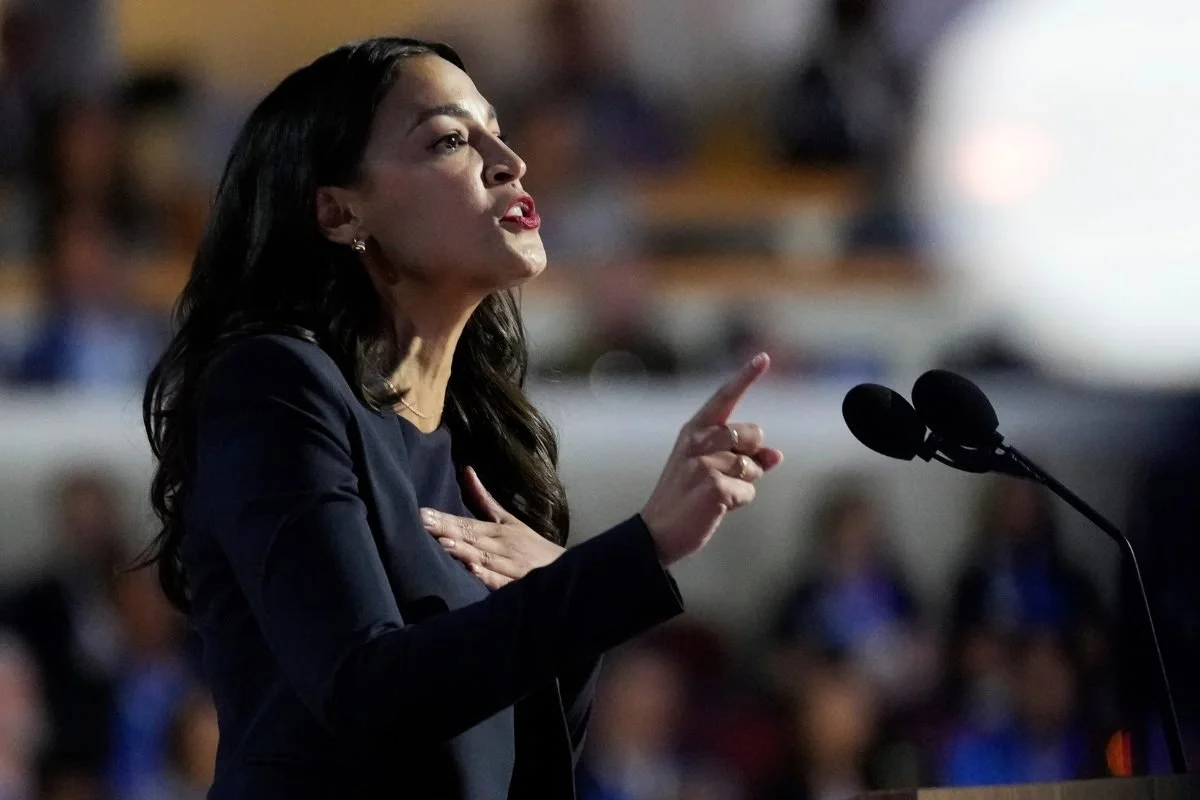
Alexandria Ocasio-Cortez at a rally in 2025
In ‘What Moved AOC? A History of Carrots and Sticks’, the author presents the question of what moves electeds to change their public position on issues of national importance. They introduce this schema as a contrast between “‘the carrot’, of building power and strengthening interpersonal relations with electeds” and “‘the stick’ of red lines and consequences for breaking with party lines”. What this approach fails to reconcile, however, is that the carrot and stick framing is not only a false dichotomy, but a formulation that ignores the most important question: that of alignment.
The analogy obscures the real answers to the question it itself poses by framing the issue as simply weighing the relative efficacy of two different but related tactical approaches to DSA’s relationship with its sitting electeds, the carrot and the stick. The true catalyst within both of the tactical approaches, which the author frames as being in conflict, is buried in ‘the carrot’, building power. It’s the concrete power of the DSA and its growing relationship with the broader American left that actually determines whether any particular tactical approach is effective in aligning any of our sitting electeds with our positions and priorities. It's just power: moral power, rhetorical power, the power to dispatch an army of motivated volunteers to door knocking, protesting, or packing out town halls and hearings. To build an effective and nationally scalable approach to DSA’s relationship with its sitting electeds, we need to think beyond the narrow scope of the carrot and stick outlined in the article.
We cannot completely ignore the personal relationship an individual or chapter may have with any particular elected, just as we cannot ignore that any particular elected is an individual with their own complete interiority, the same as any of us, possessing a personal and sometimes incoherent politics all their own. Whatever may or may not have been achieved by the personal relationship model, this cannot be the basis of a scalable and durable strategy for encouraging our electeds to align with our priorities. Alignment here can be understood in opposition to the more commonly discussed formulation centered around ‘discipline’ because any discipline that we may wish to impose upon an elected is only as real as the political leverage which we are able to apply to them.
As it stands today, we do not get DSA-endorsed candidates elected to office by turning out sufficient numbers of card-carrying DSA voters as a winning majority of voters in the candidate’s district. Taking AOC as an example, the author of the Carrots and Sticks article points out that DSA was late to support her initial campaign and, by AOC’s assessment, “was not responsible for her win”. AOC has been elected three more times since that first win in 2018, and whatever DSA may have contributed to those campaigns, I think it would be dishonest to portray the DSA as the primary factor in those victories. In practice, we send our volunteers out to advocate, agitate, and persuade a broad coalition of voters, other organizations, and other interests, who themselves possess varying degrees of alignment with DSA’s priorities and with DSA as an organization.
If we were at a point where DSA members represented the majority of voters in a particular election (or even a majority of a particular elected’s constituency), the threat that we would simply primary a candidate if they moved out of alignment with DSA would be sufficient to make the candidate’s alignment a natural outgrowth of the DSA’s democratically determined priorities. Since we are not there yet, we have to think and operate in terms of the actually existing, coalitional base of support for the candidate, which DSA is only (as of 2026) a relatively minor partner. The majority of this coalition ends up being independent of and not directly accountable to the DSA. DSA’s engagement with mass politics isn’t exclusively limited to our electoral work, and we cannot underrate how all of our external campaigns impact the direction and shape of this coalition, along with our place within it. We must take these facts into account when we consider the current possibilities and limitations of our approaches to both the internal mechanics of electoral discipline and our existing approach to building relationships with our electeds.
Trying to correctly assess the actual relationships of power between DSA and AOC (or any prominent elected for that matter) should not be limited to just analyzing the specifics of any particular election, and we should not constrain our analysis to only an electoral context. It would be incorrect to just look at the individual relationship between DSA and AOC when trying to determine the root cause of a change in AOC’s position on an issue. Because we understand that DSA does not yet hold sufficient mass leadership to be considered the leading representative of the democratic mass will, we must consider the broader context that this relationship exists within. AOC changing her position on whether to provide military aid to Israel is worth examining. The genocide perpetrated by Israel in Gaza, a genocide that has been livestreamed to the world since October 7, a genocide which, as of this writing, is still largely denied by both major American political parties, has driven a massive shift in American public opinion on the issue of Israel and Palestine. Since then, DSA came together and clarified our position and reaffirmed our commitment to anti-zionism in national resolution 22, “For a Fighting Anti-Zionist DSA”.
According to an article released by Gallup in February of this year, “U.S. public opinion toward the Israeli-Palestinian conflict has shifted in the past 12 months, and for the first time in Gallup’s annual measurement since 2001, Americans’ sympathies no longer lie more with the Israelis than the Palestinians.” While the temptation exists inside DSA to analyze the positions and actions of our electeds as a direct response to the shifts in position or direct interventions of DSA, failing to consider how changing public opinion created the space for AOC to shift her position on the matter leaves the analysis incomplete and subsequently voluntaristic. It’s also worth noting that the ‘liberal’-zionist lobbying organization J Street publicly shifted its position on US military aid to Israel shortly after AOC’s statements at the NYC-DSA electoral forum.
I don’t believe that AOC influenced J Street’s position on this, or that J Street influenced AOC’s position either, but that the shift in public sentiment created both the pressure to align and the space to do so. This shift in public opinion was not totally disconnected from DSA. While we cannot by any means claim a primary leadership role in the struggle for Palestinian liberation, our engagement with this issue at the individual, chapter, and national level is the kind of engagement with mass struggle that actually builds power to sway our electeds. Just as we often overrate our agency and our influence over our electeds through the model of building and maintaining insider relationships, we often underrate the possibilities for agency and influence that are available through our engagement with mass struggle and developing our potential as leaders there.
DSA cadre candidate Zohran Mamdani’s high-profile victory in New York City has contributed to the perceived electoral power of both DSA as an organization and anti-zionism as a position in mainstream American politics. Without digging into how Zohran has navigated his relationship to anti-zionism over the course of his campaign and since taking office, for the purpose of the present argument, I am content to take his enemies at their word as to how much his election represents a threat to the zionist project. In the months since Zohran’s election, a wave of left-populist candidates, both DSA-endorsed and not, has sprung up across the country in races at all levels. These candidates aren’t just imitating the Zohran campaign’s vertical video social media style; they are also expressing DSA-aligned messaging through their various campaigns. The DSA-endorsed candidates certainly possess, to a greater or lesser extent in each case, individual relationships with parts or all of the particular DSA chapter that endorsed them, but focusing on the specifics of these relationships as the central tactic structuring DSA’s relationship to our electoral projects limits our ability to define DSA’s relationship to this broad, left-populist electoral moment.
These candidates are filling the vacuum that has been created by both the Democratic Party’s political failure to meet the moment in their response to Trump’s second term as president, and also the deep moral failure of most elected Democrats in not meeting the moment in response to the ongoing genocide in Gaza; this resonance has been proven in actually lived political time, especially in the wake of Zohran’s victory and growing mass mandate. We may be able to connect DSA’s politics to this left-populist moment by having our high-profile electeds like Zohran or AOC agitate around the issues animating this turn to left-populism by articulating a clear democratic socialist vision, but this path is bottlenecked by having to try to coordinate a few individual electeds around a message and assumes that the DSA and the broader left should be trailing along behind these few highly visible individuals. We should instead structure the tactics we use to relate to electeds in general around the assumption that alignment with DSA’s goals and socialist strategy should be considered the measure of our proximity to any electeds, whether they are cadre candidates or not.
Rather than focusing on the relationships between individual chapters (or often just individuals in chapters) and our sitting electeds and subordinating the politics of the organization to the political reality our electeds have to navigate inside the bourgeois state, we should be focusing on building and maintaining the power of our organization as both a vehicle for mass politics and as a coherent national structure. The heavy focus on individual chapter relationships with endorsed electeds is a symptom of a broader problem within DSA that is especially visible in our electoral work, the problem of localism. The local autonomy and flexibility that have allowed our organization’s most advanced chapter electoral programs to succeed in their local conditions are also impeding the organization as a whole in coming together to make serious electoral interventions on a national scale at a moment where the door is opening to our politics in more places than just New York, LA, or DC. American politics is constructed on the national, politico-cultural level, and DSA must reflect such construction within its own organizational apparatus if it is to find consistent resonance with mass struggle.
The narrow scope of the ‘carrot’ on offer in the original article is a product of this chapter-first, chapter-only outlook, while the ‘stick’ is the only one of the two options presented that points to a national or international politics that can include the masses. The people can’t all fit into a conference room with AOC and her staff. We resign ourselves to operating through layers of intermediaries, professionals, and just-trust-us individuals when we focus our tactical orientation towards electeds on the ‘carrot’ of individual relationship building. The “‘stick’ of red lines and consequences for breaking with party lines” at least acknowledges the existence of a party that could have lines with which to break. The ‘stick’ as described imagines both the existence of DSA as an organization and as something through which the politics of the masses could be expressed and, more importantly, advanced.
It is an error to frame the DSA’s red lines, like DSA’s commitment to anti-zionism as expressed in national resolution 22, “For a Fighting Anti-Zionist DSA”, exclusively as a negative position, as a ‘stick’, or as just a collection of possible punishments facing a member or elected if they fall too far out of alignment with our commitment to anti-zionism. We should instead consider how these red lines also function as a positive force. You cannot be in alignment with the principles of DSA if DSA has no principles. We cannot have political allies if we have no politics, or if we subordinate the primacy of the politics we do have to the upkeep and maintenance of insider relationships with electeds, as could be argued was the case in the Chi Osse debacle. Establishing democratically agreed-upon political principles and priorities helps build the power of the DSA. The threat of punishment, censure, or expulsion that we have democratically decided to connect to particular principles is an articulation of the importance we’ve put on those priorities, but is only as effective at influencing our electeds as our organization is effective at grounding those principles in mass politics. When we can connect our principles to mass politics, we can build towards class politics.
We cannot meaningfully enforce discipline over our most prominent electeds solely through our willingness or ability to formally exclude them from participation in our organization. Unfortunately, at this stage of development, the threat of expulsion from DSA does not create sufficient pressure to align our established electeds when they possess a mass base that transcends what can be mustered by DSA on its own, especially when it comes to the most prominent stratum of electeds like Zohran and AOC, who have, in turn, become far more vulnerable to establishment forces.
We can’t expect alignment from our most prominent sitting electeds through what comes with a DSA endorsement alone. AOC could win her district again as an incumbent without DSA. By the end of his first mayoral term, it’s possible that Zohran will have consolidated a broad enough coalition, including established powers in NYC, that he could disavow DSA and win reelection anyway. If we are to revoke endorsement and these prominent socialists win anyway, where does that leave us? Our current orientation towards these prominent individuals needs to be grounded in both the political independence of the DSA and an acknowledgement that these high-profile electeds are operating independently of the DSA in many ways once they are actually in power. We can then build together where we are aligned and push back where we are not.
We need to move beyond conceiving of our relationship with our SiOs in the terms of carrots that we dole out to individual electeds through our individual relationships and sticks that we can wield democratically as an organization, but which have little to no practical impact. We need to think of the carrots and sticks that we can realize through our organization and its relationship to mass politics. We need to move beyond conceiving of our relationship with electoral politics in terms of individual figures that we elevate above the rest of the membership and then feel forced to follow along behind. Any positive association we gain from our sitting electeds is something we should use, but not something we should compromise our principles to maintain.
These relationships should not be cultivated for their own sake or because we feel the individual sitting elected is themselves a monument to DSA’s winning, and therefore distance from them would represent DSA somehow losing. Our wins should be our wins. We should be using what we learn and build through successful electoral campaigns to reach a position where the stick we have in hand to threaten electeds who drift out of alignment is our ability to primary them and win again. As Teddy Roosevelt once said, when you carry a big stick, you need only speak softly. The carrot we should be hoping to offer is that when electeds are aligned and need support, they will have the people in the street supporting them. DSA must represent those people, not the electeds; only through engaging the former will the latter be made to engage with us.
The author of What Moved AOC? A History of Carrots and Sticks wasn’t wrong to consider possible tactical interventions in terms of carrots and sticks, and we should commend them for taking the question on in a serious way, but in their framing of these two tactics as being an either-or proposition, they lose sight of the real purpose of tactics to begin with. It is not the case that one is superior to the other on its own merits. Even if the author was correct that only the carrot of building supportive, interpersonal relationships between AOC and individual members of NYC-DSA was responsible for moving AOC to finally, openly oppose military aid to Israel, this still doesn’t tell us anything that necessarily carries over to other issues or other individual electeds.
By not accounting for the possibility that political red lines function in ways that extend beyond just the mechanics of enforcement the DSA builds around them, and by not considering the impact of changes in both DSA’s position and popular opinion on AOC’s position, which was and still is lagging behind both DSA and the broader public, the author creates only enough space in their narrative for the carrot of positive interpersonal relationship building to be seen as operating effectively. As both DSA-endorsed and unendorsed but aligned electeds continue to rack up wins all over the country, we need to be thinking bigger. If AOC is going to run for president in 2028, we’re going to need to reframe our political strategy away from unscalable insider relationships towards wielding mass leadership.