
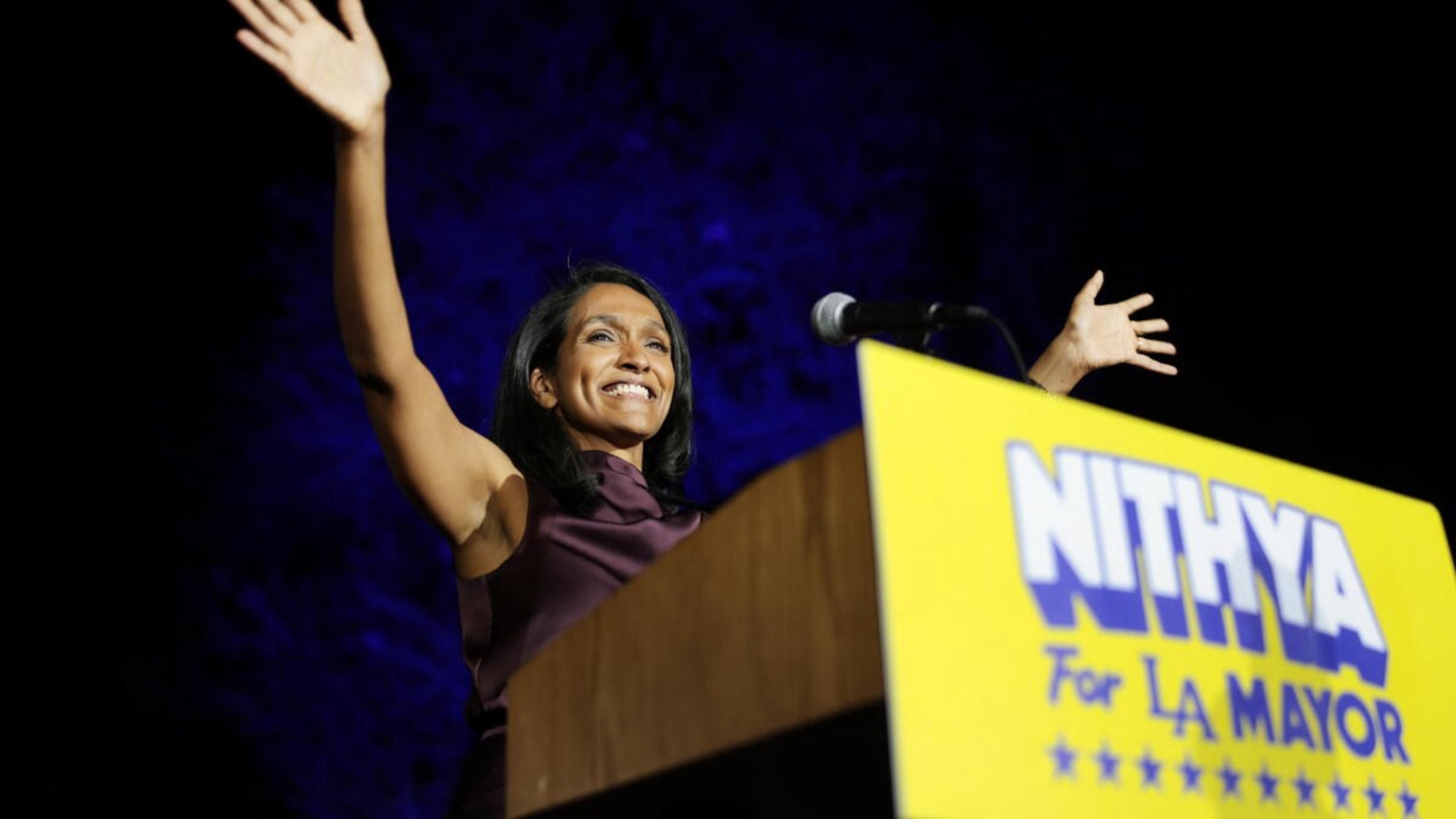
Nithya Raman giving her victory speech on election night.
Democratic Socialist Nithya Raman has clinched her bid for Mayor of Los Angeles against the incumbent Karen Bass. Within the span of one momentous year, the two largest cities in the United States of America will be governed by Democratic Socialists. The question now becomes: what role does Nithya have to play in the rapidly growing Democratic Revolution and the fight it is now leading against the establishment for the future of America?
Raman’s election comes off the heels of a groundbreaking election night in LA, with victories for Democratic Socialists Angela Gonzales-Torres for the House of Representatives and Marissa Roy for city attorney. Nithya’s victory, along with the success of the DSA-LA slate generally, represents a condensation of the growing strength of the fight against not only Karen Bass, but the broader corruption of the liberal establishment and its incompetence in representing democratic values.
Nithya’s campaign announcement signaled to many progressives and socialists in LA that a real fight would be possible over the city’s highest office. As a councilmember, Nithya reduced homelessness in her district by half while it increased in the city at large. This, along with her clear support for the liberation of Palestine and her opposition to the Israel lobby (a position she improved greatly over the last years and months), made Nithya the obvious candidate to outflank Bass on claims to the progressive vote.
Her victory represents a showing of Angelenos who are looking for bold democratic restructuring in City Hall. With the combined victories of a formerly hamstrung city controller, a city attorney who campaigned on fighting Trump, ICE, and corporate power, and Nithya herself, the status quo coalition that had encircled Karen Bass will find itself in open conflict with a newly emboldened popular movement that has come to its doorstep in Los Angeles.
When asked about his thoughts on Nithya’s potential win weeks prior, LA City Controller Kenneth Mejia replied, “The one thing I’m excited about the most, for every voter out there, is I am going to audit the hell out of City Hall, and I am going to investigate the nearly 800 fraud, waste, and abuse claims that I get every year, which I can't do because the Mayor cut my budget to do that oversight…”
During the primary, City Attorney-elect Marissa Roy’s plan to run her office like a “public interest law firm” was deemed “insane” by the outgoing incumbent, foreshadowing the disruption that this incoming class means for the LA bureaucracy.
While LA governance has historically been captured by the political machinery of the establishment, Angelenos have thoroughly rebuked their dominance—it is now facing down the barrel of a Raman-Mejia power duo that could significantly alter the balance of forces locally.
Nithya’s post-primary endorsement by DSA-LA, an organization whose New York contingent elected Zohran Mamdani to mayoral office along with many other socialist allies in this election cycle, was no small factor with regard to her victory. DSA’s ground apparatus, which in Los Angeles alone knocked over 110,000 doors this election cycle, played a major role in greater turnout for Nithya relative to the primary when Nithya was not yet endorsed by the chapter.
But the endorsement process was not without controversy within DSA. Although Raman was only endorsed by the local chapter, the organization as a whole began litigating the validity of Raman's endorsement shortly before the election, resulting in the left-wing of DSA’s National Political Committee (NPC) pushing for her expulsion and un-endorsement, attempting to override the LA chapter’s prior vote. Although Raman committed to using her mayoral powers to halt cooperation between the LAPD and Israel, many felt her previous history around BDS (Boycott, Divestment, and Sanctions), including a 2024 endorsement by Democrats for Israel Los Angeles for which she was censured by DSA-LA, indicated a lack of genuine commitment to anti-Zionism. Ultimately, the NPC narrowly voted not to void the local chapter's decision (14-13), although it remains to be seen if she will be expelled as an individual member.
The NPC wasn’t alone in its skepticism toward Raman, with the opposition even including colleagues of hers within the City Council—some of whom were themselves endorsed by DSA-LA only for them to then come out in support for Bass. This reflected the internal ambivalence toward Nithya: the organization opted to endorse neither Raman nor potential progressive dark horse Rae Huang in the jungle primary, but backed Nithya in the general, where she would face off against an incumbent whose cumulative disappointments made her vulnerable to popular accountability.
Deliberation about Nithya, for DSA-LA in particular, demonstrated a microcosm of broader questions about socialist strategy that have dominated discussion for years as the momentum of left populism has grown since 2016. After a volley of constructive essays from a variety of perspectives published in Geese, discussion around support for Nithya’s campaign became clearer, and the key issues that would define it were identified. The culmination of these discussions led to the successful vote to endorse Nithya Raman in September, with the vote even winning by a resounding two-thirds majority. Ultimately, DSA-LA decided that, despite there being some valid critiques of Nithya’s agenda, a Democratic Socialist winning LA’s mayorship was a tactical necessity.
Regardless of what one concludes about the contentious, yet constructive debates within DSA around Nithya’s candidacy, her mayoral victory represents an opportunity for further struggle in all directions. If it is reasonable to question Nithya’s agenda and its potential sufficiency or insufficiency predicated on its policy initiatives alone, the fact remains that she will be a voice for democratic socialism in the second biggest city in the country (with the first also occupied by an explicit socialist). She will also be a voice nationally against the cost of living crisis, against ICE kidnapping our neighbors and children, and for socialized healthcare and government welfare services.
Many in DSA-LA saw Nithya Raman as a candidate worth supporting for her specific platform and her progressive contrast to Bass. But for others, the fight being staged between Nithya’s bold ideas and the’ long-time ineffectiveness and corruption of the status quo incumbent represented a localized instance of the pro-democratic insurgency sweeping the whole country—putting socialism and the DSA itself in a position to lead one of the most important fights in America this century.
Yet the debate we witnessed over Nithya’s endorsement raises questions about socialist electoral strategy in general that remain to be answered—specifically relating to the false dichotomy of strategic necessity versus adherence to principles. Is having an ideal or ‘true socialist’ platform enough for a candidate to be successful? What does this mean if the ‘correct ideas’ don’t match the immediate needs and desires of voters at a given juncture? Can they still be considered functionally correct? And if not, what constitutes correctness in the context of socialist strategy? At the same time, how does an organization respond when the lifespan of its advocated platform expires? Is it enough that a candidate is vaguely associated with an organization to credibly represent a broad and heterogeneous national movement?
Even the lofty notion of compromise through synthetic reconciliation between two positions such as these is itself illusory. In political struggle, despite potential exchanges, there will always be one side that reigns victorious over the other. And while electing Raman is indicative of accurate political assessments by her supporters and volunteers, it does not negate the sharp criticisms contributed by her left-flank dissenters. But it is only through the cycle of her incumbency, successes and failures included, that these criticisms can truly be brought to light where it effectively matters—through the lived experience of the millions.
In many ways, DSA-LA has an advantage over its peers from other parts of the nation. The tension around Raman’s political history means that uncritical support for her administration is impossible. She may surprise some and govern more progressively than many expect. Even if she does, the DSA’s political program far exceeds what Raman can personally achieve. While her election opens up new opportunities for socialism—both within the city and for future candidacies elsewhere—many of those opportunities come in the form of conflicts where the chapter must distinguish itself from Raman’s compromises and stand on the side of progress. She will occupy a key national platform endorsing AOC’s potential 2028 presidential run, one that, if successful, could represent a consolidation of this stage of the Democratic Revolution against fascism that showed its vibrancy on Tuesday night.
In this regard, socialists face a paradox. While ideally Raman would live up to her promises, we know full well that the structural contradictions of bourgeois society will prevent their realization to a greater or lesser degree. As such, when she inevitably fails, we are then obligated to overcome sentimental urges that cling to her defense, and make way for the arrival of tomorrow’s radicalism. Transformation of mass consciousness can only happen in this way, and history proves it. First New York, now Los Angeles—socialism has entered a new phase of struggle; not just on Capitol Hill, but in our biggest city executives from coast to coast.
Of course, the role of Geese in how the debate to endorse Raman took place must also be viewed from the lens of conscious intervention. Although the status quo of modern neoliberal society has hitherto lauded debate, it is fetishized for the sake of spectacle and profit; it lacks the essence found within its intention—to progress. If we are to truly embody the humans of tomorrow, what that means for us as communists is key: the product of new history is a unique creation that can only materialize through the unity of opposites in struggle. Like a mosaic shaped from the debris of colliding stars, it is not enough to simply win—we must push through the fight in order to change for the better. To struggle is the point.