
Sep 11, 2026
American Communism is Anti-National
Concretizing communism in a country of no nation.
by Jack M
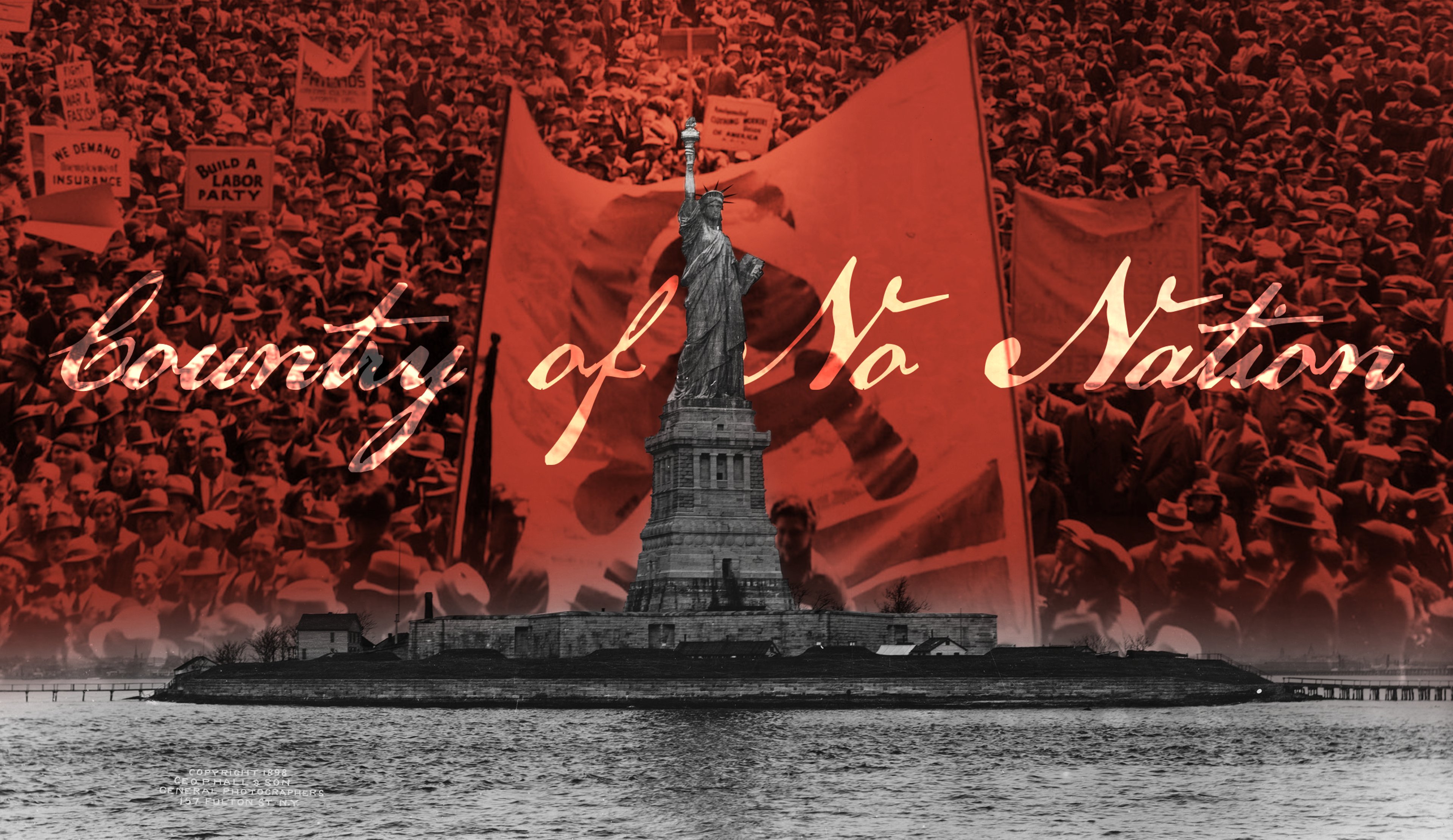
The hungry self of the Nation shall burst in a violence of fury from its own shameless feeding.
For it has made the world its food,
and licking it, crunching it and swallowing it in big morsels,
It swells and swells
Till in the midst of its unholy feast descends the sudden shaft of heaven piercing its heart of grossness.
The crimson glow of light on the horizon is not the light of thy dawn of peace, my Motherland.
It is the glimmer of the funeral pyre burning to ashes the vast flesh,—the self-love of the Nation—dead under its own excess.
Rabindranath Tagore (Excerpted from “Sunset of the Century," 1899)
It has been two months since the organized and disorganized left in the United States, spurred by the festivities marking the 250th anniversary of the signing of the Declaration of Independence, fell over each other to declare the correct opinion on the American republican project and its legacy. Of chief importance in this debate is how the American left ought to relate to the ambivalent legacy of the United States as both a beacon of liberty and an empire of slavers. This appears as both a discourse on tactics—how we relate to the masses enamored with the American idea—and a moralistic discourse—how we may condemn the many crimes of this country; it's easy to see why this issue has stirred up such strong feelings.
For our part, Geese contributed to this discourse in a number of articles that more or less seek to identify a progressive, democratic vision of Americanism that communists can genuinely and wholeheartedly adopt and celebrate. This is, to my mind, worthwhile, even if its single contribution is to endeavor to articulate a communist politics capable of genuine mass appeal in this country. Yet, in both our attempts at drawing out this line and in similar gestures by the Communist Party USA, I find that this discourse too often fails to examine its foundational categories. This allows us to ease back into uncritically accepting one particular fraught category: that of the nation. There are entire scholarly disciplines dedicated to the study of what exactly a nation is and how nations are constituted. Anyone who has witnessed the abusive ways in which Benedict Anderson’s work gets used for whatever political ends knows that the question of what, exactly, a nation is remains stubbornly live.
Standing on this unstable footing strikes me as suitable to American conditions. When we talk about the national or the nation in this country, it does not come intuitively that we are talking about a people or group at all. Rather, the state comes logically prior and we are discussing what it encompasses. Perhaps most typically, the nation seems to be identified by vibe. For this reason, I do not propose that it is a primary task for communists to distill the one correct scientific answer to the national question. It remains possible to set its ambiguities aside and note that nation-building is a process, often conducted with extreme violence and prejudice. Already at its core, we are retreating from emancipatory ends. But there is a unique opening for the critique of the nation here. To move beyond this category entirely, we might take advantage of one of the incredibly special attributes of our republic: its status as a robust and surviving country of no nation.
I use this term to refer to a country where belonging is not contingent on an ethno-political construct apart from the civic institutions themselves. I first came across it in the work of Rabindranath Tagore, a Bengali poet and independence activist who is famous for having composed the national anthems of both India and Bangladesh (though he died before either was an independent country). In his book, Nationalism, Tagore saw the horizon of a subcontinent liberated from British imperialism but became concerned about the nationalist tendencies in the independence movement. He raged against such an independent state taking on the project of constructing a nation on top of the pluralistic civilizational space he observed as the world of No-Nations. This modern machine, which both divides and homogenizes, was first built by humans but would come to dominate them. The American case is quite different from the South Asian one. The contours of our pluralism were the result of settler colonialism, the Transatlantic Slave Trade, and migration since then. Nonetheless, this pluralism is tangible and a real issue for nationalism in both cases.
Tagore’s own limits are clear: one wonders how coherent or effective his political anti-nationalism really was, having become a national hero of two nations. His failure should frighten us, however, as Americans. The success of Indian nation-building is visible in the ever-strengthening hegemony of the BJP and the terror of the RSS. In fact, this should hardly be surprising to us. The formation of such a nation-state out of our own country has been the explicit project of myriad reactionary movements, from white supremacy to Anglo-Saxonism to modern-day “heritage Americanism.” Even the more hospitable and cosmopolitan forms of American nationalism basically insist on forcing some Americans into a collective to which they have no interest in belonging—an equally unacceptable conclusion, in my view. It is a small miracle that none of these have been durably successful. There is today not one national identity that has successfully monopolized the right to being American. Perennial Geese favorite, DSA New York City Councilmember Chi Ossé, expressed a similar idea in his ode to New York City as a model of what the country can be:
[T]he boldest invention was the country itself. America, on its better days, is a country of and by whoever chooses to show up and add something to our shared project, no bloodline required. We have not always honored that idea, but the idea is the point, and nowhere lives up more to that ideal than New York.
What Ossé recognizes in New York is, in fact, the emancipatory kernel in the American project itself.
This presents obvious problems when attempting to compose a communist movement responsive to the particular conditions of the United States. The notion that we are creating a “national” political movement in the mold of Georgi Dimitrov (or Earl Browder, for that matter) is overfitting the conditions of the 20th-century state-building project of the Soviet Union. In doing so, such an approach oversteps the realities of American political life. When we identify as an American, it is not as a member of a singular people but as a citizen-subject of the republic—an inherently pluralistic imaginary. This alone precludes it from being a nation in the mold of, say, Germans or Englishmen. Communism cannot be thus [made] into the logical conclusion of American life, of expressing organic practices that, every day, animate politics without disposing of nationalism. To concretize communism to American conditions means recognizing that America is, again, a country without a nation. It becomes our task as American Communists to take up this invention and carry it to its furthest possible ends.
Of course, this country of no nation is an ideal. A 2025 YouGov poll asking Americans the question of “what makes someone an American” gives an interesting look into the realities that this ideal runs up against. A majority of Americans view participating in American customs and traditions as at least “somewhat important.” Ditto for being born in the U.S. and speaking English. What does this tell us? Quite plainly, that our ideal of the American country of no nation is unrealized and is continuously contested. Tailing existing hegemonic discourses of American-ness, however, would be a discursive capitulation to what remains an essentially reactionary political form. Ignoring it, however, causes a misunderstanding of the United States as it really exists. To participate in the contest—to fight against the nation—is the constant progressive urge in American history. It peeks through in moments, like the Civil War, where the emancipated future appears above the horizon. These moments are what we call the democratic revolution. It is what we call communism.
A conspicuous elephant remains in the room with us: the various national liberation struggles within this country. Not only do they pose a counter-example of the people who have been most obviously excluded from and excluded by this synecdochical universalism, but they also have a far more coherent national imaginary. This is a fundamental tension in the very universalism I am arguing for, which is released only in the synthesization of these national struggles into American anti-nationalism, which is the historical result of the Black Nationalist movement. I was struck recently while reading Ashley D. Farmer’s excellent new biography on Queen Mother Audley Moore by this passage describing her son Tom returning from the Korean War:
Tom returned from the war two years later, wounded, with two Purple Hearts and a different outlook on life. In yet another heartbreak for Moore, she found the war had not radicalized Tom as she had hoped. Her only child was not interested in joining the struggle for a separate Black nation. Instead, he was set on using his GI Bill benefits as most were: to buy a house, get a college education, and settle down. The world opened up for Tom postwar as he entered the middle class. Meanwhile, his mother’s world continued to shrink
Queen Mother Moore was devastated that she was unable to form her son into a dedicated cadre of Black nationalism because of the promises of American wealth. From Tom’s perspective, though, you can imagine a struggle fulfilled; he didn’t have to suffer for sovereignty in quite the same way his mother did. Of course, the struggle for Black Liberation did not end in 1953. It did, however, take on brand new contours that were no longer as compatible with, for instance, the Black Belt nation-state. When we view these results not as a grand failure of one movement but rather as part of the grand dance, we can find ourselves much happier with the results.
America acting as colonizer, too, offers us pause for reflection. The Puerto Rican struggle serves as an instructive example. Specifically, I think it serves us to look with clear eyes at what happened to Puerto Rican nationalism in the mid-century. Though a period of dramatic militancy by Nationalist Party members, the post-war era represented a decline in the popular relevance of independence, especially after the death of Pedro Albizu Campos. It represented the beginning of the current status quo with the adoption of the Constitution of Puerto Rico, the dominance of the Popular Democratic Party, and Operation Bootstrap. Among other effects, this initiated a mass migratory wave of Puerto Rican people to the metropoles of the mainland. It was in these cities where a new wave of activists of Puerto Rican liberation sprang up, as in the case of the Young Lords. They valiantly fought for the dignity of Puerto Ricans in America through initiatives in sanitation, community healthcare, and more. They acrobatically conceived their nationalism as that of a “Divided Nation” where, “regardless of its distance from Puerto Rico, the Puerto Rican community in the continental U.S. had an immutable social, cultural, historical, and political bond to Puerto Rico, even if members of the mainland community did not speak Spanish or had never visited the island” . This thesis collapsed upon contact with the actually existing Puerto Rican nationalism on the island when the Young Lords Party attempted to transplant themselves in part to the island. They alienated themselves with their brazen—nearly hubristic—attitude, and not least because they advocated for the liberation of Afro-Puerto Ricans against a nationalist movement “led by the overwhelmingly white Puerto Rican bourgeoisie and petite bourgeoisie” 349). For the Young Lords Party, what was first self-conceived as nationalism was in effect American anti-nationalism. That is, they were militantly opposing nationalism’s exclusion of Puerto Ricans' personhood: the right to clean cities, tuberculosis checks, good-quality healthcare, and community. For the Young Lords, this language took the form of a call to nationalism by a diaspora. Where it failed, it was because it was incapable of serving as an effective nationalism for the homeland.
Good, I say! The discourse of national liberation of America’s oppressed nations thus has functionally served as an American anti-nationalism, but the central demand of independence is something no longer relevant to the vast majority of these subjects today. This failure could have been met with the realization of the mass character of the movement but instead slunk into the sectarian anti-revisionism of the New Communist Movement, screaming mostly at each other. Indeed, this is the main takeaway of Kevin 'Rashid' Johnson’s “Black Liberation in the 21st Century:”
Without need of pursuing a struggle to achieve a New Afrikan nation state, we have achieved the historical results of bourgeois democracy, at least as far as transforming ourselves from a peasant to a predominantly proletarian national grouping through the “Great Migration.”
Of course the Amerikan liberal democratic revolution begun in 1776, which was continued by the Civil War (1861-1865), remains unfinished—in particular as far as Black people are affected. Pre-capitalist forms of exploitation continue to exist, such as the “slave status” of U.S. prisoners, institutionalized torture, legalized “lynching” as embodied in the racist death penalty, and all manifestations of racism, sexism and discrimination that prevent all from enjoying the “life, liberty, and pursuit of happiness” promised by liberal democracy.
To complete the liberal democratic revolution and move forward to socialist reconstruction the proletariat must lead the struggle which is stifled by the increasingly antidemocratic, fascistic and reactionary bourgeoisie. The bourgeois are no longer capable of playing a progressive role in history.
Rashid recognizes that the very changes in American society that made the Black Belt Thesis and the Separation/Integration dichotomy obsolete are not a defeat of our ideas unless we stubbornly and dogmatically remain by 20th-century analyses of the National Question. As an aside, this problem is not limited to the National Question. The dogmatism of large swathes of the communist movement is both constitutive of and reinforced by its self-imposed marginality and reflected in its subcultural character. This is something we must break away from if we are to recognize the inherent possibility in this state of affairs. This possibility is summed up cleanly again by Rashid. “The proletariat fundamentally has no country and seeks to create a world without boundaries or nation-states.” It is for this reason that only communists, for whom the proletariat is their political subject, can be actual anti-nationalists. This task thus remains up to us today.
This disposition grants American communism the ability to become a synecdochical universalism. Because of the promise made in Emma Lazarus’ famous poem, American communism is hospitable to workers of all nations. If we are to become ourselves the Mother of Exiles that lifts her lamp beside the golden door, American communists must be more than internationalists. We fight against a “resolution” to the National Question and offer the entire world the capacity to belong to America. American communism makes a claim on the entire world precisely because it is capable of negating itself. If there is a revolutionary kernel in the concept of America, it is precisely that America’s identity has always been in flux. American Communism is, then, partially a defense of that flux. It defends the pluralism and contestability of the idea of America. It defends the country of no nation against the incursion of the inhuman mechanism of the nation-state. To assert the movement’s American-ness is to negate these attempts to construct an exclusive national character. It means to embrace and reflect the plurality of the American masses and to enact the unrealized promise at the core of the American republic. I do not suppose that this should take the form of shouting, “Death to the nation!” at the first and every opportunity. Rather, we must internally recast our defense of America’s democratic tradition as a resolute stand against the American nationalism that seeks to enclose it. In other words, anti-nationalism is one front of the Democratic Revolution that will allow people to manage their own destiny, rather than constructing a new apparatus of domination.