
Jun 5, 2026
Problems with Scientific Analysis in Marxism: A Response to Black Lamp
In dialogue with Nabi Eullman's essays examining the relationship between Marxism and science, P.K. Gandakin develops a materialist concept of knowledge-production and asks what it would mean to understand Marxism scientifically, and science Marxistically.
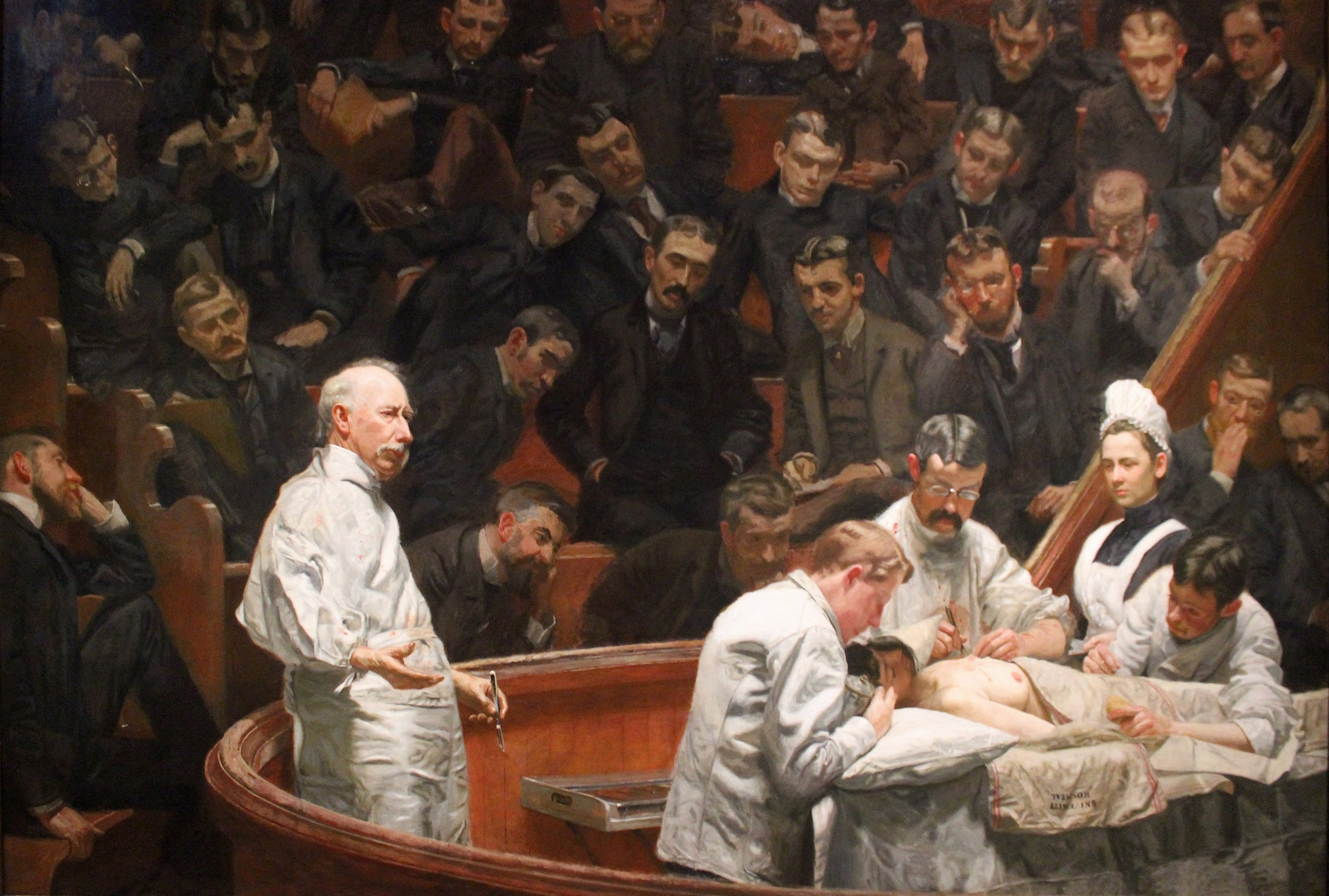
The Clinic of Dr. Agnew, Thomas Eakins (1889)
These essays were written in dialogue with The Black Lamp Collection by Nabi Eullman.
The splitting of a single whole and the cognition of its contradictory parts[…] is the essence (one of the “essentials,” one of the principal, if not the principal, characteristics or features) of dialectics.
V. I. Lenin, On the Question of Dialectics (1915)
0. Introduction
Marxism is often treated as a doctrine: a body of correct ideas or propositions (a system to be defended, a science of reality). But, at its core, Marxism is a theory of practice. As such, to pose it as a doctrine is already misleading: it implies that there exists, parallel to human practice, an inner logic or transcendental Law. Subtly, radical dialectical materialism is transformed into a traditional dualism. To move beyond this, we must openly pose the question of what it means for Marxism to be a practice rather than a theory—i.e., not merely to abstractly pose Marxism as a practice, but to do what might be called a phenomenology of Marxism.
For this reason, the critique (or philosophy) of science is essential to communism. Within the demystification of scientific practice is contained the kernel of the riddle of thinking in general: that, contrary to the mysticism of the world developed on the back of the division of intellectual and physical labor, there is no fundamental difference between labor of the mind and labor of the body. Scientific thought does not occupy a special realm that escapes the conditions of social life; it belongs here, in the mean dirt—not merely tainted by it, but the dirt itself, in the tumult.
What we find, too, is that this version of science remains more authentic both to the genuine pattern of scientific discovery and to the war against alienation. It is derived from both the practice of science and the science of men in their practical activity. What is revealed by this is that the objectivism of science is actually the ideological form of alienation which belongs less to ‘science’ itself than to the underlying philosophy of bourgeois society. Consequently, the critique of science becomes, in practice, another means to sharpen the weapon and develop the critical consciousness carried by the party necessary for revolution.
The series of essays that follows engage in the critique of science and its relation to Communism through the form of a dialogue with the essays on Marxism and science by Nabi Eullman published in Black Lamp and republished in this magazine. They are not refutations or polemics, but attempts to advance.
I. The Relationship Between Marxism and the Philosophy of Science
What is the current status of communism as an object? With this in mind, what is the relation of communism to the critique of science? In what sense can we say that the critique (or the philosophy) of science is identifiable with the materialist theory of knowledge itself?
If it is true that Marxism is a theory of practice, it must also, necessarily, be a theory of the content and structure of human practice. Consequently, a theory of action must also be a theory of the role of knowledge in action or a theory of knowledge as a form of action. So, Poulantzas writes in Political Power and Social Classes:
Dialectical materialism (Marxist philosophy) has as its particular object the production of knowledge, that is the structure and functioning of the process of thought. Strictly speaking, the object of dialectical materialism is the theory of the history of scientific production.
This “particular object” contains within it the old and oft-forgotten principle of Marx and Engels: the unity of knowledge, and the materiality of knowledge. Dialectical materialism, as such, becomes one branch of what Marx calls in Capital “commodity studies”—the research of the characteristics of the concrete labor of a specific branch of human labor, viz., scientific production. Once knowledge is posed as a production rather than an object, the starting-point for a Marxist theory of knowledge-production (or a dialectical materialism) is uncovered.
Greek-French Marxist theorist Nicos Poulantzas (1936-1979)
In 1946, mulling over this question of the essential connection between theory and practice, Karl Korsch proposes:
There is no use in discussing controversial points in any social theory (not even in that social theory which is commonly described as religion) unless such discussion is part of an existing social struggle. There must be several possibilities of action for the party, group, or class to which the social theory in question refers[…] Yet the result of any such materialist discussion must in all cases “make a difference” in respect to the actual behavior not of an individual nor of a small group of people, but of a veritable collectivity, a social mass. In this materialist sense, it is not even sure that the particular social theory called Marxism has ever been the subject of a discussion in this country.
For Marxism to “exist” in any substantive sense, according to Korsch, it is required that it genuinely influences a “veritable collectivity, a social mass.” With this principle in mind, Korsch counterposes against common sense the surprising theory that, despite its formal and theoretical existence, Marxism in the United States is characterized by non-existence due to its lack of social grounding.
Marxism, in other words, does not just exist as a doctrine. For Marxism to be truly present, according to the theory of Marxism, it must be embodied in a social group—it must truly “make a difference” in the behavior of a genuine mass of people. American Communism thus far has played an important role in a series of historical struggles, ranging from the unionization movement in the early 20th century to the Black liberation movements of the late 20th—but has it done so qua communism? Did these individuals and social groups take as their lodestar communism and communist theory when determining the direction of their activity? I do not think the claim can be defended with any seriousness.
Here we begin to see in a rather simple example the intimate connection between political Communism and this question of knowledge and its structure. If Marxism is a doctrine that contains truth, its mere presence in the American universities, sects, and micro-parties is sufficient to indicate its real existence. But if we begin from a strictly practical approach to knowledge, we must reassess these moments as attempts of particular sets of intelligentsia with communist beliefs to transform Marxism into a politics, and beyond an idea. Conceiving of the process of forming the political party of communism in this way (which we might term “concretization”) allows for clarification of the revolutionary legacy of past struggles: for example, we understand that the Black Panther Party was able to rise to the level of historic importance and political efficacy not because they were particularly doctrinaire Marxists or especially effective organizers, but because they were able to translate communism into something that meant something significant and salient for a real social group within American politics. The fundamental lesson of the Black Panthers is the need to speak boldly and clearly the aspirations and demands of a social group—that this, and only this, is true revolutionary practice.
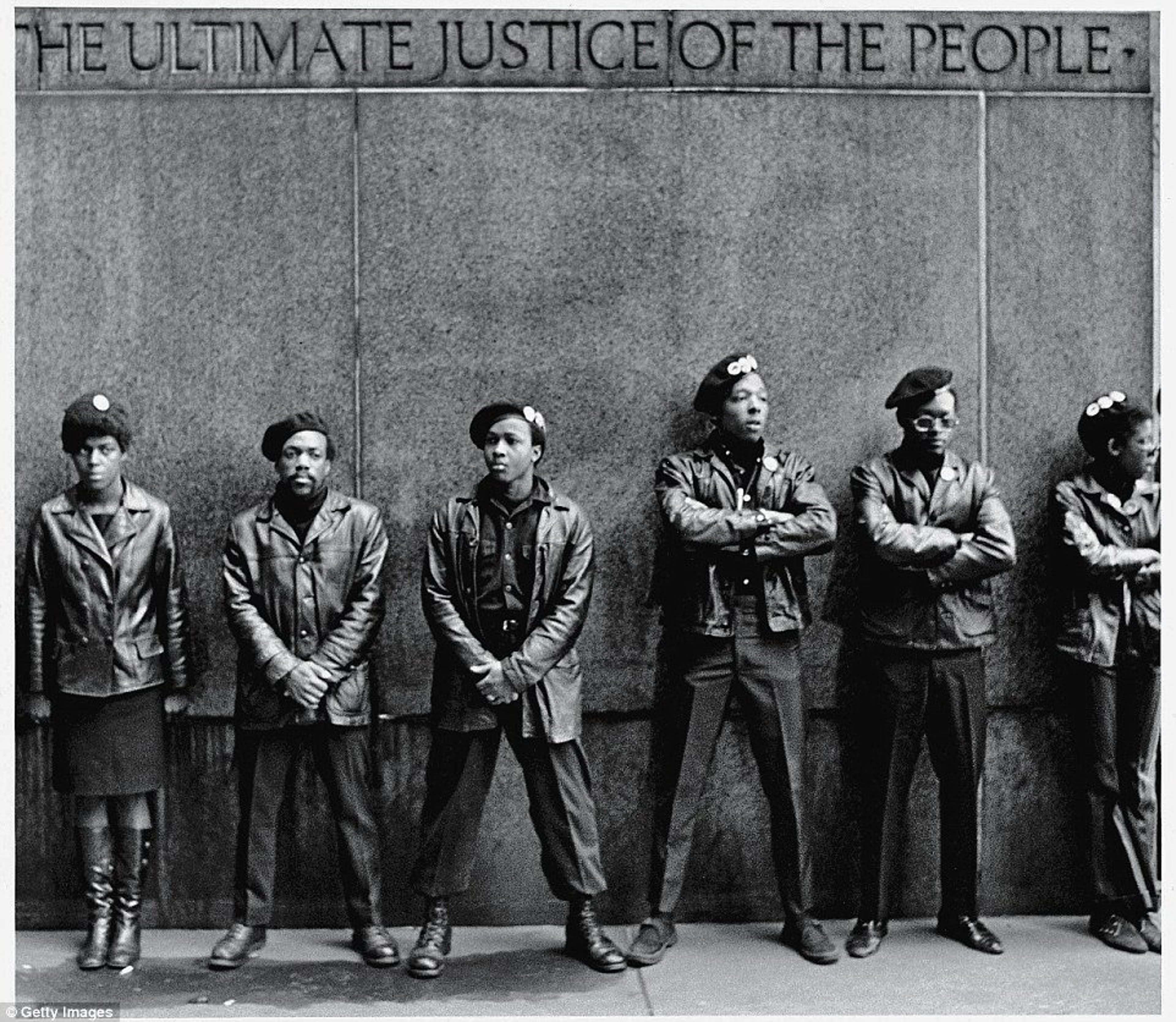
The Black Panther Party was one of the few Marxist party formations in American history that managed to achieve widespread social influence and offer real political leadership.
Reflecting on this, I wondered in what ways the relative backwardness of the American communist movement might actually prove to be our unique strength. In some ways, the lack of a universal and developed canon of Marxist interpretation in the United States has forced historical parties to be immediately confronted with the need to be ‘relevant’ to the American population. So, even if the American communist parties failed, we see a recurrent pattern of attempts to concretize communism throughout—in Browder’s Communist Political Association and “Americanism,” in the attempt to ground the communist movement in organized labor in unique and bold ways, to develop interpretations of Marxism applicable to our unique situation, etc. Even—especially—where these attempts failed or were defeated.
In Europe and many other places in the world, there obviously remains some degree of experimentation. But where Marxism has been successfully institutionalized and identified with a particular theoretical strain, the problems of knowledge tend to be backgrounded in favor of rote repetition of slogans determined by tradition. Here, where the isolation of the communists is most pronounced, however, the lack of institutionalization allows for communism to figure as a true ‘critique of the existing state of affairs’ in a full, comprehensive sense—and the road to the adoption of communism as a revolutionary practice is at least more direct, even if less well-trodden and more perilous.
II. Scientific Production as Real Production
The Korschian radical reduction of the content of an ideology to its social existence runs into many problems when presented in this schematic way. However, particularly in our circumstances, it is more right than wrong. It counts sufficiently as ‘stick-bending.’
Even where the claim that the essence of an ideology is not in its formal content but its social existence as the basic premise of historical materialism is granted in words, it is granted rarely in thought, and even more rarely in practice. Again and again, those who attempt to move beyond bourgeois epistemology and notions of knowledge seem to invariably land back in the original place, albeit with perhaps some additional theoretical sophistication. What is revealed by this is only the structural dependence of communist ideology on bourgeois theory in the current period.
Take, for example, a criticism of my examination of Althusser’s critique of science by Nicholas Villarreal. My examination posits that Althusser is a theorist of science as a social practice in the Marxist sense, i.e., as a practice with its own means of production, object, etc. The validity of scientific ideas, as products of labor rather than reflections of objects, therefore can only be determined according to what Althusser terms historically contingent and socially determined “norms of scientificity”—a given evaluating community or subject’s set of standards it uses to categorize ‘scientific’ versus non-scientific ideas—rather than by correspondence to objective truth or a model of science involving the unambiguous accumulation of facts. Importantly, there are no conditions on these “norms of scientificity”—they are, more or less, contingent and historically determined.
To this, Villarreal objects that he has no qualms with recognizing the ‘impact’ of history or society on scientific practice. That this is his objection indicates the unfortunate shallowness of this all-too-common position with regard to the complex question of scientific production and social determination: it is clear that Althusser is not merely asserting the banal and widely adopted liberal thesis that personal bias, society, etc. ‘influence’ or ‘play a role’ in scientific practice, but that scientific discovery is fully also a social, personal, productive, etc. process which, at the level of our examination, is not distinguishable from other forms of intellectual practice in terms of truth-value, correspondence to reality, etc. It is not merely that science investigates the object while under the taint of biased society; rather, it is that there is no real division between a valid method of truth-identification and an external, subjective, deviating practical element that taints it in the first place.
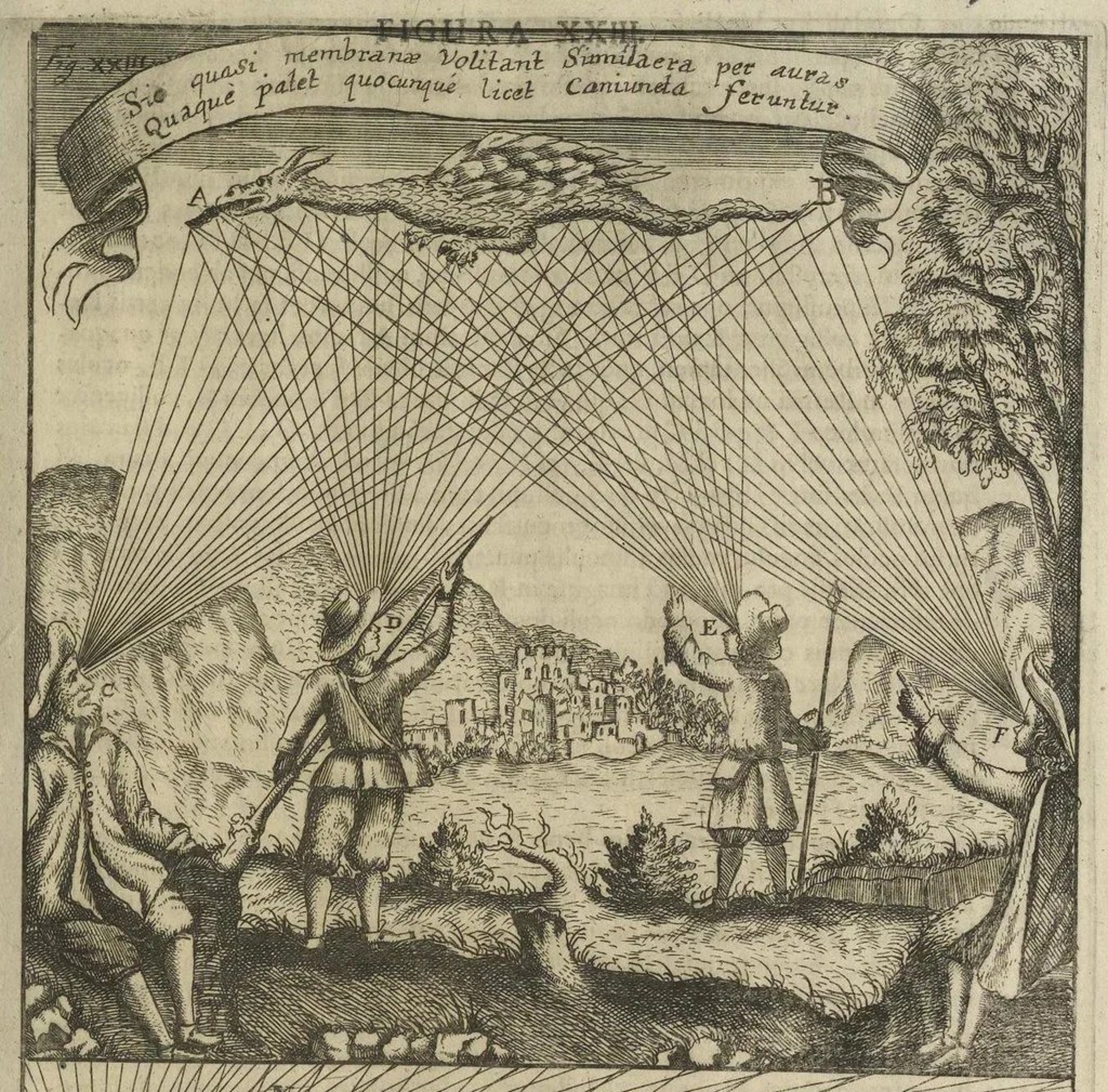
Many ancient physicists believed in the “extramission” theory of vision, which held that vision was the product of extended ‘luminous tendrils’ that constituted the field of vision, rather than images being received. Image: Oculus Artificialis, Johann Zahn (1685)
The problem with Villarreal (and modern Marxism)’s ‘objectivist’ approach is clear: the dimensions of the basic, invariant elements of human practice are considered to be excepted in the case of scientific labor. Scientific labor is supposed instead to be the only type of labor hitherto in history which has performed something truly exceptional—real cognition without interaction with a trans-material substance called ‘Truth’—granting that the history and presence of what is currently considered scientific practice is an extremely small and short one.
To maintain this position, we must examine the compatible concepts of scientific practice and see under what theoretical conditions they can be asserted. We will quickly see that these defenses depend on distortions and deviations from Marxist philosophy that cannot be justified within its terms. The relation between practice generally and scientific practice specifically is hand waved in a manner that pays, again, only lip service to social determination, i.e., in terms of dialectical logic, the scientific aspect is not allowed to penetrate the social aspect, or vice versa. The objections (and replies to the objections) are largely limited to the following, albeit with different forms in each real, particular case:
- That the objects of scientific practice are uniquely truth-objects that are not the objects of other practices (which seems to be prima facie wrong if the claim is that the objects of scientific practice aren’t specifically scientific objects but the real objects of the world; nevertheless, this claim, or at least some version of it, does seem to be coherently extractable from Althusser);
- That the method or result of scientific practice is unique in that it corresponds to truth (which seems to depend on the further, less intuitive claim that the concepts of the methods designated as scientific, e.g, falsification, experimental method, and so on, exist in the world objectively, which—given that they are treated as heuristics and means to access truth rather than truths themselves—is plainly idealist or otherwise does not seem to be a statement we can make sense of);
- That there is no special distinction between the object or results of scientific practice in particular but that the objects of intellectual practice in general (scientific, cultural, moral, etc.) correspond to truth; scientific practice, then, is simply more effective as a means of forming truths than these other practices (this approach does point us in the direction of understanding intellectual practice as only cognizable through its own specific means of production and “norms of scientificity.” Many descriptions of science, especially positivistic ones which treat it as merely especially developed or systematized forms of regular cognition, can fit under here);
- Finally, that scientific and intellectual labor is simply shown in practice to be specifically capable of producing truths as its ‘use-value.’ In the sense that all labor has its own unique, specific benefit, the specific utility of scientific practice is the production of Truths.
This, through and through, seems like the most expressly idealist position, but also the one most defensible as Marxistic. We might posit it this way: given that each type of labor is under capitalism divided into the categories of ‘abstract’ and ‘concrete’ labor, the latter comprising the actual production of use-values, the ‘use-values’ produced by intellectual labor would be truths and approximations to reality just as, say, the concrete use-value produced by a chef is the devouring of the meal.
This also, however, indicates the key difference: the purpose of all labor is to produce use-values, but use-values (food, clothes, even capital goods, etc.) are all produced as objects for use, i.e., consumption; the laborer acts on the external object to produce something that satisfies a need in the subject. With scientific labor as truth-identification, we are purported to have achieved the production of a use-value that is not produced to sate a use or a need within a consuming person or collectivity (although it might be utilized for that purpose), but rather as an object defined by its relation to something outside of people or need, viz., Truth and Reality—this knowledge is something that carries the conventional name of ‘useful’, but is not assimilable directly to Marx’s category of ‘use-value’. Note that where Marx does refer to the use-value of intellectual labor, it is sheerly in its deployment as a means of production by industry or society generally, not in its function as an approximation or truth-statement.
Each of these models depends on the posing of a distinction between the realm of concepts and the real world of practice where, as much as the latter might play a role in the life of the former, a dualism corresponding to the traditional philosophical dualism of Mind and Body is retained. Society can only ever ‘impact’ or ‘bias’ genuine scientific practice, which remains a unique type of truth-finding, somehow intrinsically distinct from any other type of intellectual or social practice. Scientific truths can be used or deployed in practice, but are not conceived of as being in unity with the category of practice.
Society as the source of subjectivity, error, irrationality, etc., is preserved; Reason, Science and the Intellect as the means of truth, objectivity, etc., are asserted—a perfect picture of philosophical idealism.
III. Alienation and Objectivity
It is not true—and this is the real content of the concept of alienation—that the State, Administration, Nature, Scientific Truth, and so on, are external concepts that impose themselves on Man. They only appear to us as external entities because we ourselves have cast them as such. Marx writes in Capital:
There it is a definite social relation between men, that assumes, in their eyes, the fantastic form of a relation between things. In order, therefore, to find an analogy, we must have recourse to the mist-enveloped regions of the religious world. In that world the productions of the human brain appear as independent beings endowed with life, and entering into relation both with one another and the human race.
To the individual of bourgeois society, the world takes the appearance of a series of commodities—of consumable, but essentially external and alienable objects that contain their own Truth, inner logic and lives, and so on. This is a world of intimidation: the world where man, within himself, recoils from fear of his own creation as an Other. Worse, the intimidation is invisible: the Otherization of the other is often instead defined by a subjectivity of passive deference to authority, appreciation of ‘facts,’ and so on. Society is not the sum, here, of human practice: it is the coinciding of the results of various objective and truth-seeking rational processes. It is cast as something that is decided under and beneath the eyes of genuinely living people.
The role of the philosophy of science (—really, for us, the critique of objectivism—) is to break up this illusion and develop the consciousness of these apparently objective processes as really practical and subjective means of social existence. We free ourselves from the objectivity of the model of the atom as something discovered and understand it as a model produced in human minds and with human hands—the ‘atom’, as we understand it, is a guide to scientific practice, a means of creating cognizable objects and performing meaningful research. Its value is that it allows the scientist to work effectively to produce intellectual objects, not that it correctly ‘pictures’ something in the external world. As such, scientific practice almost takes the appearance of a constant carousel where ‘objective’ qualities, theories, and objects are rotated ceaselessly in the quest for concepts and tools that allow for achieving the desired outcomes (problems and problem-solutions).
This can most clearly be seen in the sequence of transitions in the theoretical models of atoms. Schematically posed, we begin with the basic, indestructible and irreducible unit of Democritus. Its modern equivalent was Dalton’s solid sphere model. This was replaced by the plum pudding model in the early 1900s, which was itself quickly replaced by the planetary model, which was itself quickly replaced by the nuclear model. Today, we believe in the quantum model of the atom, dispensing with all particular orbits or movement altogether, in favor of the theory that electrons more or less spawn in and out of existence randomly in a field around the nucleus.
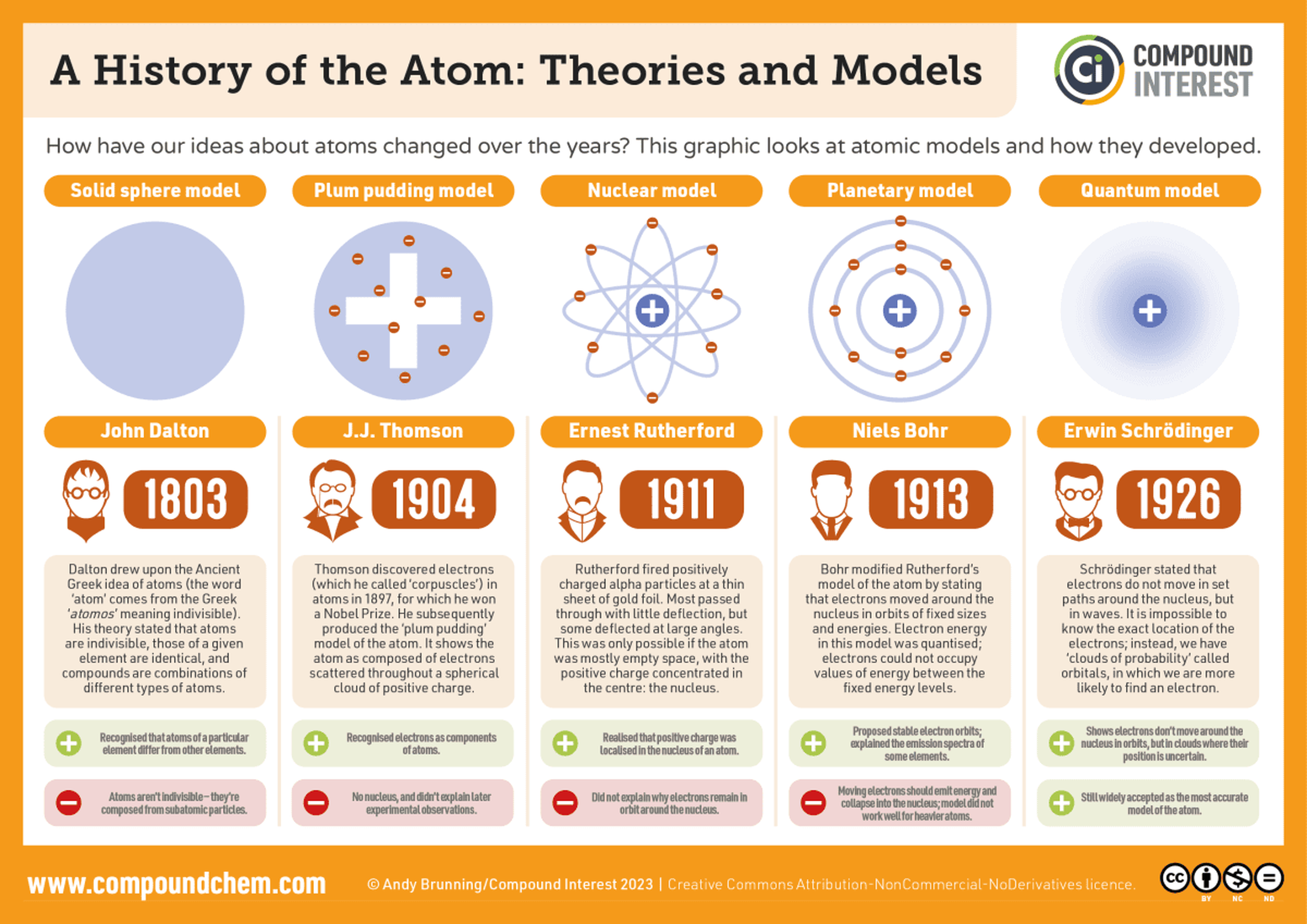
Various models of the atom over time. Source: CompoundInterest
Which one was right? Which one was the best description of the atom? Until we have secured the coveted ‘picture,’ it is impossible to know. All we do know is that, despite lack of access to the ‘truth’ of the atom: 1) we were able to progress from model to model in an account fashionable as progressive advancing of knowledge, 2) we were able, within each model of the atom, to continue to engage in generative research and scientific practice—to not only better understand but also to actively utilize in thinking and practice—despite the fact that we were later shown to have been operating using ‘false’ models. What becomes evident is that there is no additional purpose to the model of the atom except to fulfill these twin functions: to function, first, as an object for critique and additional scientific development (i.e., to be negated), and, second, as a precondition of engaging in scientific research in the first place—as a tool that can be manipulated and theorized—which has little to do with any relation to the concept of Truth.
So, too, with the categories of Marxism. The notion that Marx and Engels, who scoffed at all acts of definition as metaphysical, who believed that beneath the world of words was a deeper one of practice, would take as their starting-point the concepts of ‘Truth’ and ‘False’—is false. They not only saw their project as not depending on these concepts, but as superseding them—for their dialectical materialist philosophy, the terms ‘true’ and ‘false’ were only relative, pragmatic distinctions used for making practical decisions rather than actually applicable to the ‘real world.’
What this worldview means in practice is defined in the sum of Marx’s works.
IV. The Pragmatic Critique and the Response of Marxism to Science
The mid/late twentieth century saw an explosion of critical and pragmatist theory, particularly in the field of the philosophy of science. The most important and famous of these texts, Thomas S. Kuhn’s The Structure of Scientific Revolutions, was published in 1962 and generated an immense controversy over the question of whether science was determined by ever-closer approximations of Truth, or was rather a creative process marked by discontinuities in scientific concepts rather than linear progress or accumulation of facts.
In the wake of the general critique of scientific practice and objectivity, the Marxist response took two basic forms: the first is what we might call Althusserian-style radical reduction of scientific practice to productive practice generally, with scientific practice being stripped of any special or unique connection to the ‘objective’ and it being constructed according to the classic model of production, again, e.g., with a distinct means of production, object, skills, etc.; the second is best exemplified by the attempt to utilize this critique not to form a general criticism of scientific practice (or a Marxist theory of scientific practice) but as a means to establish Marxism qua formal doctrine as a science against the criticisms of individuals like Popper, exemplified by figures like Michael Burawoy. Under the former, scientific practice is incorporated within the theory of Marxism and its lessons are generalized; under the latter, Marxism is preserved as a set of propositions and placed in relation to the theory of scientific practice as being one or the other especially ‘good’, ‘accurate’, etc. scientific fruit.
The problems with both approaches can explain to us why, today, their ideas seem to have little salience within Marxism. Althusser, by leaning on Bachelard, is only able to resolve the Gordian knot between his relativism and commitment to Marxism-as-Truth by rendering ‘Truth’ itself a mystical power that bursts onto the scene post facto—a concept basically useless for practical or analytical purposes. Burawoy, on the other hand, only offers an elaborated epicycle to the age-old attempt to claim a fully scientific and complete systematic status for the claims of Marxism. Where he differs from the objectivists of the past is merely that he presents the completed Truth of the Marxist Doctrine in the form of Lakatos’ model of science; he does not carry the implications of that model of science or the critique of science generally to the heart of his concept of Marxist theory.
It is hard not to read this history as a reproduction in Marxism of a strain that has always existed in it, and which also defines the strain that not only Althusser but Kuhn, Rorty, Feyerabend, and countless others took aim at: the definitive strain of Philosophy and ‘the position of contemplation’ that desires, above all, for Marxism to possess some sort of external, indisputable ground that makes it capital-T True. It is not enough, for the metaphysicians, that Marxism be useful, deployable, valuable, vital, or whatever—it must also be inscribed into the fabric of the universe; the thoughts of a 19th century German militant must be discoverable by the scientist’s eye peering through the proverbial sociological microscope.
Nabi Eullman’s work for The Black Lamp reflects this tension between, as Burawoy describes it, the ‘critical’ (contingent, relativistic) and ‘scientific’ (systematic, propositional) tendencies within Marxism. Eullman’s work is especially valuable due to their identity as a consciously political communist and practicing scientist; frequently, and only to their detriment, forays into philosophy by Marxists are not political, and practicing scientists prefer to remain within their cloister and are too concerned with the dazzling superiority and successes of their field to understand it as merely one more dirty type of practice among others.
Eullman emblematizes a key moment in the development of Marxist theory: the struggle to move beyond the old Metaphysics, stuck halfway through the transition, precisely because the supposed antinomy (Dialectics? Practice? Critique?) is not present on the other side. The failure to produce a theory for the modern day—one that maintains the critique of Marx while moving beyond the current hegemony of bourgeois rationality and technocratism—is the only explanation for both the surge of communist criticism of rationality in the 20th century, and the quiet subsiding that followed. In miniature, this is represented by figures like Latour, who move from radical critiques of science to the most servile defense of banal notions of Truth in the name of ‘anti-conspiracism’ after a failure to develop the critique of science into a dialectical approach to thinking as a whole.
In this middle period, steps are uneven, there is no railing; but to have the courage to venture forth on the rickety bridge is itself a merit that cannot be undervalued. That the promised destination is lacking, only shows us the worth of the journey. For The Black Lamp and Eullman to consciously and openly throw into question the epistemological security offered by vulgar materialism in favor of an attempt to truly grapple with the practical and scientific elements of social practice is, as we have already seen, itself a difficult task in the period of marginality. Innovation in thought seems only to proceed at a frightening pace in our enemies: it feels, at times, that we have invented nothing new since liberals invented the New Deal and the modern administrative State, and the fascists invented death camps. The overwhelming weight of dogma finds its origin in the suffocating and overwhelming isolation of our movement where, given no content to work over, the intellectual devotes himself to slavishly worshipping the singularity offered by the form instead.
It is only by conceiving communism as a practice rather than an ideal arrangement of society, aim or end, etc., that we can appreciate the role the philosophy of science plays in relation to dialectical and historical materialism. By introducing the concept of history into science, the philosophy of science shatters the bourgeois premise of the security of Truth and the power of Reason in favor of an account that understands science as a subjective and social practice of a given and particular stage of society. For what is Truth and Reason except ideological justifications at the level of theory for the ruling ideas of a given period? As Gramsci writes: “what is practice for the [ruling] class becomes “rationality” and speculation for its intellectuals.” (116)
Beyond and above rationality is the continuous formation of new rationalities—new “norms of scientificity”—and this defiance of the determinism of the framework is precisely the materialist credo, that the world is always more than what we think of it.
V. Where Objectivism Clashes With Practice
Eullman begins their engagement with the philosophy of science by reviewing the cluster that characterizes its most recent, radical and historical side (Kuhn, Lakatos, and Burawoy). The presence of Burawoy here is necessary: without him, there is no link between metaphysical Marxism proper and the critique of science. Why? Michael Burawoy (1947-2025) was primarily a Marxist sociologist, and in this capacity has had a continued and significant positive impact on Marxist theory. Lesser known, he also helped define the modern Marxist reception to the critique of science or, more precisely, aided in maintaining the viewpoint of metaphysical Marxism in the face of its increasing untenability by returning to a pre-critical and pre-praxis theory of science through his attempt to posit Marxism as following the structure of a scientific theory.
As discussed in my essay on Kuhn, Kuhn’s analysis of science is revolutionary because it does not introduce an element of subjectivity into the scientific process but undermines the subjective/objective distinction at the heart of science itself. This is to say that science is not defined either by the application of a set of rules or by a verifying impulse from the objective world. In the text, I identify four basic ideas that are our starting-point for the role of Kuhn in a communist conception of scientific practice. I write:
Kuhn presents us with the concept of worldview, which encompasses not just the attitudes we have towards the objects of our world but also our understanding of what those objects and their laws are for our perception.
Kuhn’s examination of the relationship between a worldview and practice indicates that this relationship is characterized by strangeness; a practicing subject both depends on a worldview and various exemplars to structure his practice while, at the same time, is continually forced into tension with that very same worldview when she continuously confronts novel events in the carrying out of that practice.
The result of this tension is that neither practice nor worldview is ever ‘final’ but always in a process of development in the form of a constant succession of problem events—there is no such thing as ‘a’ static or logically clear worldview.
Finally, these worldviews replace one another after both the presence of crisis as anomalies in the worldview’s ability to adequately structure the practice and after the successful articulation of an alternative worldview that more effectively structures future practice, and never due to the presence of either on their own.
What is clear in these basic theses is that Kuhn’s notion of science is similar to what I’ve described as being the heart of Althusser’s critique of ideology: that scientific practice is an act of production by individuals that, just like any other act of production, with its own means of production (scientific tools and paradigms), laborers, and object, produces also its own distinct theoretical objects.
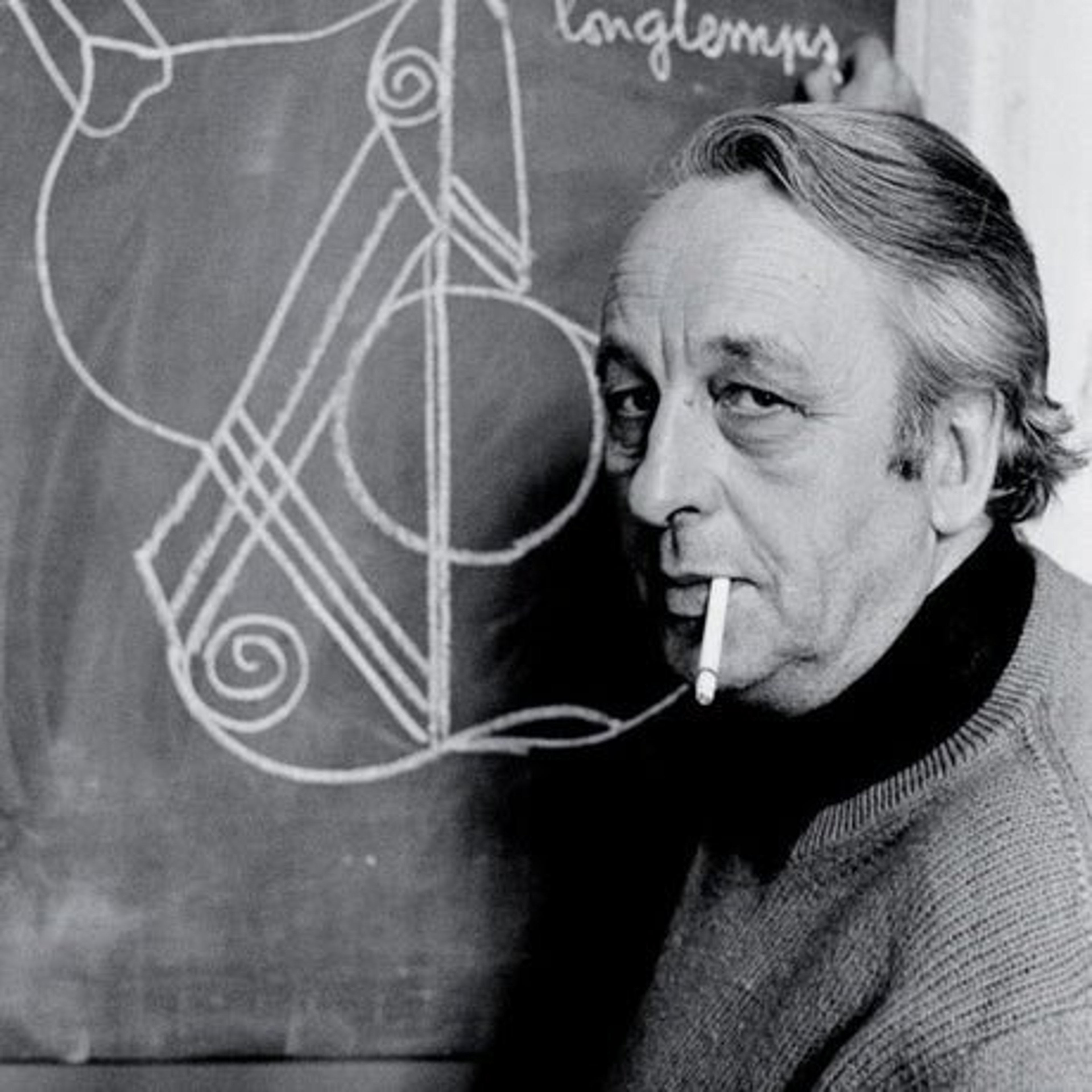
French Marxist philosopher and revolutionary Louis Althusser (1918-1990) developed an interpretation of Marxism that has changed its terrain permanently.
What is key in this maneuver is that the sentence ends there. That is all science is—there is no need to append the description offered by also saying that the theoretical objects produced are “truths”, “reflections,” or otherwise contain some mystical relation between Truth and Thought behind and beneath their status as objects in production.
Does this mean that the theoretical objects produced by scientific practice are arbitrary or not useful? This objection rests on the notion that scientific practice must be the collection of truth-statements about the external world for the objects it produces to be socially useful. But as seen in the introduction with the example of the atom, the notion that truth is the basis for forming useful scientific assumptions is plainly untrue (think also of the continued use, for example, of the technically incorrect model of Newtonian physics in delimited fields where the falsity of the theory does not interfere with the successful production of effective scientific-theoretical objects, such as mechanics or fluid dynamics). Throughout all of human history, we have continued to advance our scientific concepts and continually refute the models and concepts offered by previous scientists without this process ever interfering with the practical utilization of those concepts—and, in fact, the turning point of the application of science in society in history is not marked by the discovery of an especially useful scientific truth that heralds this change, but a massive explosion in the quantity of scientific labor and tooling caused by industrialization.
This point becomes clearer as we move away from the mysticism of science to other practices of production. In the intellectual field, for example, to say that a literary novel or political exhortation is ‘not true’ is banal and is not assumed whatsoever to correspond to the utility or social consequences of those theoretical objects. Again, ‘truth’ is unnecessary—whether Crime and Punishment actually happened makes no difference to book’s personal or social use-value (except, perhaps, as it affects the perception and consumption of the book—again, something that does not depend on the actual truth or correspondence of the object to reality but qualities, such as the presence and valuation of a certain belief, in the consuming subject).
But what is rendered here clear within the world of intellectual labor maintains the obscurity of alienation by refusing to rise to the criticism of the Intellect as a supra-material force. The example of a fictional book should be supplanted with the image of a more conventional commodity produced through the process of manual labor, which is where we can really highlight the essential elements shared between scientific practice and productive process more generally. It is absurd, for example, to claim that a produced car or airplane is ‘not useful’ because that car or airplane is not a ‘picture of reality’. The notion that a physical object produced by individuals working on raw material somehow has a deep and fundamental connection to some inscribed and written Truth of the Universe (and, further, that it requires this connection to have value) clashes with common sense. The difficulty of the intellectual, raised and trained to see the demarcation between these two types of labor as essential, is understanding that their labor of the mind differs in no fundamental way from the labor of the body in terms of the relation that labor or its products have to the essential truths or structure of the universe or reality.
In both cases, rather, what we see is simply humans working to produce useful objects.
VI. Eullman’s Kuhn
Let us, at this point, turn to Eullman. Their evaluation of Kuhn as complementary to the objectivist theory of scientific practice is, on one hand, consonant with certain ambiguities within Kuhn’s own thinking and works. Kuhn does waver towards a more conventional notion of science at times in The Structure, and clearly suffers from the lack of precision characteristic of the innovator. On the other hand, it is apparent that these ambiguities are interpreted in certain directions or in certain fashions according to the biases (and dare I say the paradigms?) of that very same objectivism, to which Eullman remains attached.
Eullman praises Kuhn for offering in his theory “a valuable corrective to the overly abstract conception of science as pure falsification.” But what is the content of this corrective? For Eullman (and thinkers like Burawoy), it is a reminder that humans are affected by biases, personal judgments, and so on, and that these all have a distorting effect on scientific practice. Take this extended example offered by Eullman as anecdotal evidence supporting Kuhn’s thesis:
What the scientific community values is of course historically contingent. Anyone familiar with day to day scientific practice will experience this, even if they are not cognizant of it. Who and what gets funded, which papers are published, and who gets hired are all strongly socially determined. To give just one example, as a working scientist I have had a paper outright rejected by one journal with seemingly partisan reviews, and then accepted in another with only stylistic edits suggested. It is likely that the first set of reviewers were hostile to the research programme I adhere to, whilst the second set were fellow travellers.
In Eullman’s account, the personal elements of scientific practice are not characteristic but deviations from the norm. Where Kuhn is attempting to provide a general theory of what scientific practice looks like and how it actually progresses, the modern interpretation—exemplified here by Eullman—instead sees him as outlining the role that social or subjective factors play on the scientific process.

Historian and philosopher of science T. S. Kuhn (1922-1996), author of The Structure of Scientific Revolutions (1962).
We might put this as follows: Eullman’s account of personal biases and the disputes between journals has no theoretical relevance to Kuhn’s claims or the larger problem of scientific practice. The notion that individuals may be biased towards certain beliefs rather than acting purely neutrally is totally compatible with both the concept of science as the neutral accumulation of objective facts and Kuhn’s concept of science as a series of incompatible conceptual schemes produced for practical purposes. Whereas, for example, we earlier discussed the changing shape of the model of the atom (which is not a series of observations of different atomic structures sequentially replacing one another but a series of incompatible theoretical—i.e., theorized—models), for Eullman, the entry of Kuhn’s critique happens before and outside of this process: in the hiring panel, the publishing committee, etc. Reducing Kuhn to a commentator on the scientific process rather than one in it does not grapple with the role of practice in science, but turns Kuhn into his opposite—a rationalist bemoaning the interfering in science of personal subjectivity and interest.
But this dispute over interpretation of Kuhn is only relevant when we understand why Eullman interprets Kuhn in this fashion. And here again we find that underneath the surface we discover the same old quest for certainty, the philosopher’s quest for the capital-T Truth and for the ‘real order’ of propositions between the surface of appearances… Eullman writes:
However, the problems for demarcation are clear: because everything is conceived through the lens of the dominant paradigm, the history and methodology of science are rewritten with every paradigm shift, leaving us with no approach for demarcating between scientific progress and intellectual degeneration; science and pseudoscience become indistinguishable.
Previously, I have written on the ‘position of contemplation’ that Marx accused the philosophers of occupying and which, treating the world as a set of objects that can be rationally understood by the educated individual, have forgotten completely the role of man and practice. Here, Eullman adopts a concept of science that falls into a similar error and results in an approach antithetical both to the actual history of science and continued vitality in its practice. They do so by centering the dichotomy between “pseudoscience” and “science” for which, Eullman argues, there is required a means to assess scientific validity ‘from outside’ the world of science, i.e., objectively. In this model, our previously identified sequence of models of the atom is granted to be ‘approximations’ or otherwise an increasingly accurate series of pictures of the atom rather than purely effective concepts.
But, again, this is totally disconsonant with the history of scientific practice. Continuing, we learn with specification the two elements attaching to scientific practice by which we reach objectivity: first, the identifiable pattern of ad hoc modifications to a theory indicating a ‘degenerative’ (bad) research program, with predictive power being the proof of a ‘progressive’ (good) one.
But these are not capable of clearing up the mystery of scientific production.
VII. Ad Hoc modifications
In order to ground his distinction between a ‘degenerative’ (bad) research program, and a ‘progressive’ (good) one, Eullman offers the test of the development of ad hoc modifications. Eullman writes:
Lakatos—a student of the Hegelian Marxist Gyorgy Lukacs—distinguished between progressive and degenerating research programmes. Where theory leads to the discovery of novel facts in the former, the degenerating research programme is characterized by the fabrication of theories in order to accommodate known facts.
What is the content of the “fabrication of theories in order to accommodate known facts”? While unclear, it seems to correspond to whether a fact is identified outside of the theory or paradigm and then incorporated into the theory, versus that same fact being predicted by the theory before its appearance. They write:
A research programme is progressing as long as its theoretical growth anticipates its empirical growth [my emphasis—P.K.G.]. It is stagnating if its theoretical growth lags behind its empirical growth (providing only post hoc explanations of chance discoveries).
Before proceeding, it is worthwhile to touch briefly on the philosophical assumptions contained here that may be invisible and which are in stark contrast to real scientific practice. Take the claim that facts are external to theories or concepts and that the relation of a theory to a fact is the marker of a theory’s progressiveness. Under this model, the series of atomic models can only be arrived at by a sequence of picturing, with each picture producing different results (a plum pudding here, a probability cloud a century later). The undefined factual stimuli must, in some sense: firstly, stand outside the models and act as a mutual standard for both; secondly, be rationally comprehensible both within either paradigm—and all three objects being comprehensible by a ‘third term’ outside each model and outside the fact; this ‘position of contemplation’ is necessary to be able to neutrally evaluate the whole.
Let us turn to Kuhn’s theory. The easiest place to begin with Kuhn is his famous concept of the scientific “paradigm,” the set of concepts and specific knowledge—together, a worldview—possessed by a practicing scientist. These “paradigms” are, for short, basically akin to the examples of the atom given earlier. During one period, a scientist possesses a certain concept of the atom that informs his understanding of what the atom is, what it looks like, how it acts, etc. In a later period, a different paradigm predominates; and the atom observed by the scientist in the modern day is not the atom of old. Kuhn writes, describing paradigms:
Successive paradigms tell us different things about the population of the universe and about that population’s behavior. They differ, that is, about such questions as the existence of subatomic particles, the materiality of light, and the conservation of heat or of energy. These are the substantive differences between successive paradigms […] But paradigms differ in more than substance, for they are directed not only to nature but also back upon the science that produced them. They are the sources of the methods, problem-field, and standards of solution accepted by any mature scientific community at any given time. (103)
What is essential in short from the study is the discontinuity between the objects across paradigms. In Kuhn, and Marx’s Model of Scientific Practice, I write:
These paradigms, learnt in the classroom, become the scientists’ ways of viewing the world. They determine what his objects (or “population”) are, his “methods,” and what is considered a correct or incorrect “solution.” This means that, contrary to intuition, they determine what is actually ‘observed’ as an object: what, for example, was observed as an “epicycle” under Ptolemaic astronomy is, after Kepler, seen instead as elliptical orbits. The factual stimuli in a certain sense remains the same, but the factual data, i.e., the actual objects we identify when presented with stimuli, is, under different theories, not only given different meanings but is actually a different set of objects altogether.
For Kuhn, these paradigms change throughout history through revolutions that replace one with another, not via evolution of one into another through progression of research. Emblematic is the shift from Newtonian mechanics to Einstein’s relativity, or, the replacement of geocentric theories of the solar system with heliocentric ones by Copernicus. Relativity, or heliocentrism, were not additions to previous theories but ruptures that shattered the worldviews that preceded them. New paradigms do not merely introduce additional concepts to an old one, but actually “change the meaning of established and familiar concepts[…]
Kuhn also compares a change in paradigm to a ‘gestalt switch,’ or one of those images that can be seen as two things alternatively without itself changing. (Trendy examples might be of the dress that can be seen as both blue and black and white and gold, or, in audio, the voice clip that can be heard as either “yanny” or “laurel.”) A scientist who undergoes a paradigm shift undergoes a similar effect: at one point he sees one thing; the next, another.
Again: the scientist operating under a new paradigm is not merely gaining a clearer image of the same object—the plum pudding model of the atom is not merely on a continuum with the model that depends on quantum mechanics—but “at one point sees one thing; the next, another.” Different scientific theories do not merely offer different interpretations of the objects in question, but propose different objects as the objects of study altogether.
This is an essential point, because it is here that the link between the popular conception of rational science, and the real practice of science, is broken. And this can somewhat be identified in Eullman’s own work, as well. For example, they write alongside Kuhn that “[t]he paradigm shift is not a purely data-driven process, because data is perceived through the lens of the currently dominant paradigm.” Consequently, the content of a paradigm shift (a movement from one model of the world or the objects of a science to another) consists of “sufficiently convincing that other scientists commit to dedicating their careers to it,” a fundamentally subjective process, even if guided by the requisite norms of scientificity. “Anyone familiar with day to day scientific practice will experience this, even if they are not cognizant of it.”
Here, precisely, is where the criticism of Kuhn is expressed: “the problems for demarcation” between scientific paradigms are too weighty for Eullman to accept Kuhn’s thesis, as there is no way within his concept of a paradigm shift to evaluate competing paradigms outside of the subjective assessment of the relevant scientific communities. Under this view, Kuhn’s description is condemned as irrationalist and subjectivist.
Marx writes somewhere: “The state is an abstraction; the people alone is the concrete.” Here we must ask Eullman: where can this evaluation of scientific paradigms can ever be located except in the judgments of the relevant scientific community? There is no Science that speaks for Itself and passes Judgment on fact and error, there are only the actual, living, thinking scientists who must be convinced to adopt the idea as a Scientific Idea. Does this evaluation then come from the philosopher or historian of science? In that case, we are only displacing Kuhn’s community acceptance thesis with the community of philosophers over the community of practicing scientists. Abstractly, it is always possible to ask whether x or y theories and paradigms are more true or false than the other. In scientific practice (as we shall see), the dispute between two paradigms can never find appeal in the notion of Truth, which is, like the emperor’s crown, only granted to the triumphant theory at the moment of its victory over a territory occupied by men.
Some specific examples reinforcing this point will be useful. As we established at the beginning of this section, Eullman offers the ability for a theory to predict or fail to predict novel phenomena and facts as the relevant marker for whether a theory is ‘progressive’ or “intellectual degeneration.” Firstly, the category of “intellectual degeneration” here indicates the treatment of scientific concepts as more or less in relation to Truth rather than as practical concepts for scientific work. In the search for a way to demarcate certain ideas as scientific and others as unscientific, Eullman fails to account for the utility of scientific concepts that are, under this view, “intellectual degeneration[s].” But before the existence of our current scientific theories, there were other ones. And before those, there were still others, and so on and so forth. And during each of these periods, the methods and results (say, e.g., in the sphere of industrial production) were as expected of what society then and now would deem to be describable as ‘science.' Outdated knowledge still gave us the engine, vaccines, etc. Greek philosophy gave us the outlines of modern science and anatomy. As Kuhn puts it:
The more carefully they study, say, Aristotelian dynamics, phlogistic chemistry, or caloric thermodynamics, the more certain they feel that those once current views of nature were, as a whole, neither less scientific nor more the product of human idiosyncrasy than those current today. If these out-of-date beliefs are to be called myths, then myths can be produced by the same sorts of methods and held for the same sorts of reasons that now lead to scientific knowledge. [my emphasis — P.K.G].
The first problem that the objectivist theory of truth runs into is its inability to account for why the objects it takes as true in this period are not the objects designated as true in earlier periods, despite the fact that earlier periods deployed methods we consider scientific and achieved results on the basis of scientific practice that we deem to be proofs of the success of science. With this in mind, “facts” (and anticipation thereof) no longer appear as objective means of judging accuracy but are the contingent terms given to the scientific products that are accepted in a current period.
But this will be most clear when we examine a specific scientific theory. Eullman offers Newtonian physics as an exemplar of their concept of science. Eullman quotes Lakatos:
The classical example of a successful research programme is Newton's gravitational theory: possibly the most successful research programme ever. When it was first produced, it was submerged in an ocean of 'anomalies' (or, if you wish, 'counterexamples') and opposed by the observational theories supporting these anomalies. But Newtonians turned, with brilliant tenacity and ingenuity, one counterinstance after another into corroborating instances[…]
The conversion of anomalies into corroborating instances is described here as the key to a successful research program. And this becomes the basis for demarcation between scientific ideas and paradigms: a progressive research program “explains the success of this prior programme, and supersedes it by a further display of heuristic power.” The theory is even able to predict answers to future problems, i.e., identify a fact before it is observed (in our terminology: to fashion beforehand the intellectual concept appropriate for adequate scientific perception); a progressive theory’s “theoretical growth anticipates its empirical growth.”
This notion, like most of objectivism’s scientific theories, comports neatly with the philosophy of common sense. It is probably, in short, the cleanest summary of how the layman perceives how theoretical and scientific dispute does or should proceed to earn the name of ‘scientific’; for many outside the academy, even Popper’s thesis of falsification figures as a subversion of traditional notions.
It is also plainly contradictory with the actual history of scientific progress: if this view of science were consistently adopted, none of the scientific achievements we laud today would ever have been discovered.
Take the example offered of Newtonian physics. Even in the account of the quoted section, Lakatos informs us that the opening of Newtonian theory was marked by “an ocean of anomalies.” It was only after the formation of the theory that these counterinstances were turned “into corroborating instances.” But, again, the corroborating instances only appeared after the scientific theory was elaborated—the formation of the scientific theory could not depend on the theory’s ability to explain facts, which follows that formation of the theory itself.
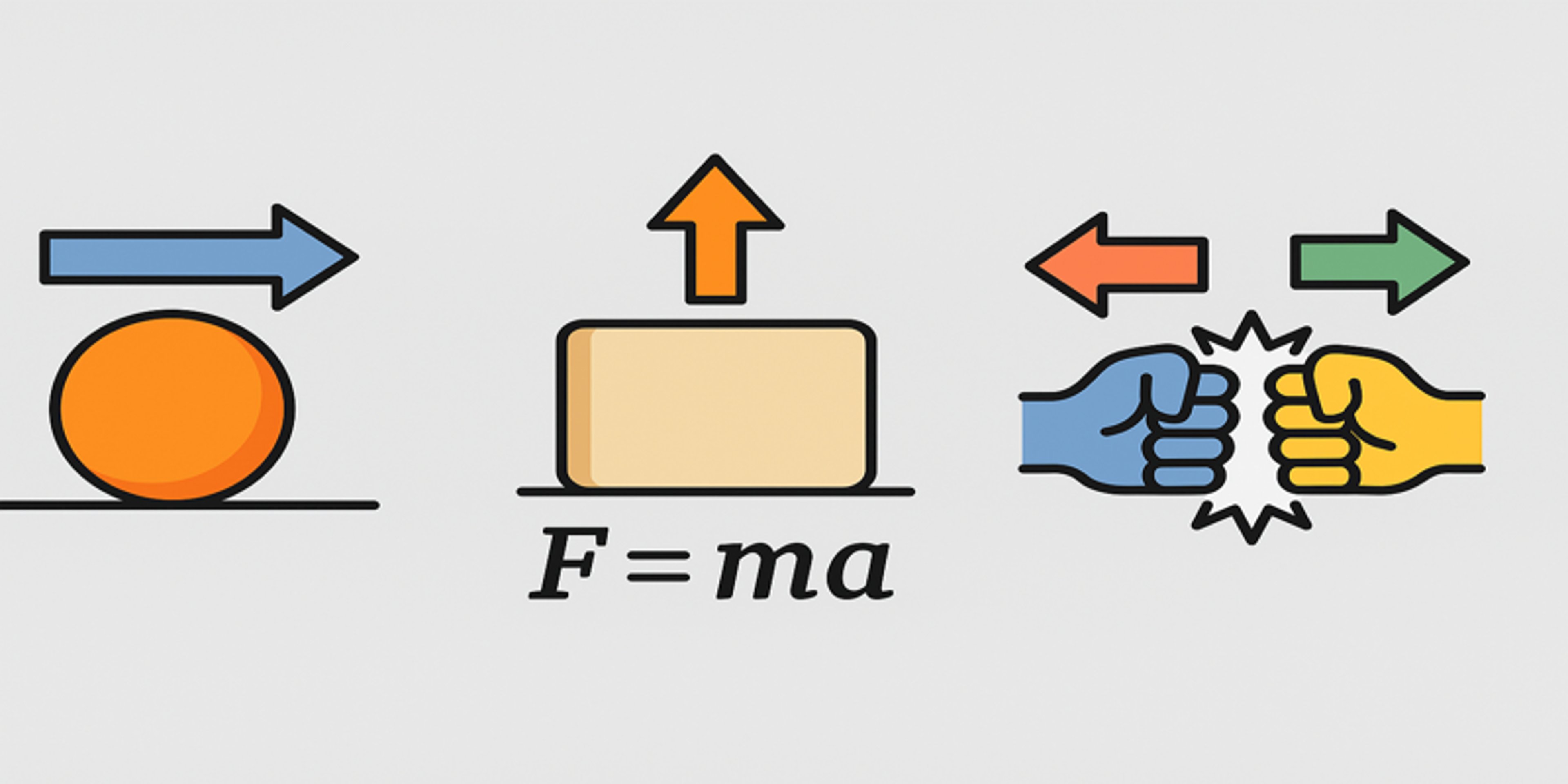
The model of Newtonian physics. [P.K.G.: Can you believe this is just a useful shorthand?]
Logically, under this model the transformation into corroborating instances also follows the adoption of the Newtonian paradigm—given that it is normal scientific labor under the auspices of a paradigm that produces these corroborations; so, the adoption of the theory similarly cannot depend on the theory’s ability to explain facts, let alone novel facts—which is again only discovered after adoption. At its opening, the theory is “submerged in an ocean of anomalies [my emphasis]”. If we applied Eullman’s concept of progressive and degenerating research programs, we should have rejected Newtonian mechanics at the outset (if we ever formulated it at all) for its lack of explanatory power. We would’ve fastidiously stuck to the previous, teleological notion of physics, which was comfortably able to explain every past and future phenomenon within its theory and did not run at all into a countervailing instance it could not turn into an epicycle. Ability to explain the facts, despite the infection of this phrase in modern pop science, is functionally useless as a real adjudicating principle. As Kuhn writes:
All historically significant theories have agreed with the facts, but only more or less.
In fact, it seems as if the very problem with a theory that marks it as archaic is not its inability to explain, but its inability to be unable to explain (and this is perhaps the rational kernel of the Popperian critique of ‘falsificationism’ divested of its formalism). Kuhn puts forward that the rationalizing of facts as corroborating instances—what is posed here as the precondition for scientificity—is actually the function of a scientific paradigm. But this means that the vitality of a scientific idea lies in its ability to allow for scientists to problematize and ask questions—i.e., to what extent it can create new problems of science that require resolution. In Kuhn, I write:
Kuhn writes that “no process yet disclosed by their historical study of scientific development at all resembles the methodological stereotype of falsification,” and this appears to be valid. The models of nature historically replaced by new ones were rarely proven wrong but, often, were actually able to explain and classify a much wider host of phenomena than the theories that followed them. Ptolemaic astronomy, for example, was able to explain far more about the orbit of the planets with its theory of epicycles than Kepler’s elliptical orbits when the latter was first formulated and replaced it; and the general theory of relativity required much time and elaboration before it could rival the explanatory power of Newtonian mechanics. In fact, it seems that only in the rarest cases can a rival theory or worldview be ‘disproved.’
Moreover, this problematizing function—against the explanatory function—is essential to the practice of science. I continue:
Or, more sharply put: “there are always some discrepancies.” (81). Neither is the necessary presence of anomalies that require correction an unfortunate pill to swallow. Rather, again, they are central to what science is. As Kuhn argues, “it is just the incompleteness and imperfection of the existing data-theory fit that, at any time, define many of the puzzles that characterize normal science.” (146). If theory and data coincided, then there would be no scientific practice at all, and the subject under discussion would be purely technical and without controversy (i.e., as Kuhn puts it, it would “cease to yield research problems at all and [] instead become tools for engineering,” 79).
The result? That, if we turn from the popular concept of science to its actual practice, we find, invariably, that it seems to appear as its opposite: under the guise of being a collection of truths and fact-explanations, we find instead that in essence it is “a problem-creating or problematizing practice.”
Conclusion
It is often the case that this or that theory of Marxism puts itself forward and proclaims, with much pomposity, its scientific character or analytical power. This ‘analytical’ Marxist looks at the world today and sees confusion and chaos. What even is the modern working class? Where is the revolutionary party? Sometimes, the ‘analytical’ Marxist boldly comes forth and dispels this confusion with a wave of his hand: here, in fact, is the True concept of the proletariat, clean, without contradiction, without problems.
This concept of the proletariat has simplified itself and ceased to be scientific. It is no longer able to serve as a concept that problematizes the world around us, leading us to uncover deeper insights and new relations of forces where we did not initially expect. No: having successfully removed all contradiction from their Marxism, the ‘analytics’ find that their Marxism has been divested of vitality.
Grey, dear friend, is all theory,
And green the golden tree of life.
—Goethe, Faust, Part I